Tokenomics Basics for a Compliant Token Sale

Tokenomics is the backbone of any successful token sale. It defines how your token is created, distributed, and used within your ecosystem. For a compliant token sale in 2026, understanding tokenomics basics is essential to avoid regulatory pitfalls and attract informed investors. Whether you are launching a utility token, security token, or governance token, the structure must align with both your project goals and the legal requirements of your chosen jurisdiction.
This guide covers the fundamental principles of tokenomics for a compliant token sale, including supply mechanics, allocation models, and legal considerations. We also explore how jurisdictions like Panama and others in the EU can affect your token design. Consulting24 has helped over 500 crypto projects obtain licenses and structure compliant token sales. Use this page as a starting point, then book a consultation to tailor your tokenomics to your specific needs.
What Is Tokenomics and Why Does It Matter for Compliance?
Tokenomics refers to the economic model of a token, covering its creation, distribution, and incentives. For a compliant token sale, tokenomics must satisfy securities laws, anti-money laundering (AML) rules, and tax regulations. Poor tokenomics can lead to regulatory action, investor distrust, or project failure. Key elements include total supply, inflation rate, vesting schedules, and utility design. In 2026, regulators scrutinize these factors to determine if a token is a security or a utility asset. A well-structured tokenomics model demonstrates good faith and reduces legal risk.
For example, the EU's Markets in Crypto-Assets (MiCA) regulation, fully in force in 2026, requires clear disclosure of tokenomics in a whitepaper. This includes details on supply, distribution, and rights attached to the token. Similarly, Panama offers a flexible framework for token issuers, with no specific crypto licensing but a clear legal environment for compliant sales. Consulting24 advises on structuring tokenomics to meet these diverse requirements.
Who Needs a Compliant Token Sale Structure?
Any project planning to raise funds by selling tokens to the public or to accredited investors needs a compliant token sale structure. This includes startups building decentralized applications (dApps), blockchain protocols, decentralized finance (DeFi) projects, and tokenized asset platforms. Even projects with a clear utility token must ensure their tokenomics does not inadvertently create a security. In 2026, regulators are more active than ever, and non-compliance can result in fines, delisting from exchanges, or legal action.
Founders targeting EU investors must comply with MiCA, which imposes capital requirements and disclosure obligations. Those choosing Panama benefit from a simpler regime, but must still ensure their tokenomics aligns with international standards. Consulting24 helps founders identify the right jurisdiction and structure their tokenomics accordingly, whether they operate in Estonia, Lithuania, or Panama.
License Type and Regulator for Token Sales
The regulatory classification of your token determines the license or registration required. In the EU under MiCA, tokens are categorized as asset-referenced tokens (ARTs), e-money tokens (EMTs), or utility tokens. Utility tokens generally face lighter regulation, but if they promise future profits or are marketed as investments, they may be considered securities. The relevant regulator varies by jurisdiction: in Lithuania, it is the Bank of Lithuania; in Estonia, the Financial Intelligence Unit (FIU) handles crypto licenses; in Panama, the Financial Analysis Unit (UAF) oversees AML compliance, but there is no dedicated crypto license.
For a compliant token sale, you must engage with the appropriate regulator early. Consulting24 has direct delivery experience in Estonia, Lithuania, and Panama, and advises on other jurisdictions. We recommend structuring your tokenomics to fit a utility token classification where possible, as this reduces regulatory burden. However, if your token has security-like features, a securities license may be required.
Cost and Timeline for Structuring a Compliant Token Sale
| Item | Cost (EUR) | Timeline |
|---|---|---|
| Legal review of tokenomics | 3,000 - 8,000 | 2-4 weeks |
| Whitepaper drafting | 5,000 - 15,000 | 3-6 weeks |
| License application (if required) | Varies by jurisdiction | 2-6 months |
| Panama company setup (flat fee) | 6,000 | 1-2 weeks |
| AML/KYC integration | 2,000 - 5,000 | 1-3 weeks |
These figures are indicative. The total cost for a compliant token sale can range from EUR 15,000 to 50,000 depending on complexity and jurisdiction. Consulting24 offers fixed-price packages for Panama company setup at EUR 6,000, which includes incorporation and support for token sale structuring. Exact pricing is confirmed in a consultation.
Capital Requirements for Token Issuers
Capital requirements depend on the token type and jurisdiction. Under MiCA, issuers of asset-referenced tokens must hold minimum capital of EUR 350,000, while significant ARTs require EUR 500,000. For utility tokens, no specific capital requirement exists, but the issuer must have sufficient funds to cover operational risks. In Panama, there is no statutory capital requirement for token issuers, but the company must demonstrate financial solvency. Consulting24 recommends maintaining at least EUR 50,000 in reserve to cover legal and operational costs.
For projects using a Lithuanian or Estonian crypto license, the capital requirement is part of the license application. Consulting24 advises on the appropriate capital level based on your tokenomics and business plan. In all cases, transparent disclosure of capital in the whitepaper builds investor trust.
Tax Treatment of Token Sales
Tax treatment varies widely. In the EU, token sales may be subject to VAT, corporate income tax, or capital gains tax depending on the token's classification. For example, utility tokens used for future services are often treated as prepayments and taxed when the service is delivered. Security tokens are subject to securities transaction taxes. Panama offers territorial taxation, meaning income earned outside Panama is not taxed. This can be advantageous for token issuers targeting global investors.
Consulting24 advises founders to obtain local tax advice in their chosen jurisdiction. We can coordinate with tax experts in Estonia, Lithuania, and Panama to ensure your tokenomics structure minimizes tax liabilities. Always include a tax section in your whitepaper to inform investors.
Allowed Activities Under a Compliant Token Sale
Depending on the license or registration, token issuers can typically: issue tokens, conduct a public or private sale, list tokens on exchanges, and manage token distribution. Activities that are generally prohibited include: promising guaranteed returns, using misleading marketing, and operating without AML/KYC procedures. Under MiCA, issuers must publish a whitepaper, notify the regulator, and comply with transparency rules. In Panama, there are fewer restrictions, but international AML standards still apply.
Consulting24 helps you define the scope of allowed activities in your tokenomics model. For example, if you plan to offer staking rewards, ensure they are not construed as dividends. We recommend including a clear use of funds section in your whitepaper.
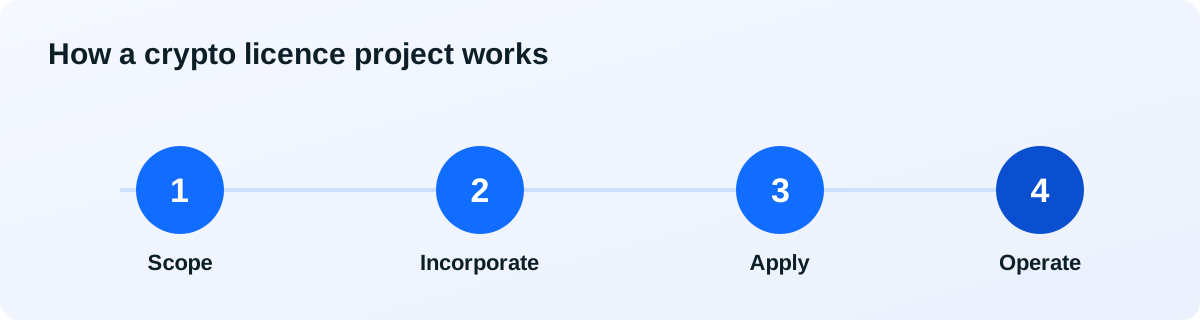
Step-by-Step Process for a Compliant Token Sale
- Define tokenomics: Determine supply, distribution, vesting, and utility. Ensure compliance with target jurisdiction.
- Choose jurisdiction: Compare Panama, EU member states, and others. Consulting24 advises on the best fit.
- Legal structuring: Incorporate a company, draft whitepaper, and obtain legal opinions. For Panama, use our flat-fee setup.
- License application: If required, apply with the regulator (e.g., Bank of Lithuania, Estonian FIU).
- AML/KYC implementation: Integrate identity verification for sale participants.
- Token creation: Develop smart contract and audit it.
- Sale execution: Conduct the sale via a compliant platform.
- Post-sale compliance: Ongoing reporting and tax filings.
Consulting24 manages steps 1-4 for clients in Estonia, Lithuania, and Panama, and coordinates with local partners in other jurisdictions.
Banking and Payment Processing for Token Sales
Access to banking is critical for a token sale. Many banks are wary of crypto-related businesses. In Panama, local banks may accept token issuers with proper AML procedures. In the EU, MiCA-licensed entities have better access to banking services. Consulting24 can introduce you to payment processors and banking partners that support crypto businesses. We recommend setting up a separate bank account for sale proceeds and using fiat on-ramps for investor payments.
For EU projects, consider using licensed electronic money institutions. For Panama, we can help open a corporate bank account after company setup.
Benefits of Compliant Tokenomics
- Investor trust: Clear tokenomics with vesting and transparency attract serious investors.
- Regulatory clarity: Compliance reduces risk of enforcement actions.
- Exchange listing: Major exchanges require compliant tokenomics.
- Long-term value: Well-designed tokenomics supports token price stability.
- Global reach: Compliant structures allow cross-border fundraising.
Consulting24 has seen firsthand how compliant tokenomics leads to successful fundraising. Our clients benefit from our experience in 500+ license applications.
Compliance and Trust: Building a Credible Token Sale
Compliance is not just about avoiding penalties; it builds trust with investors, partners, and regulators. A credible token sale includes a detailed whitepaper, audited smart contract, clear tokenomics, and transparent team. In 2026, investors expect projects to have legal opinions and AML procedures in place. Consulting24 advises on best practices for compliance, including regular reporting and community engagement. Note: This is general guidance, not legal advice. Always consult a qualified lawyer for your specific situation.
We recommend including a legal disclaimer in your whitepaper and on your website. Consulting24 can help you draft these documents.
Common Mistakes in Tokenomics Design
- Overly complex tokenomics: Investors prefer simple, understandable models.
- Ignoring regulatory classification: Assuming your token is a utility when it functions as a security.
- No vesting for founders: Raises red flags about team commitment.
- Unlimited supply: Can devalue the token.
- Poor liquidity planning: Ensure sufficient liquidity for trading.
Avoid these pitfalls by working with experts. Consulting24 reviews your tokenomics and flags issues before you launch.
Alternatives and Comparisons: Panama vs. Other Jurisdictions
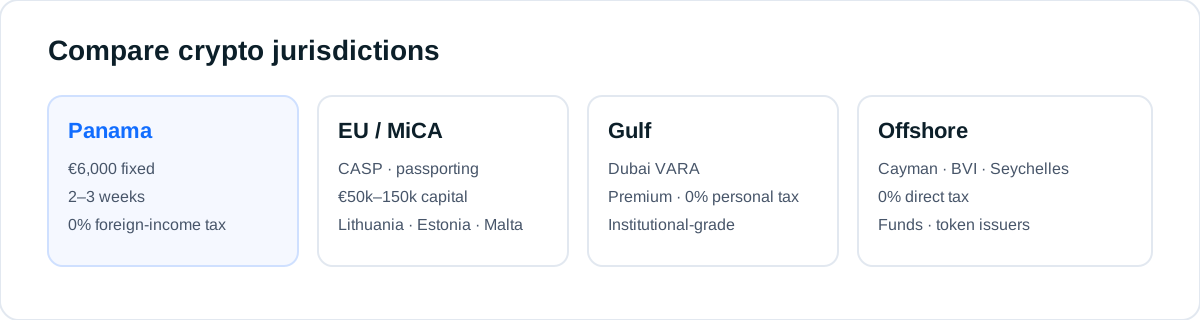
When choosing a jurisdiction for your token sale, consider Panama, EU member states (e.g., Lithuania, Estonia), and others like Dubai or Switzerland. Panama offers a flat EUR 6,000 company setup, no specific crypto license, and territorial tax. Lithuania requires a crypto license with capital of EUR 125,000 for exchange and wallet services, but offers EU passporting. Estonia has a similar license with lower capital but stricter AML. Dubai (VARA) has a comprehensive regulatory framework but higher costs. Consulting24 delivers directly in Panama, Estonia, and Lithuania, and advises on others. For most projects, Panama is cost-effective for token sales, while EU licenses provide regulatory credibility.
Compare your options by reading our Panama vs. Lithuania guide. Book a consultation to discuss which jurisdiction fits your tokenomics.
How Consulting24 Helps You Launch a Compliant Token Sale
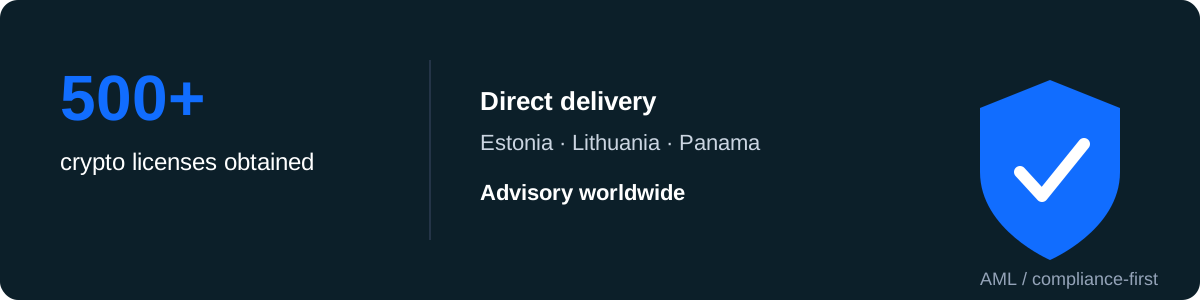
Consulting24 (X24Consulting OU, Tallinn, Estonia) has obtained 500+ crypto licenses. We deliver directly in Estonia, Lithuania, and Panama, and advise/coordinate in all other jurisdictions. Our services include company setup, license application, tokenomics review, whitepaper drafting, and AML/KYC integration. For Panama, our flat fee of EUR 6,000 covers incorporation and initial compliance support. We do not guarantee approval, but our track record speaks for itself.
Contact us via WhatsApp or book a consultation to start your compliant token sale journey. Our experts will guide you through every step.
Frequently asked questions
What is tokenomics in simple terms?
Tokenomics is the economic model of a cryptocurrency token. It includes total supply, how tokens are distributed, their utility, and incentives for holders. Good tokenomics ensures the token has value and aligns with the project's goals.
Do I need a license to conduct a token sale?
It depends on the jurisdiction and token classification. In the EU under MiCA, utility token sales may not require a license, but a whitepaper must be published. Security token sales require a securities license. Panama has no specific crypto license, but AML compliance is mandatory.
What is the minimum capital for a token sale in Panama?
Panama does not have a statutory minimum capital for token issuers. However, we recommend at least EUR 50,000 to cover operational costs and demonstrate solvency. The company setup fee is a flat EUR 6,000.
How long does it take to set up a compliant token sale?
The timeline varies. Panama company setup takes 1-2 weeks. Legal documentation and whitepaper drafting take 4-8 weeks. License applications in the EU can take 2-6 months. Total time from start to sale can be 3-6 months.
Can I use a Panama company for an EU token sale?
Yes, but you must comply with EU regulations if you target EU investors. Panama offers a flexible base, but you may need to register in the EU or use a licensed distributor. Consulting24 can advise on the best structure.
What are the tax implications of a token sale in Panama?
Panama has territorial taxation, meaning income earned outside Panama is not taxed. Token sales to non-Panamanian investors may be tax-free. However, you should consult a local tax advisor for your specific situation.
What is the difference between a utility token and a security token?
A utility token provides access to a product or service, while a security token represents an investment contract with profit expectations. Security tokens are subject to securities laws. MiCA provides clear criteria for classification.
How do I ensure my tokenomics is compliant?
Work with legal experts to classify your token correctly. Include transparent vesting schedules, avoid promises of returns, and publish a detailed whitepaper. Consulting24 offers tokenomics review as part of our services.
What ongoing compliance is required after a token sale?
Ongoing requirements include AML/KYC checks, periodic reporting to regulators (if licensed), tax filings, and transparency updates. In the EU, MiCA requires annual reports. Panama has lighter requirements but still expects AML compliance.
Can Consulting24 help with tokenomics design?
Yes, Consulting24 reviews your tokenomics model and suggests improvements for compliance and investor appeal. We also coordinate with legal and tax experts to ensure your structure is sound. Book a consultation to get started.
Official sources
Related jurisdictions

Talk to a crypto-licensing expert
500+ licenses across Estonia, Lithuania, Panama and beyond. Tell us your model and we'll map the right route, honestly.
💬 Talk to an expertFree consultationGeneral guidance, not legal advice. Rules and fees evolve, and we confirm current requirements for your case.