How to Get a Crypto License in UAE Step-by-Step

If you are looking to launch a crypto business in the Middle East, the UAE is one of the most attractive hubs. But getting a crypto license in UAE requires working through a complex regulatory environment. This step-by-step guide explains the process for Dubai (VARA) and Abu Dhabi (ADGM/FSRA), covering costs, timelines, and key requirements. We also compare the UAE route with simpler alternatives like Panama and other jurisdictions that Consulting24 serves directly.
Whether you are an exchange, a DeFi project, or a custody provider, understanding the UAE's licensing framework is essential. This page provides accurate, up-to-date information as of 2026, based on official regulations. However, please note that Consulting24 delivers crypto licenses directly in Estonia, Lithuania, and Panama, and advises on other jurisdictions. For UAE licensing, we offer comparison and guidance but do not file applications ourselves.
What Is a UAE Crypto License?
A UAE crypto license is a regulatory authorization that allows a company to operate virtual asset services within designated free zones or onshore. The two main regulators are the Virtual Assets Regulatory Authority (VARA) in Dubai and the Financial Services Regulatory Authority (FSRA) in Abu Dhabi Global Market (ADGM). Both have comprehensive frameworks that align with international standards, including FATF recommendations.
Each license defines the scope of permitted activities, such as exchange, custody, advisory, or lending. Licenses are mandatory for any business offering crypto-related services to UAE residents or operating from the UAE. The process involves a rigorous application, compliance with AML/CFT rules, and ongoing reporting. The UAE has positioned itself as a global crypto hub, but the regulatory bar is high. For example, VARA requires a detailed risk assessment and a local presence with a physical office in Dubai World Trade Centre (DWTC). ADGM similarly demands a substance test with local staff and board meetings. The license is not a one-time approval; it requires annual renewal and continuous compliance monitoring.
Who Needs a Crypto License in UAE?
Any entity that provides virtual asset services in or from the UAE must obtain a license. This includes:
- Crypto exchanges (centralized and decentralized)
- Digital asset custodians
- Broker-dealers and market makers
- Payment service providers using crypto
- Advisory and portfolio management firms
- Token issuers (in some cases)
If your business touches virtual assets in any regulated activity, you need a license. Operating without one can lead to fines, closure, or criminal liability. The UAE has been aggressive in enforcing its regime, with several enforcement actions against unlicensed operators. Even if your target market is outside the UAE, if you have a physical presence or staff in the UAE, you likely need a license. This applies to both retail and institutional services. For example, a DeFi protocol with a development team in Dubai may need a VARA license if it offers services to UAE residents.
License Types and Regulators
Dubai: VARA
VARA issues licenses for various activities under its Virtual Assets and Related Activities Regulations 2023. License categories include: Exchange, Custody, Advisory, Broker-Dealer, Lending and Borrowing, and more. VARA also requires a Dubai World Trade Centre (DWTC) free zone company as the licensed entity. The application process includes a mandatory 'fit and proper' test for directors and shareholders. VARA has a tiered approach: Category 1 for full exchange and custody, Category 2 for broker-dealer and lending, Category 3 for advisory. Each tier has different capital and compliance requirements.
Abu Dhabi: ADGM FSRA
ADGM offers a broader financial services license that covers crypto under its Financial Services and Markets Regulations. License categories include: Operating a Multilateral Trading Facility (MTF), Custody, Asset Management, and Advisory. ADGM is known for its strong regulatory framework and is often preferred by institutional players. The FSRA has a 'sandbox' regime for fintech startups, but full licensing is required for commercial operations. ADGM also requires a local office and a minimum of two resident directors.
Both regulators require a physical presence, local staff, and compliance with AML/CFT rules. The choice between VARA and ADGM often depends on the business model: VARA is more crypto-native, while ADGM is more aligned with traditional finance.
Cost and Timeline
The cost of obtaining a crypto license in UAE varies significantly by emirate and complexity. Below is an indicative table based on typical figures as of 2026. Exact pricing should be confirmed with regulators or consultants.
| Item | Dubai (VARA) | Abu Dhabi (ADGM) |
|---|---|---|
| Application fee | EUR 10,000 - 15,000 | EUR 8,000 - 12,000 |
| License fee (annual) | EUR 30,000 - 50,000 | EUR 25,000 - 40,000 |
| Regulatory capital | EUR 100,000 - 500,000 | EUR 50,000 - 150,000 |
| Setup costs (company, office) | EUR 15,000 - 30,000 | EUR 10,000 - 20,000 |
| Total first year (approx) | EUR 55,000 - 95,000 | EUR 43,000 - 72,000 |
| Timeline | 4 - 8 months | 3 - 6 months |
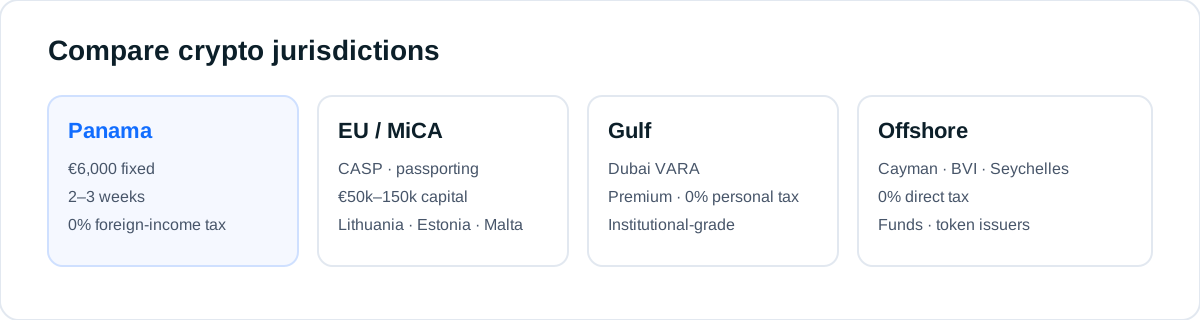
Compare this with Panama, where Consulting24 offers a flat fee of EUR 6,000 for the entire license setup. For many startups, Panama is a more cost-effective entry point. The UAE timeline can stretch if the regulator requests additional information or if the applicant fails to meet substance requirements. Delays are common, especially for first-time applicants. It is advisable to budget for at least 6 months for VARA and 4 months for ADGM. The costs above exclude legal fees, which can add EUR 10,000 - 20,000 for a typical application.
Capital Requirements
Capital requirements depend on the license category and regulator. For VARA, minimum capital ranges from AED 500,000 (EUR 125,000) for advisory to AED 2,000,000 (EUR 500,000) for exchange and custody. ADGM requires a minimum of USD 50,000 (EUR 46,000) for advisory, USD 150,000 (EUR 138,000) for custody, and USD 500,000 (EUR 460,000) for operating an MTF. These figures are subject to change and should be verified.
Capital must be held in a local bank account and may be in fiat or liquid assets. Some part can be in crypto if the regulator approves. The capital serves as a buffer for operational risks and is not a deposit. It must be maintained throughout the license period. For example, if you hold EUR 125,000 for a VARA advisory license, you cannot use that capital for operating expenses; it must remain as a reserve. Failure to maintain capital can result in license suspension. In contrast, Panama has no minimum capital requirement, making it much easier for startups.
Tax Treatment
The UAE offers a favorable tax environment. There is no federal corporate income tax, though a 9% corporate tax was introduced for profits exceeding AED 375,000 (EUR 95,000) from June 2023. However, free zones like DWTC and ADGM often provide tax exemptions for 15-50 years, provided the business does not trade with the mainland. VAT at 5% applies to most services, but crypto transactions may be exempt depending on classification.
There is no capital gains tax or withholding tax on dividends. Personal income tax is zero. This makes the UAE attractive for crypto businesses, but tax advice is essential as interpretations vary. For example, if your UAE entity trades crypto with a mainland customer, you may lose the free zone tax exemption. Additionally, the UAE has signed double taxation treaties with many countries, which can reduce withholding taxes on cross-border payments. However, the tax market is evolving, and the introduction of corporate tax in 2023 has added complexity. Panama, by contrast, offers a pure territorial tax system with no tax on foreign-source income, which is simpler for offshore crypto businesses.
Allowed Activities
Under a UAE crypto license, you can conduct a range of activities, subject to the specific license scope:
- Exchange services (spot, OTC, DEX)
- Custody and safekeeping
- Brokerage and dealing
- Advisory and portfolio management
- Lending and borrowing
- Token issuance and listing (with approval)
- Payment and remittance services
Activities not covered include derivatives (unless separately licensed) and gambling-related tokens. Stablecoin issuance is tightly regulated. Always check the latest regulatory updates. For example, VARA prohibits the use of privacy coins and requires all listed tokens to be approved. ADGM is more permissive but still requires disclosure. If you plan to offer staking or yield products, you need a specific license for lending or asset management. The scope of activities is defined in the license, and operating outside that scope can lead to penalties. Panama, on the other hand, allows a broad range of crypto activities under its general business license, with no specific restrictions.
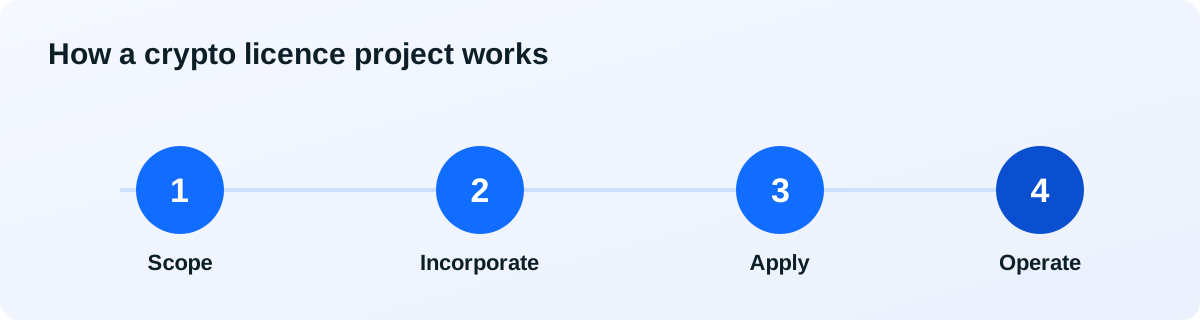
Step-by-Step Process
- Choose your emirate and regulator: Decide between Dubai (VARA) or Abu Dhabi (ADGM) based on your business model and target market.
- Establish a local company: Register a free zone company (e.g., DWTC for Dubai, ADGM for Abu Dhabi). This includes name reservation, MOA, and shareholder documentation.
- Prepare the application: Draft a detailed business plan, AML/CFT policies, risk assessment, and governance framework. Engage a local compliance consultant.
- Submit to the regulator: File the application with VARA or FSRA, including all supporting documents and the application fee.
- Regulatory review and interview: The regulator will review, may request additional information, and conduct interviews with key personnel.
- Capital deposit: Deposit the required capital in a local bank account and provide proof.
- License issuance: Once approved, pay the license fee and receive the license. This may be conditional on meeting ongoing requirements.
- Post-licensing compliance: Set up reporting, audits, and AML monitoring systems. Appoint a local MLRO and auditor.
Timelines vary from 3 to 8 months. Consulting24 does not handle UAE applications directly but can connect you with vetted local partners. The most common bottleneck is the company registration, which can take 2-4 weeks, followed by the regulatory review, which can take 2-4 months. The interview stage is critical; the regulator will assess the competence and integrity of the management team. Prepare thoroughly with mock interviews and a clear business case.
Banking and Payment Partners
Opening a bank account in the UAE for a crypto business is challenging. Most traditional banks are cautious. Options include:
- Local banks with dedicated fintech units (e.g., RAKBANK, Mashreq)
- Digital banks (e.g., Zand, Al Maryah Community Bank)
- Payment processors like Checkout.com or Stripe (for fiat on/off ramps)
ADGM-based firms may have easier access to banking due to the regulatory clarity. Many firms use a multi-bank strategy. Consulting24 can assist with banking introductions in the jurisdictions we serve, including Panama, where banking is more straightforward. In the UAE, expect to provide extensive documentation, including the license, business plan, source of funds, and personal wealth statements. Some banks require a minimum deposit of EUR 50,000 or more. The process can take 2-3 months. Alternatives include using a payment services provider like Airwallex or Currencycloud for fiat handling, but these may not offer full banking services. Panama, by contrast, has a well-established offshore banking sector with many banks open to crypto businesses, and account opening can be done in 1-2 weeks.
Benefits of a UAE Crypto License
- Strong regulatory reputation: A VARA or ADGM license is recognized globally and signals trust.
- Tax advantages: Zero corporate tax in free zones, no personal income tax.
- Strategic location: Gateway to Middle East, Africa, and Asia.
- Access to a growing crypto ecosystem: Dubai has a vibrant blockchain community and government support.
- High-quality infrastructure: World-class legal, banking, and professional services.
However, the cost and complexity are high. For many startups, a Panama license (EUR 6,000 flat) offers similar benefits at a fraction of the cost. The UAE license is best suited for companies that need a strong regulatory stamp to attract institutional investors or partners. For example, a crypto exchange targeting high-net-worth individuals in the Gulf region would benefit from a VARA license. But if your primary market is outside the UAE, Panama or Lithuania may be more practical.
Compliance and Trust
UAE regulators require strong compliance frameworks. Key requirements include:
- AML/CFT policies aligned with FATF standards
- KYC and CDD procedures
- Transaction monitoring and reporting
- Appointment of a local MLRO
- Regular audits and regulatory reporting
- Cybersecurity measures and data protection
Non-compliance can result in fines, license suspension, or revocation. This is general guidance, not legal advice. Always engage a local compliance expert. For example, VARA requires quarterly transaction reports and annual AML audits. ADGM mandates a compliance officer who is a resident of the UAE. The cost of compliance can be significant: expect to spend EUR 20,000 - 50,000 per year on compliance staff, software, and audits. In contrast, Panama's compliance requirements are lighter, with no mandatory local MLRO and simpler reporting. However, Panama is still subject to FATF standards, so basic AML procedures are necessary.
Common Mistakes
- Underestimating timeline: Many expect 2-3 months but face 6-8 months.
- Insufficient capital: Not having the required capital in liquid form.
- Poor documentation: Business plan and policies must be detailed and tailored.
- Ignoring local presence: Regulators require a physical office and local staff.
- Choosing the wrong free zone: Not all free zones are suitable for crypto.
- Overlooking banking: Bank account opening is a major hurdle; start early.
Learn from others' mistakes. For example, some applicants submit a generic business plan that does not address specific risks, leading to rejection. Others fail to budget for the full cost, including legal and compliance fees. A common pitfall is assuming that a UAE license allows passporting to other Emirates; it does not. You need separate licenses for each emirate if you operate there. Consulting24 helps clients avoid these pitfalls in the jurisdictions we serve directly, such as Panama, where the process is simpler and more predictable.
Alternatives: UAE vs Panama vs Lithuania vs Estonia
While the UAE is a top-tier jurisdiction, it is not the only option. Here is a comparison:
| Jurisdiction | Cost (first year) | Timeline | Capital | Tax |
|---|---|---|---|---|
| UAE (Dubai VARA) | EUR 55k - 95k | 4-8 months | EUR 125k - 500k | 0-9% |
| UAE (Abu Dhabi ADGM) | EUR 43k - 72k | 3-6 months | EUR 50k - 150k | 0% (free zone) |
| Panama | EUR 6,000 flat | 2-4 weeks | None | 0% offshore |
| Lithuania | EUR 5k - 10k | 2-4 months | EUR 125k (MiCA) | 15% |
| Estonia | EUR 10k - 15k | 1-2 months | EUR 100k (MiCA) | 20% |
Panama offers the lowest cost and fastest setup, ideal for startups. Lithuania and Estonia are EU-regulated under MiCA, which provides a clear legal framework but comes with capital requirements. Consulting24 delivers directly in Panama, Lithuania, and Estonia. For UAE, we provide advisory and comparison. If you need an EU passport, Lithuania or Estonia may be better. If you want a cost-effective offshore solution, Panama is hard to beat. The UAE is best for those who need a prestigious license and have a larger budget.
Why Choose Consulting24?
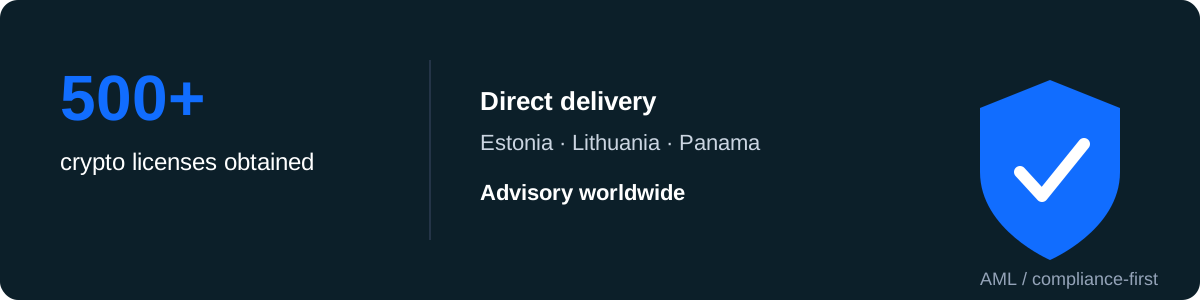
Consulting24 has obtained over 500 crypto licenses across multiple jurisdictions. We deliver directly in Estonia, Lithuania, and Panama, and advise on others including the UAE. Our Panama license costs a flat EUR 6,000 with no hidden fees. We provide end-to-end support from company setup to license application and banking introductions.
For UAE, we do not file applications but can help you compare options and connect with trusted local partners. Our expertise helps you avoid common pitfalls and choose the right jurisdiction for your business. Contact us to discuss your project.
Frequently asked questions
What is the difference between VARA and ADGM for crypto licensing?
VARA in Dubai is a dedicated crypto regulator with a focus on virtual assets, offering licenses for exchange, custody, advisory, and more. ADGM in Abu Dhabi is a financial free zone with a broader financial services framework that includes crypto under its FSRA. VARA is more crypto-native and has a faster application process in some cases, while ADGM is more aligned with traditional finance and is preferred by institutional players. Both require a local presence and compliance with AML/CFT rules.
How much does a UAE crypto license cost in 2026?
The total first-year cost for a UAE crypto license ranges from EUR 43,000 to EUR 95,000, depending on the emirate and license category. This includes application fees, license fees, regulatory capital, and setup costs. For Dubai VARA, expect EUR 55,000-95,000; for Abu Dhabi ADGM, EUR 43,000-72,000. Ongoing annual costs are around EUR 30,000-50,000 for license renewal and compliance. Compare this with Panama at a flat EUR 6,000.
Can I get a UAE crypto license without a local office?
No. Both VARA and ADGM require a physical office in the respective free zone. For VARA, you must have an office in Dubai World Trade Centre (DWTC). For ADGM, you need a physical presence in the Abu Dhabi Global Market. The office must be staffed with local employees, including a compliance officer and MLRO. Virtual offices are not accepted. This is a key difference from Panama, where no physical office is required.
What are the capital requirements for a UAE crypto license?
Capital requirements vary by license category. For VARA, minimum capital ranges from AED 500,000 (EUR 125,000) for advisory to AED 2,000,000 (EUR 500,000) for exchange and custody. For ADGM, it ranges from USD 50,000 (EUR 46,000) for advisory to USD 500,000 (EUR 460,000) for operating an MTF. Capital must be held in a local bank account and maintained throughout the license period. Panama has no minimum capital requirement.
How long does it take to get a UAE crypto license?
The timeline is typically 4-8 months for Dubai VARA and 3-6 months for Abu Dhabi ADGM. This includes company registration (2-4 weeks), application preparation (2-4 weeks), regulatory review (2-4 months), and post-approval compliance setup. Delays are common due to incomplete documentation or additional information requests. In contrast, Panama can be done in 2-4 weeks.
Is a UAE crypto license valid across all Emirates?
No. A license from VARA is valid only within Dubai and its free zones. A license from ADGM is valid only within Abu Dhabi. To operate in other Emirates, you may need additional licenses or approvals. There is no federal crypto license in the UAE. This is an important consideration if you plan to serve clients across the country.
What are the tax benefits of a UAE crypto license?
UAE free zones offer 0% corporate income tax for 15-50 years, provided the business does not trade with the mainland. There is no personal income tax, capital gains tax, or withholding tax. VAT at 5% applies to most services, but crypto transactions may be exempt. However, a 9% corporate tax applies to profits exceeding AED 375,000 for businesses that trade with the mainland. Panama offers a territorial tax system with no tax on foreign-source income.
Can I use a UAE crypto license to serve customers outside the UAE?
Yes, but you must comply with the laws of the customer's jurisdiction. The UAE license authorizes you to operate from the UAE, but it does not grant passporting rights to other countries. You need to ensure that your services are legal in the target market. This is similar to other jurisdictions like Panama, where the license allows you to operate globally but requires compliance with local laws.
What is the hardest part of getting a UAE crypto license?
The hardest part is often the regulatory review and meeting the substance requirements. The regulator will scrutinize your business plan, AML policies, and the fit and proper status of directors. Additionally, opening a bank account for a crypto business in the UAE is very challenging. Many applicants underestimate the timeline and cost. Consulting24 can help you compare with simpler jurisdictions like Panama.
Does Consulting24 help with UAE crypto license applications?
Consulting24 does not file UAE crypto license applications directly. We provide advisory and comparison services, helping you understand the requirements and connecting you with vetted local partners. We deliver directly in Estonia, Lithuania, and Panama, where we have a proven track record. For UAE, we focus on helping you evaluate if it is the right choice for your business.
Official sources
- Dubai Virtual Assets Regulatory Authority (VARA)
- Abu Dhabi Global Market (ADGM) Financial Services Regulatory Authority
Related jurisdictions

Talk to a crypto-licensing expert
500+ licenses across Estonia, Lithuania, Panama and beyond. Tell us your model and we'll map the right route, honestly.
💬 Talk to an expertFree consultationGeneral guidance, not legal advice. Rules and fees evolve, and we confirm current requirements for your case.