How Long Does a Malta Crypto License Take in 2026?

If you are a crypto founder planning to launch a regulated exchange or wallet service in the European Union, Malta remains a top-tier jurisdiction. But the question everyone asks is: how long does a Malta crypto license take in 2026? The answer is not a simple number, because the timeline depends on the type of license, the completeness of your application, and the current workload of the Malta Financial Services Authority (MFSA). Under the full implementation of MiCA (Markets in Crypto-Assets Regulation), Malta has aligned its framework with EU-wide standards, meaning the process is rigorous but predictable.
In this guide, we break down the entire timeline, from preparation to approval, and compare it with other popular jurisdictions like Panama and Lithuania. We also explain how Consulting24, with 500+ licenses delivered, can help you work through the process efficiently. Whether you are applying for a Class 1, 2, 3, or 4 license, this article gives you the concrete timelines and steps you need. For a faster and cheaper alternative, our Panama service offers a flat fee of EUR 6,000 and a typical timeline of 2-3 months, making it ideal for startups that do not require EU passporting.
What Is a Malta Crypto License?
Malta, often called the 'Blockchain Island,' was one of the first EU countries to create a comprehensive regulatory framework for virtual financial assets (VFAs). The Malta Financial Services Authority (MFSA) regulates crypto businesses under the Virtual Financial Assets Act (VFAA) and, as of 2026, in full alignment with MiCA. A Malta crypto license allows companies to offer services such as exchange, wallet custody, portfolio management, and advisory services for virtual assets.
The license is divided into four classes, each with different permitted activities and capital requirements. The MFSA is known for its thorough due diligence, which means the application process is detailed but the resulting license is highly respected across the EU. For founders seeking a credible passport to operate across the European Economic Area, Malta is a strong choice. However, the cost and timeline are significant: expect to invest EUR 50,000 to 90,000 in the first year and wait 6 to 12 months for approval. In contrast, Panama offers a flat EUR 6,000 license with no minimum capital, obtainable in 2-3 months, though without EU passporting rights.
Who Needs a Malta Crypto License?
Any company that provides services involving virtual financial assets in or from Malta needs a license. This includes cryptocurrency exchanges (both fiat-to-crypto and crypto-to-crypto), wallet providers, custodians, asset managers dealing with crypto, and brokers or dealers in virtual assets. If your business model involves holding client funds, executing trades, or giving investment advice on crypto assets, you fall under MFSA oversight.
Even if your target market is elsewhere in the EU, obtaining a Malta license can serve as a regulatory passport under MiCA, allowing you to operate across member states with minimal additional paperwork. However, if your focus is purely on non-EU markets, other jurisdictions like Panama may offer faster and cheaper alternatives. For example, a Panama license covers the same core activities (exchange, custody, wallet) at a fraction of the cost, but does not provide access to EU customers. Consulting24 helps you decide which route fits your business model, whether you need EU passporting or a cost-effective base for global operations.
License Types and the Regulator
The MFSA issues four classes of VFA licenses under the VFAA, each aligned with MiCA's CASP categories:
- Class 1 - Advisory services only (no holding of client funds or assets).
- Class 2 - Execution of orders and dealing on own account (no custody of client assets).
- Class 3 - Custody of client assets and execution of orders (full exchange and wallet services).
- Class 4 - All VFA services including portfolio management and investment advice.
The regulator is the Malta Financial Services Authority (MFSA), which operates under the Ministry of Finance. The MFSA conducts a two-phase review: a pre-application meeting and a formal application assessment. Under MiCA, the MFSA also coordinates with other EU regulators for passporting. The MFSA is known for its hands-on approach: it expects applicants to have a physical office in Malta, a local compliance officer, and a detailed business plan. For a comparison of regulatory approaches across jurisdictions, see our hub page.
Cost and Timeline
The total cost for a Malta crypto license varies significantly based on the license class and the complexity of your application. Below is a summary of the main fees and timelines as of 2026. Exact figures are confirmed during a consultation, but the ranges below reflect typical market data.
| Item | Cost (EUR) | Timeline |
|---|---|---|
| Pre-application meeting fee | 500 | 1-2 weeks to schedule |
| Application fee (Class 1-2) | 4,000 - 6,000 | N/A |
| Application fee (Class 3-4) | 8,000 - 12,000 | N/A |
| Annual supervisory fee | 5,000 - 15,000 | Ongoing |
| Professional fees (legal, compliance, AML) | 30,000 - 60,000 | Throughout process |
| Total estimated cost (first year) | 50,000 - 90,000 | 6-12 months total |
The timeline from start to license issuance typically ranges from 6 to 12 months. The MFSA aims to process complete applications within 6 months, but delays often occur due to incomplete documentation or additional queries. Consulting24 advises clients to budget 9 months as a realistic target. For a faster alternative, Panama offers a flat EUR 6,000 fee and a 2-3 month timeline, with no minimum capital. The trade-off is that Panama does not provide EU passporting, so if your target market is the EU, Malta may be worth the wait.
Capital Requirement
Under MiCA, which Malta fully applies in 2026, capital requirements are tiered by service class. For Malta, the minimum capital requirements are:
- Class 1 - EUR 50,000
- Class 2 - EUR 125,000
- Class 3 - EUR 150,000
- Class 4 - EUR 150,000
These amounts must be held as paid-up share capital or equivalent reserves. The MFSA may require additional capital based on the risk profile of the business. For comparison, Panama has no minimum capital requirement for its crypto license, making it a more accessible option for early-stage projects. However, Panama's license does not allow EU passporting. If you are a startup with limited funds, Panama may be the better choice initially, with a view to upgrading to a Malta license later as the business grows.
Tax Treatment
Malta offers a favorable corporate tax system. The standard corporate income tax rate is 35%, but through a full imputation system and tax refunds, the effective rate can be as low as 5% for foreign shareholders. Crypto transactions are treated as ordinary income or capital gains depending on the nature of the business. VFA service providers must also charge VAT on fees (currently 18%), though some services may be exempt.
It is important to note that Malta has not introduced specific crypto tax exemptions. However, the refund mechanism makes it attractive for holding companies. Consulting24 recommends a detailed tax structuring review with a Maltese tax advisor. In contrast, Panama operates a territorial tax system: income earned outside Panama is not taxed, and there is no capital gains tax on crypto. This can be significantly more tax-efficient for businesses that do not primarily serve the EU market.
Allowed Activities
Depending on the license class, a Malta VFA licensee can engage in the following activities:
- Receiving and transmitting orders for VFAs
- Executing orders on behalf of clients
- Dealing on own account
- Portfolio management
- Custody and administration of VFAs
- Investment advice on VFAs
- Underwriting and placing VFAs
- Operating a VFA exchange (order matching)
Class 3 and 4 licenses allow the broadest set of activities, including holding client funds and operating a trading platform. Class 1 is limited to advisory only. It is essential to choose the right class from the start, as upgrading later requires a new application. If your business model is still evolving, consider starting with a Class 3 license, which covers most common services. For a simpler scope, Panama allows all these activities under a single license without class distinctions, making it easier to scale.
Step-by-Step Process
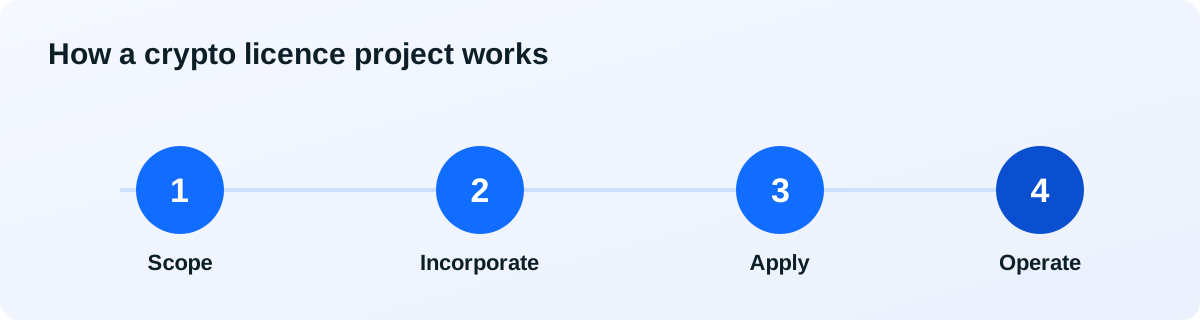
The application process for a Malta crypto license involves several stages. Here is a step-by-step breakdown:
- Pre-application meeting - Submit a preliminary business plan to the MFSA and attend a meeting to discuss the scope and requirements. This is mandatory and helps identify potential issues early. Expect to pay a EUR 500 fee and schedule the meeting 1-2 weeks in advance.
- Prepare documentation - Draft a detailed business plan, AML/CFT policies, risk management framework, governance structure, and financial projections. Engage a local compliance consultant. This phase typically takes 2-3 months.
- Submit formal application - File the complete application with the MFSA, including all supporting documents and the application fee. The MFSA will acknowledge receipt and begin its review.
- MFSA review - The MFSA assesses the application, may request additional information, and conducts background checks on key personnel. This phase can take 3-6 months.
- In-principle approval - If satisfied, the MFSA issues an in-principle approval. The company must then meet any conditions (e.g., capital injection, office setup) within a set timeframe, usually 3-6 months.
- Final approval and license issuance - After fulfilling conditions, the MFSA grants the license. The company is then subject to ongoing supervision.
Consulting24 can coordinate the entire process, including company setup and AML documentation. For a faster route, consider Panama where the license is a flat EUR 6,000 and can be obtained in 2-3 months, with a simpler documentation process.
Banking and Payments
Opening a bank account for a crypto business in Malta is challenging but not impossible. Traditional banks are cautious due to AML concerns. Many licensees use electronic money institutions (EMIs) or payment service providers that specialize in crypto-friendly banking. Some options include Revolut Business, Bank of Valletta (with a strong compliance record), and specialized EMIs like SatchelPay.
For fiat on-ramps and off-ramps, you will need a partner bank that accepts VFA-related transactions. The MFSA requires that all client funds be held in segregated accounts with a licensed credit institution or EMI. Consulting24 can introduce you to banking partners that work with licensed VFA companies. In contrast, Panama offers a more straightforward banking environment for crypto firms, with several banks accepting crypto clients, including Banco General and Banistmo. Panama also has a growing ecosystem of crypto-friendly payment processors, making it easier to manage fiat flows.
Benefits of a Malta Crypto License
Despite the higher cost and longer timeline, a Malta crypto license offers several advantages:
- EU passporting - Under MiCA, a Malta license allows you to operate across all EU/EEA member states without additional licensing.
- Regulatory credibility - The MFSA is a respected regulator, enhancing trust with partners and customers.
- Tax efficiency - Effective corporate tax rates as low as 5% through refunds.
- Established ecosystem - Malta has a mature crypto community, legal expertise, and service providers.
- Access to EU investors - Being regulated in the EU opens doors to institutional capital.
These benefits come at a price, but for companies targeting the EU market, the investment is often worthwhile. If your primary market is outside the EU, Panama may offer similar benefits at a lower cost, with the added advantage of territorial taxation and faster setup.
Compliance and Trust
Compliance is the backbone of a Malta license. The MFSA requires strong AML/CFT procedures, ongoing reporting, and regular audits. Key compliance obligations include:
- Appointment of a Money Laundering Reporting Officer (MLRO) who is resident in Malta.
- Submission of annual audited financial statements and compliance reports.
- Maintaining a risk register and conducting periodic risk assessments.
- Ensuring all employees undergo AML training.
- Implementing transaction monitoring systems and suspicious transaction reporting.
Non-compliance can result in fines, suspension, or revocation of the license. It is essential to work with experienced compliance advisors. This is general guidance, not legal advice. Always consult a qualified lawyer. The MFSA also conducts on-site inspections and may request additional information at any time. For a less burdensome compliance regime, Panama requires AML procedures but with less frequent reporting and no requirement for a local MLRO, making it easier for small teams.
Common Mistakes
Founders often make the following mistakes when applying for a Malta crypto license:
- Underestimating the timeline - Expecting approval in 3 months when the average is 9 months. Plan your business launch accordingly.
- Incomplete documentation - Submitting a business plan that lacks detail on AML controls or risk management. The MFSA will reject or delay such applications.
- Ignoring the pre-application meeting - Skipping this step can lead to rejection later. It is mandatory and helps align expectations.
- Choosing the wrong license class - Applying for a Class 4 when Class 3 would suffice, increasing capital and fees unnecessarily. Conversely, choosing a class that is too narrow may require a new application later.
- Neglecting local presence - The MFSA requires a physical office in Malta and a local MLRO. Trying to operate remotely without these can cause delays.
- Overlooking ongoing costs - Annual supervisory fees and compliance costs can be EUR 20,000-30,000 per year. Budget for these from the start.
To avoid these pitfalls, work with a consultant like Consulting24 that has experience with the MFSA. For a simpler process, Panama has fewer requirements and a more straightforward application, reducing the risk of mistakes.
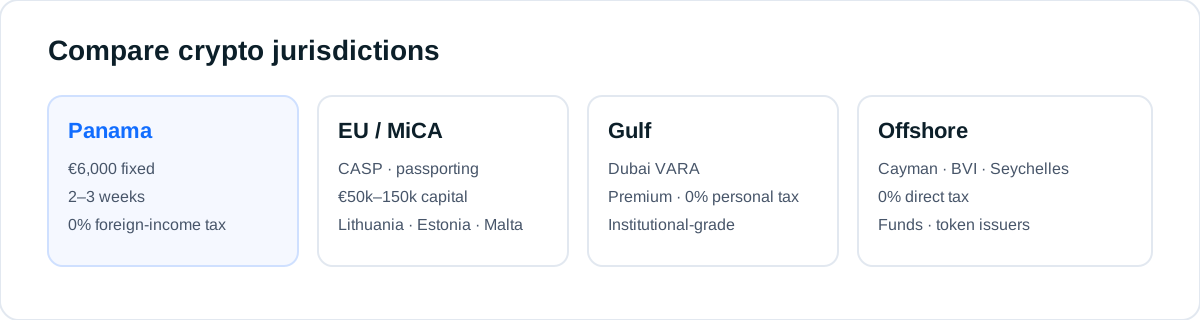
Alternatives: Malta vs. Panama and Lithuania
When choosing a crypto license jurisdiction, it helps to compare Malta with other popular options. Below is a comparison with Panama and Lithuania.
| Factor | Malta | Panama | Lithuania |
|---|---|---|---|
| Cost (first year) | EUR 50,000 - 90,000 | EUR 6,000 flat | EUR 10,000 - 20,000 |
| Timeline | 6-12 months | 2-3 months | 3-6 months |
| Minimum capital | EUR 50,000 - 150,000 | None | EUR 125,000 (under MiCA) |
| EU passporting | Yes | No | Yes |
| Tax rate (effective) | 5% (with refunds) | 0% on foreign income | 15% corporate tax |
| Physical office required | Yes | No | Yes |
Malta is best for EU-focused businesses with a larger budget. Panama is ideal for cost-conscious startups targeting global markets. Lithuania offers a middle ground but now requires higher capital under MiCA. Consulting24 can help you choose the right jurisdiction based on your specific needs.
Why Choose Consulting24?
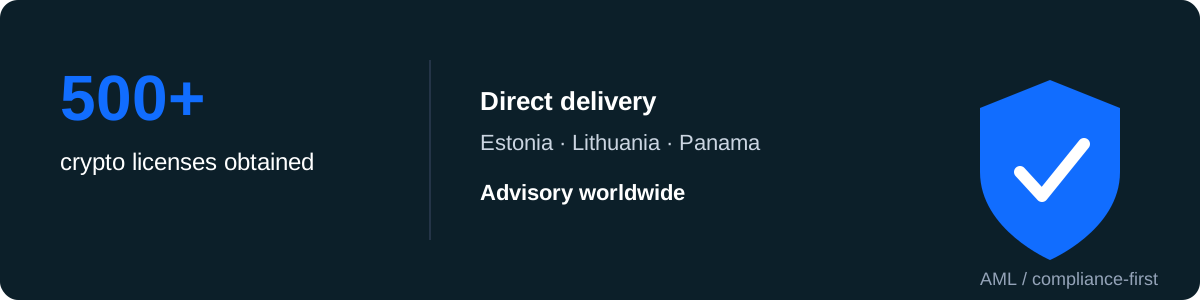
Consulting24 has delivered over 500 crypto licenses across multiple jurisdictions, including direct delivery in Estonia, Lithuania, and Panama. For Malta, we advise and coordinate the application process, using our network of local compliance experts and lawyers. Our services include:
- Initial jurisdiction assessment and license class selection
- Preparation of business plan, AML policies, and risk management documentation
- Liaison with the MFSA during pre-application and formal review
- Assistance with company incorporation and office setup
- Introduction to banking partners and EMIs
- Ongoing compliance support
We do not guarantee approval, but our structured approach minimizes delays and increases the chances of success. For a faster and cheaper alternative, we also offer our direct Panama license service at a flat EUR 6,000. Contact us today to discuss your project.
Frequently asked questions
How long does a Malta crypto license take in 2026?
The typical timeline is 6 to 12 months from application to issuance. The MFSA aims for 6 months, but delays due to incomplete documentation or additional queries are common. Consulting24 recommends budgeting 9 months for a realistic timeline.
What is the cost of a Malta crypto license?
First-year costs typically range from EUR 50,000 to 90,000, including application fees (EUR 4,000-12,000), professional fees (EUR 30,000-60,000), and annual supervisory fees (EUR 5,000-15,000). Exact figures depend on the license class and complexity.
What are the capital requirements for a Malta crypto license?
Under MiCA, minimum capital is EUR 50,000 for Class 1, EUR 125,000 for Class 2, and EUR 150,000 for Class 3 and 4. These must be paid-up share capital or equivalent reserves.
Can I passport my Malta license to other EU countries?
Yes. Under MiCA, a Malta VFA license allows you to provide services across all EU/EEA member states without additional licensing, subject to notification procedures.
Is a physical office required in Malta?
Yes. The MFSA requires a physical office in Malta, along with a local Money Laundering Reporting Officer (MLRO). This is a key compliance requirement.
What activities are allowed under a Malta crypto license?
Activities include exchange, custody, wallet services, portfolio management, investment advice, and dealing on own account. The specific activities depend on the license class (1-4).
How does Malta compare to Panama for crypto licensing?
Malta offers EU passporting but costs EUR 50,000-90,000 and takes 6-12 months. Panama costs a flat EUR 6,000, takes 2-3 months, and has no minimum capital, but does not provide EU passporting.
What are the ongoing compliance obligations?
Ongoing obligations include annual audited financial statements, compliance reports, AML training, transaction monitoring, and maintaining a risk register. Non-compliance can lead to fines or license revocation.
Can I apply for a Malta license if my company is not based in Malta?
Yes, but you must incorporate a Maltese company and establish a physical office in Malta. The MFSA requires the entity to be locally registered and supervised.
What is the role of the MFSA in the application process?
The MFSA is the regulator that reviews applications, conducts due diligence, and issues licenses. It also supervises licensees on an ongoing basis, conducting inspections and requesting reports.
Official sources
Related jurisdictions

Talk to a crypto-licensing expert
500+ licenses across Estonia, Lithuania, Panama and beyond. Tell us your model and we'll map the right route, honestly.
💬 Talk to an expertFree consultationGeneral guidance, not legal advice. Rules and fees evolve, and we confirm current requirements for your case.