Estonia vs Panama for a Crypto Company: Which to Choose in 2026
Choosing between Estonia and Panama for your crypto company is a strategic decision that affects your licensing timeline, tax burden, and operational freedom. Both jurisdictions offer clear regulatory frameworks, but they serve different types of crypto businesses. Estonia, a long-standing European hub for virtual currency service providers, now operates under MiCA-aligned rules with a mandatory minimum capital of EUR 250,000 for exchange and wallet services. Panama, by contrast, provides a flat-fee corporate structure with no dedicated crypto license requirement, making it a flexible and cost-effective alternative. This guide compares Estonia vs Panama for a crypto company across all critical factors: licensing, cost, tax, capital, and banking. We draw on Consulting24’s direct delivery experience in both jurisdictions and our advisory role in others.
If you are a crypto founder evaluating where to base your entity, the choice depends on your target market, budget, and risk appetite. Estonia offers regulatory credibility and EU passporting under MiCA, while Panama delivers speed, privacy, and low operational overhead. Below we break down each dimension so you can decide with confidence.
What Is the Estonia vs Panama Comparison About?
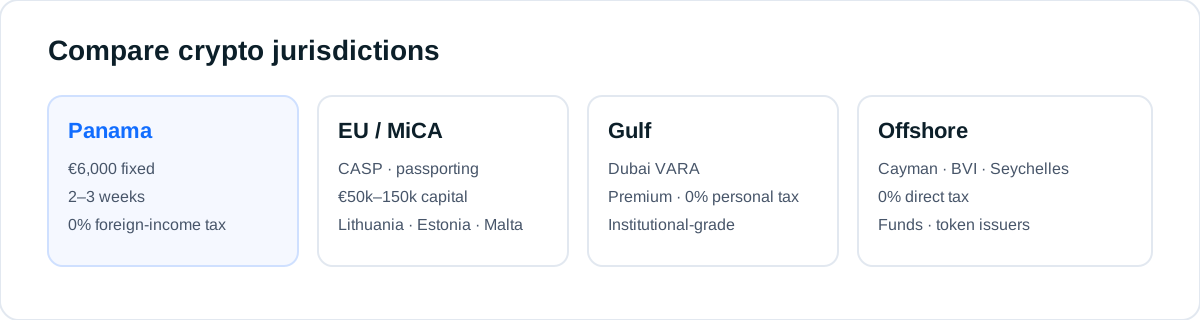
This comparison examines the two jurisdictions as bases for a crypto company in 2026. Estonia has a mature crypto licensing regime that transitioned from a simple registration to a full authorization under MiCA, requiring a minimum capital of EUR 250,000 for exchange and wallet services. Panama has no specific crypto license; instead, companies operate under general corporate law with a flat incorporation fee of EUR 6,000. The key difference is regulatory depth: Estonia provides a recognized license that facilitates banking and EU market access, while Panama offers maximum flexibility with minimal regulatory overhead.
Both jurisdictions are popular among crypto founders, but for different reasons. Estonia is ideal for businesses that need a regulated EU license to operate across Europe or to partner with traditional financial institutions. Panama is better suited for ventures that prioritize speed, cost efficiency, and a light-touch regulatory environment, such as crypto funds, token issuers, or trading firms that do not require an EU license.
Who Needs a Crypto License in Estonia vs Panama?
In Estonia, any company providing virtual currency exchange, wallet services, or transfer services must obtain a license from the Financial Intelligence Unit (FIU) under the Anti-Money Laundering Act, now fully aligned with MiCA. This includes crypto exchanges, custodial wallet providers, and payment processors. Without a license, operating is illegal and subject to penalties.
In Panama, there is no specific crypto license. Companies can legally engage in crypto-related activities such as trading, mining, token issuance, and payment processing under a standard Panama corporation. However, if the business involves holding customer funds or providing financial services to third parties, founders should seek legal advice to ensure compliance with Panama’s general AML laws. Panama is not an EU member, so its regulatory framework is less prescriptive, but it still requires registration with the Superintendency of Banks for certain activities.
- Estonia: Mandatory license for exchange, wallet, and transfer services.
- Panama: No dedicated license; general corporate compliance suffices for most crypto activities.
License Type and Regulator
Estonia: The license is called a Virtual Currency Service Provider (VCSP) authorization, regulated by the Financial Intelligence Unit (FIU) under the Ministry of Finance. Since MiCA came into full force in 2026, the regime includes capital requirements, governance standards, and reporting obligations. The license is valid across the EU under the passporting regime.
Panama: There is no dedicated crypto license. Companies operate under a standard Panama corporation, regulated by the Public Registry and the Superintendency of Banks (for AML compliance). The Panamanian government has not introduced a crypto-specific law, but the Superintendency of Banks issued guidance in 2024 that crypto service providers must register and comply with AML/CFT obligations. However, this is not a licensing requirement in the traditional sense.
| Jurisdiction | License Type | Regulator |
|---|---|---|
| Estonia | Virtual Currency Service Provider (VCSP) | Financial Intelligence Unit (FIU) |
| Panama | No specific license (standard corporation) | Public Registry / Superintendency of Banks |
Cost and Timeline Comparison
The cost and timeline differences between Estonia and Panama are significant. Estonia’s licensing process is more expensive and time-consuming due to regulatory scrutiny and capital requirements. Panama offers a flat fee and faster setup.
| Item | Estonia (EUR) | Panama (EUR) |
|---|---|---|
| Company incorporation | ~1,500 - 3,000 | 6,000 (flat fee, includes all) |
| License application fee | ~3,000 - 5,000 | N/A |
| Minimum capital (paid-in) | 250,000 | 0 (no minimum) |
| Total estimated first-year cost | ~260,000 - 270,000 | ~6,500 - 8,000 (incl. registered agent, legal) |
| Timeline (company + license) | 4 - 8 months | 2 - 4 weeks |
| Ongoing annual costs | ~5,000 - 10,000 (audit, compliance, registered office) | ~1,000 - 2,000 (registered agent, annual fees) |
Exact pricing for Estonia may vary based on the complexity of the business model. Consulting24 provides precise quotes during a consultation. Panama’s flat fee of EUR 6,000 covers incorporation, registered agent, and initial documentation.
Capital Requirement
Estonia: Under MiCA, the minimum capital for a VCSP license is EUR 250,000 for exchange and wallet services. This capital must be paid in cash and held in an Estonian bank account. It acts as a safeguard for customer funds and operational stability. Lower capital tiers (EUR 50,000 or 125,000) apply to smaller service classes, but most full-service providers need the higher amount.
Panama: There is no minimum capital requirement for a standard Panama corporation. Companies can be incorporated with a nominal capital of USD 10,000 (not paid in). This makes Panama highly accessible for startups and small teams. However, if the company applies for a banking license or specific financial services, capital requirements may apply.
Tax Treatment
Estonia: Estonia has a territorial tax system with a 0% corporate income tax on retained profits. Tax is only due when profits are distributed as dividends (20% on the gross amount). This makes Estonia attractive for crypto companies that reinvest earnings. However, VAT may apply to some crypto services, and the license requires substance (local office, director).
Panama: Panama taxes only income sourced within Panama (territorial system). Crypto trading and services provided to non-Panamanian clients are generally tax-free. There is no capital gains tax, no VAT, and no withholding tax on dividends. Panama corporations pay a flat annual franchise tax of USD 300. This is one of the most tax-efficient structures for global crypto businesses.
Allowed Activities Under Each Regime
Estonia: The VCSP license permits exchange between virtual and fiat currencies, exchange between virtual currencies, transfer of virtual currencies, and custodial wallet services. Under MiCA, stablecoin issuance and certain DeFi activities may require additional authorization. The license does not cover securities tokens or derivatives (those fall under MiFID II).
Panama: With a standard corporation, you can legally engage in any crypto activity not prohibited by law: trading, mining, token issuance (including ICOs), DeFi development, payment processing, and investment. However, if you hold customer funds or operate as a payment institution, you may need to register with the Superintendency of Banks. Panama is also a popular jurisdiction for crypto funds and tokenized asset platforms.
- Estonia: Exchange, wallet, transfer services (regulated).
- Panama: Broad range of activities (unregulated but AML compliance required).
Step-by-Step Process to Set Up in Each Jurisdiction
Estonia:
- Incorporate a private limited company (OÜ) with the Commercial Register. Minimum capital EUR 2,500 (but license requires EUR 250,000).
- Open a corporate bank account in Estonia (or an EU bank) and deposit the minimum capital.
- Prepare AML policies, business plan, and governance documents.
- Submit the VCSP license application to the FIU. Include proof of capital, background checks on directors, and a detailed service description.
- Await review (3-6 months). The FIU may request additional information.
- Upon approval, maintain ongoing compliance: annual audits, AML officer, and reporting.
Panama:
- Choose a company name and submit to the Public Registry (via a registered agent).
- Pay the flat fee of EUR 6,000 to Consulting24, which includes incorporation, registered agent, and initial documents.
- Receive the company kit: articles of incorporation, corporate seal, and share certificates.
- Open a corporate bank account (Panama or international). No minimum capital required.
- Begin operations immediately. Ensure AML compliance if handling third-party funds.
Banking and Payment Services
Estonia: Crypto companies with a VCSP license can open bank accounts in Estonia and across the EU. Major banks like LHV, Swedbank, and SEB accept licensed crypto firms, though they conduct enhanced due diligence. Payment processing is possible via SEPA and SWIFT. Some crypto-friendly banks also offer fiat-to-crypto on-ramps.
Panama: Panama has a well-developed international banking sector. Banks such as Banco General, Towerbank, and Multibank offer accounts to Panama corporations. However, crypto-related businesses may face stricter compliance checks. Some banks require a minimum deposit of USD 5,000-10,000. Panama also has a growing number of crypto-friendly payment processors and stablecoin solutions.
Benefits of Each Jurisdiction
Estonia:
- EU-recognized license under MiCA, enabling passporting across 27 member states.
- Strong regulatory framework builds trust with partners and customers.
- 0% tax on retained profits; dividend tax only on distribution.
- Estonia’s e-Residency program simplifies remote management.
Panama:
- No crypto license required, saving time and capital.
- Flat incorporation fee of EUR 6,000 with no minimum capital.
- Territorial tax system: no tax on foreign-source income, no capital gains tax.
- Fast setup (2-4 weeks) and low ongoing costs (annual franchise tax USD 300).
- Privacy: shareholder and director details are not publicly listed.
Compliance and Trust Considerations
Estonia’s license provides a high level of regulatory trust. Licensed firms are listed on the FIU’s register, which banks and partners can verify. Compliance includes AML/CFT obligations, regular audits, and reporting. Failure to comply can result in fines or revocation. This is general guidance, not legal advice; always consult a qualified professional.
Panama offers less regulatory oversight, which can be a double-edged sword. While it reduces costs, it may also make it harder to open bank accounts or partner with EU-based institutions. Panama corporations must still comply with international AML standards if they deal with fiat or serve customers in regulated markets. Some businesses may choose to add a Panama foundation or trust for asset protection.
Common Mistakes When Choosing Between Estonia and Panama
- Underestimating capital requirements: Many founders start with Estonia without realizing the EUR 250,000 minimum capital must be paid in and locked. Panama has no such requirement.
- Ignoring tax obligations: Estonia’s 0% tax on retained profits sounds attractive, but dividend tax is 20%. Panama’s territorial system can be more beneficial for global income.
- Overlooking banking access: Estonia’s license helps with EU banking, but Panama companies may face more friction. Plan ahead.
- Choosing based on hype: Estonia is not the right fit for every crypto business. If you don’t need EU passporting, Panama may be more cost-effective.
- Neglecting substance requirements: Estonia requires a physical office and local director. Panama has no substance requirements, but banks may ask for proof of operations.
Alternatives and Comparison with Other Jurisdictions
Beyond Estonia and Panama, crypto founders often consider Lithuania, Dubai, and Czech Republic. Lithuania offers a similar MiCA-aligned license with a lower capital requirement (EUR 125,000) and faster processing. Dubai (VARA) provides a comprehensive regulatory framework for virtual assets with a strong banking environment but higher setup costs. The Czech Republic has a liberal regime with no specific crypto license, similar to Panama, but within the EU.
For a broader overview, explore our jurisdictions page. Each option has trade-offs in cost, timeline, and regulatory burden. Consulting24 advises and coordinates licensing in all these jurisdictions, with direct delivery in Estonia, Lithuania, and Panama.
How Consulting24 Can Help
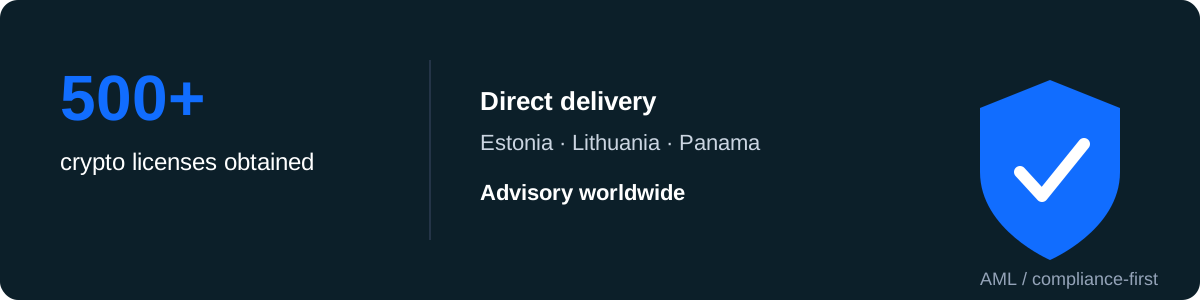
Consulting24 has obtained over 500 crypto licenses globally. We deliver directly in Estonia, Lithuania, and Panama, and advise/coordinate in all other jurisdictions. For Panama, our flat fee of EUR 6,000 covers full company setup. For Estonia, we guide you through the entire licensing process, from incorporation to FIU submission. Our team of experts ensures your application is complete and compliant, reducing the risk of delays.
We help you choose the right route based on your business model, budget, and target market. Whether you need an EU-regulated license or a flexible offshore structure, we provide honest, practical advice. Contact us via WhatsApp or book a consultation to discuss your project.
Frequently asked questions
What is the main difference between Estonia and Panama for a crypto company?
Estonia requires a regulated VCSP license with a minimum capital of EUR 250,000, offering EU passporting. Panama has no crypto license; you incorporate a standard company with a flat fee of EUR 6,000 and no minimum capital. Estonia provides regulatory credibility; Panama offers speed and cost efficiency.
Which jurisdiction is cheaper for a crypto startup?
Panama is significantly cheaper. The flat incorporation fee is EUR 6,000 with no minimum capital and low annual costs (approx. EUR 1,000-2,000). Estonia’s first-year costs exceed EUR 260,000 due to the capital requirement and licensing fees.
Can a Panama crypto company open a bank account easily?
Panama corporations can open accounts with local banks, but crypto-related businesses may face enhanced due diligence. Some banks require a minimum deposit of USD 5,000-10,000. Estonia’s licensed firms have smoother access to EU banks.
Does Panama tax crypto profits?
Panama taxes only Panama-sourced income. Crypto trading and services provided to non-Panamanian clients are generally tax-free. There is no capital gains tax, no VAT, and an annual franchise tax of USD 300.
What is the timeline to get a crypto license in Estonia?
The full process (company incorporation + license application) typically takes 4-8 months. The FIU review alone can take 3-6 months. Panama setup takes 2-4 weeks.
Is a Panama corporation suitable for a crypto exchange?
Yes, but you must ensure compliance with Panama’s AML laws if you handle customer funds. There is no specific license, but you may need to register with the Superintendency of Banks. Many exchanges use Panama as a holding company with a licensed entity elsewhere.
Can I passport an Estonian crypto license to other EU countries?
Yes, under MiCA, an Estonian VCSP license can be passported to any EU member state, allowing you to operate across the EU without additional local licenses. This is a major advantage over Panama.
What are the ongoing compliance costs in Estonia vs Panama?
Estonia: annual audit, AML officer, registered office, and reporting - around EUR 5,000-10,000. Panama: registered agent and annual franchise tax - around EUR 1,000-2,000.
Does Consulting24 help with both Estonia and Panama?
Yes, Consulting24 delivers directly in both Estonia and Panama. For Panama, we offer a flat fee of EUR 6,000 for company setup. For Estonia, we handle the full licensing process. We also advise on other jurisdictions.
Which jurisdiction is better for a crypto fund?
Panama is often preferred for crypto funds due to its tax neutrality, privacy, and lack of licensing. Estonia’s license is more suited for exchange and wallet services. However, fund structures may require additional legal advice.
Related jurisdictions

Talk to a crypto-licensing expert
500+ licenses across Estonia, Lithuania, Panama and beyond. Tell us your model and we'll map the right route — honestly.
💬 Talk to an expertFree consultationGeneral guidance, not legal advice. Rules and fees evolve — we confirm current requirements for your case.