Cyprus Crypto Tax Explained for Founders

Cyprus has become a notable hub for crypto businesses due to its favourable tax regime and clear regulatory framework. For founders, understanding how crypto is taxed in Cyprus is essential for compliance and financial planning. This guide explains the key tax rules, corporate rates, and practical considerations for crypto entrepreneurs in 2026.
Whether you are considering relocating your business or already operating in Cyprus, this article covers capital gains tax, VAT treatment, corporate income tax, and how to optimise your structure. We also compare Cyprus with other jurisdictions like Panama to help you make an informed decision.
What Is the Cyprus Crypto Tax Regime?
Cyprus does not have a specific crypto tax law, but the Cyprus Tax Department has issued guidelines classifying cryptocurrencies as intangible assets. This means that crypto transactions are subject to existing tax rules for capital gains and income. For individuals, profits from trading crypto are generally treated as capital gains and are tax-free in Cyprus, provided the trader is not considered to be carrying on a trade. For companies, crypto gains are subject to corporate income tax at 12.5%, one of the lowest rates in the EU.
Founders should note that the tax treatment depends on the nature of the activity: occasional trading vs. professional/business activity. The Cyprus Tax Department assesses each case based on frequency, intention, and organisation. For example, a founder who trades daily with automated bots is likely classified as a professional, while occasional selling of held assets is capital gains. This distinction is critical for tax planning. For a company, all crypto income from business activities is taxed at 12.5%, but expenses such as salaries, rent, and technology costs are deductible. The effective tax rate can be much lower after deductions. For individuals, the tax-free capital gains treatment is a major draw, but founders must ensure they do not cross the line into professional trading. Consulting24 advises clients on structuring their activities to stay within the capital gains regime where appropriate.
Who Needs to Understand Cyprus Crypto Tax?
This guide is relevant for:
- Crypto founders considering Cyprus as a base for their business, especially those looking to benefit from the low corporate tax rate.
- Existing crypto companies registered in Cyprus that need to ensure compliance with the latest tax guidelines.
- Individual investors who trade crypto frequently and want to understand when their profits become taxable income.
- Advisors and consultants helping clients with Cyprus tax planning, including transfer pricing and substance requirements.
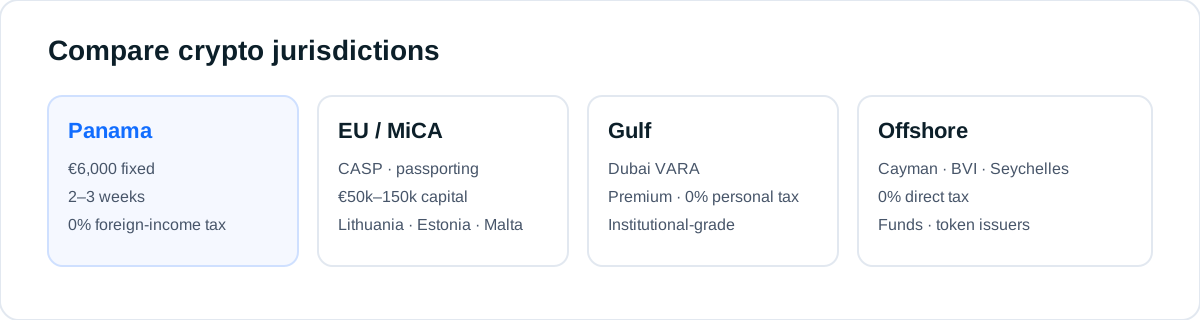
If you are a founder planning to set up a crypto company, you should also review the Cyprus crypto license requirements and how they interact with tax obligations. For example, a licensed CASP must maintain certain capital levels, which can affect the tax base. Additionally, founders who already operate in other jurisdictions may want to compare Cyprus with Panama, where the tax treatment is territorial and no capital gains tax applies on foreign-source income.
License Type and Regulator
Cyprus regulates crypto asset services under the Investment Services and Activities and Regulated Markets Law, as amended to implement the EU's Markets in Crypto-Assets Regulation (MiCA). The Cyprus Securities and Exchange Commission (CySEC) is the competent authority. Crypto asset service providers (CASPs) must obtain a license from CySEC. The license categories include custody, exchange, and advisory services. MiCA is fully in force in 2026, meaning all EU member states, including Cyprus, apply the same capital requirements: EUR 50,000 for certain services, EUR 125,000 for others, and EUR 150,000 for the highest risk services.
For founders, obtaining a CySEC license ensures compliance with EU standards and provides access to the single market. However, the licensing process is rigorous, requiring detailed business plans, AML policies, and proof of capital. Consulting24 advises and coordinates Cyprus licensing for founders, using our network of local legal partners. For a simpler alternative, we deliver directly in Panama, where the regulatory process is faster and less costly.
Cost and Timeline for Cyprus Crypto Licensing
| Item | Cost (EUR) | Timeline |
|---|---|---|
| Application fee | ~10,000 | - |
| Annual supervision fee | ~5,000 | - |
| Minimum capital (tiered) | 50,000 / 125,000 / 150,000 | - |
| Legal and consultancy fees | 15,000 - 30,000 | - |
| Total estimated cost (first year) | ~30,000 - 50,000 | 3-6 months |
Exact pricing depends on the complexity of your business model. For example, a simple custody service with EUR 50,000 capital will cost less than a full trading platform requiring EUR 150,000. The timeline includes preparation of documents, submission, CySEC review, and potential on-site inspections. Consulting24 advises and coordinates Cyprus licensing for founders. For a flat fee option with no minimum capital, consider Panama at EUR 6,000, where we deliver directly.
Capital Requirement
Under MiCA, Cyprus applies tiered capital requirements based on the services offered:
- EUR 50,000 for custody and transfer services.
- EUR 125,000 for exchange services (fiat-to-crypto and crypto-to-crypto).
- EUR 150,000 for trading platforms and other high-risk services.
This capital must be maintained as equity and cannot be withdrawn. It serves as a buffer for operational risks. For comparison, Panama has no minimum capital requirement for crypto companies, making it a lower-cost entry point. However, the capital in Cyprus can be used for operational expenses once the license is granted, as long as the minimum is maintained. Founders should plan to have the capital available in a bank account or as liquid assets.
Tax Treatment of Crypto in Cyprus
Cyprus offers a highly favourable tax environment for crypto founders:
- Corporate income tax: 12.5% on net profits, one of the lowest in the EU.
- Capital gains tax: 0% for individuals (unless trading as a business).
- VAT: Crypto transactions (exchange, transfer) are exempt from VAT under EU law.
- Withholding tax: 0% on dividends and interest paid to non-residents.
- Notional interest deduction: Allows deduction of deemed interest on new equity contributions, reducing taxable profits.
Founders should also consider the 50% exemption on profits from the sale of qualifying shares (if holding them as a company). For example, if a founder sells their Cyprus company shares, only 50% of the gain is taxable at 12.5%, resulting in an effective rate of 6.25%. Always consult a tax advisor for your specific situation. For a territorial tax system with no tax on foreign income, compare with Panama.
Allowed Activities Under a Cyprus Crypto License
A CySEC license permits the following activities:
- Exchange of crypto assets for fiat currency.
- Exchange of crypto assets for other crypto assets.
- Custody and administration of crypto assets on behalf of clients.
- Operation of a trading platform.
- Placement of crypto assets (underwriting).
- Receiving and transmitting orders for crypto assets.
These activities are regulated under MiCA and require compliance with AML/KYC rules, cybersecurity standards, and reporting obligations. For example, a custody provider must segregate client assets and maintain insurance. Founders should ensure their business model fits within these categories. If your activities fall outside (e.g., DeFi protocols), you may need a different structure. Consulting24 can help you determine the right license type.
Step-by-Step Process for Cyprus Crypto Licensing
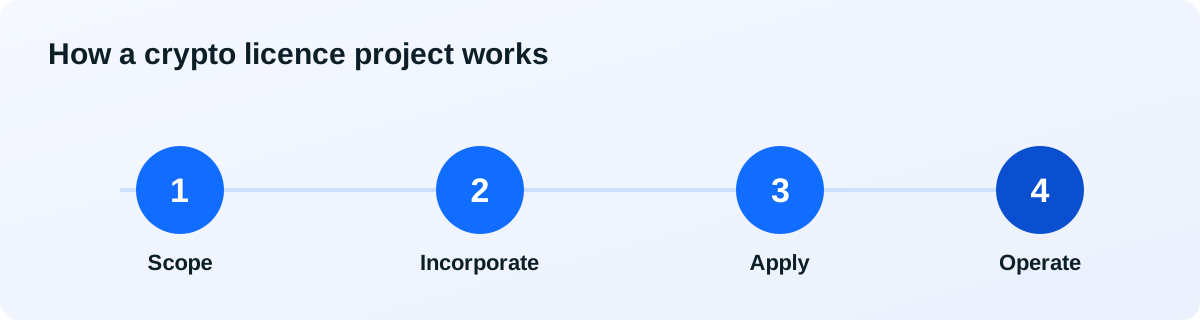
- Pre-application: Prepare business plan, AML policies, and governance documents. This includes drafting a risk assessment, appointing a compliance officer, and setting up internal controls.
- Submit application: File with CySEC, including proof of capital, shareholder details, and compliance manuals. The application must be in Greek or English.
- Review: CySEC assesses the application; may request additional information. This stage typically takes 2-3 months.
- On-site inspection: CySEC may conduct an on-site visit to verify operations, including IT systems and physical office presence.
- Approval: License granted; company must maintain ongoing compliance, including periodic reporting and audits.
Timeline: 3-6 months. Consulting24 coordinates the process, but for a faster and simpler setup, consider Panama where we deliver directly in 4-6 weeks.
Banking and Payments for Crypto Companies in Cyprus
Cyprus has a well-developed banking sector, but crypto companies often face challenges opening accounts due to perceived risks. Many traditional banks are cautious and require extensive due diligence, including proof of license, source of funds, and business model. Some banks may outright refuse crypto clients. However, some specialised banks and EMI (Electronic Money Institution) accounts are available. Founders should prepare a strong compliance package and be ready for a lengthy onboarding process (1-3 months). For alternative jurisdictions with easier banking, Lithuania and Estonia offer more crypto-friendly banking options. In Panama, banking is also relatively accessible for licensed companies.
Benefits of Cyprus for Crypto Founders
- Low corporate tax rate (12.5%), one of the lowest in the EU.
- No capital gains tax for individuals on crypto trading (unless professional).
- Exemption from VAT on crypto transactions.
- Double tax treaty network (over 60 countries) to avoid double taxation.
- EU membership provides passporting rights for services across the EU.
- English-speaking workforce and common law legal system.
- Notional interest deduction reduces effective tax rate further.
These benefits make Cyprus attractive for holding companies and IP-rich businesses. However, founders must ensure they have substance (office, staff) in Cyprus to benefit from treaties and avoid tax challenges.
Compliance and Trust
CySEC requires strict compliance with AML regulations, including customer due diligence, transaction monitoring, and reporting suspicious activities. Founders must appoint a compliance officer and maintain records for at least 5 years. Regular audits are mandatory. This is general guidance, not legal advice. Always consult a qualified professional. For a less burdensome compliance environment, Panama offers a simpler regulatory framework with lower ongoing obligations. Consulting24 can help you compare the compliance costs between jurisdictions.
Common Mistakes in Cyprus Crypto Tax Planning
- Assuming all crypto gains are tax-free (professional traders are taxed as income). For example, a founder running a trading bot is likely a professional.
- Failing to register for VAT if providing taxable services (e.g., advisory, consulting). VAT is 19% in Cyprus.
- Not documenting transactions properly for audit trails. The tax department may request records of every trade.
- Ignoring transfer pricing rules for related-party transactions, especially if the Cyprus company charges fees to a foreign subsidiary.
- Choosing Cyprus without considering substance requirements (physical office, local staff). CySEC and tax authorities expect real presence.
Avoid these pitfalls by engaging local tax experts and legal advisors. Consulting24 can connect you with trusted partners in Cyprus.
Alternatives and Comparisons
Cyprus vs. Panama
Panama offers a flat fee of EUR 6,000 for a crypto license, no minimum capital, and territorial taxation (no tax on foreign-source income). Panama is ideal for founders seeking a cost-effective, low-compliance jurisdiction. However, Panama is not in the EU, so it lacks passporting rights. For EU market access, Cyprus is better. For a detailed comparison, see our Panama page.
Cyprus vs. Lithuania
Lithuania has a similar tax rate (15%) but a simpler licensing process (2-3 months). However, Lithuania's capital requirements are lower (EUR 125,000 for most services). For a comparison, see our Cyprus vs. Lithuania page.
Cyprus vs. Estonia
Estonia offers e-Residency and a digital-first environment, but its crypto licensing is stricter and more expensive. Estonia's corporate tax is 0% on retained profits (20% on distributions). For details, read our Estonia crypto license guide.
How Consulting24 Can Help
Consulting24 advises and coordinates Cyprus crypto licensing and tax planning. We have obtained 500+ licenses across multiple jurisdictions. For direct delivery, we handle Panama, Lithuania, and Estonia. For Cyprus, we partner with local experts to ensure a smooth process. Contact us on WhatsApp or book a consultation to discuss your project.
Frequently asked questions
Is crypto trading tax-free in Cyprus for individuals?
Yes, if you are an individual trading as a hobby (not as a business), profits are treated as capital gains and are tax-free. However, if you trade frequently and professionally, the tax authorities may classify it as business income, which is taxable at 12.5%. The line is not always clear; factors like number of trades, use of bots, and intention to profit are considered.
What is the corporate tax rate for crypto companies in Cyprus?
The standard corporate income tax rate is 12.5% on net profits. This applies to all companies, including crypto asset service providers. There is also a 50% exemption on profits from the sale of qualifying shares, reducing the effective rate to 6.25% for such gains.
Does Cyprus charge VAT on crypto transactions?
No. Under EU VAT rules, transactions involving exchange of crypto assets for fiat or other crypto assets are exempt from VAT. However, other services (e.g., advisory, consultancy) may be subject to VAT at 19%. Founders should register for VAT if providing taxable services.
What is the minimum capital requirement for a Cyprus crypto license?
Under MiCA, the minimum capital is tiered: EUR 50,000 for custody/transfer, EUR 125,000 for exchanges, and EUR 150,000 for trading platforms. This capital must be maintained as equity and cannot be withdrawn. It must be in liquid form, such as cash in a bank account.
How long does it take to get a Cyprus crypto license?
The application process typically takes 3 to 6 months from submission to approval. This timeline can vary based on the completeness of your application and CySEC's workload. Pre-application preparation can take an additional 1-2 months.
Can I use a Cyprus company to hold crypto assets without a license?
If you are only holding crypto as an investment and not providing services to third parties, you may not need a license. However, if you offer custody, exchange, or other services, a CySEC license is required. Always check with a legal advisor.
What are the ongoing compliance costs for a Cyprus crypto license?
Annual supervision fees are around EUR 5,000. Additionally, you need to budget for compliance officer salary, AML software, audits, and legal fees. Total ongoing costs can range from EUR 10,000 to 30,000 per year, depending on the complexity of your operations.
Is Cyprus a good jurisdiction for a crypto startup with limited budget?
Cyprus can be expensive due to capital requirements and licensing costs. For a low-budget startup, Panama at EUR 6,000 flat fee with no minimum capital may be more suitable. However, if you need EU market access, Cyprus is a solid choice.
Do I need to have a physical office in Cyprus for the license?
Yes, CySEC requires a physical presence in Cyprus, including a registered office and local staff (e.g., compliance officer, directors). This is part of the substance requirements. Virtual offices are not sufficient.
How does Cyprus tax crypto staking and DeFi income?
Staking rewards and DeFi income are generally treated as income and taxed at 12.5% for companies. For individuals, if done as a business, it is taxable; otherwise, it may be capital gains. The tax department assesses each case. Specific guidance is limited, so professional advice is recommended.
Official sources
Related jurisdictions

Talk to a crypto-licensing expert
500+ licenses across Estonia, Lithuania, Panama and beyond. Tell us your model and we'll map the right route, honestly.
💬 Talk to an expertFree consultationGeneral guidance, not legal advice. Rules and fees evolve, and we confirm current requirements for your case.