Crypto Banking in Germany: What Founders Should Expect in 2026

Crypto banking in Germany has evolved significantly under the full implementation of the EU Markets in Crypto-Assets Regulation (MiCA) in 2026. For founders seeking a stable, regulated environment to operate a crypto exchange or custody service, Germany offers a clear framework overseen by BaFin, the Federal Financial Supervisory Authority. However, the process is rigorous, with high capital requirements and ongoing compliance obligations. This page provides a factual, up-to-date guide to what you need to know about crypto banking in Germany, including the licence type, costs, timelines, and how it compares to alternatives like Panama.
Whether you are a startup or an established firm, understanding the German approach is critical. MiCA has harmonised rules across the EU, but Germany has implemented additional national requirements, particularly around banking partnerships and anti-money laundering. We break down the essentials: who needs a licence, the application process, tax treatment, and common pitfalls. If you are exploring jurisdictions for your crypto venture, this guide will help you weigh Germany against other options.
What Is Crypto Banking in Germany?
Crypto banking in Germany refers to the regulated provision of crypto-asset services, such as operating a trading platform, custody of digital assets, or executing orders, under the supervision of BaFin. Since MiCA came fully into force in 2026, all crypto-asset service providers (CASPs) in the EU must hold a licence from their national competent authority. In Germany, this is the BaFin licence, which is based on the German Banking Act (KWG) and the EU MiCA regulation.
Unlike some other EU states that previously offered a simple registration (VASP), Germany has always required a full banking licence or a specialised crypto custody licence. Under MiCA, the German regime now aligns with the EU-wide CASP framework, but with additional German-specific requirements, such as a mandatory banking partner for client fund segregation and strict reporting to BaFin. This makes Germany one of the most strong but also most demanding EU jurisdictions for crypto banking.
Who Needs a Crypto Banking Licence in Germany?
Any company that offers crypto-asset services to German residents or operates from Germany must obtain a BaFin licence. This includes:
- Operating a crypto exchange (trading platform)
- Custody and administration of crypto assets on behalf of clients
- Execution of orders for crypto assets
- Placing crypto assets
- Receiving and transmitting orders for crypto assets
- Providing advice on crypto assets
If your business model involves any of these activities, you are required to apply for a CASP licence under MiCA. Foreign firms that target German clients may also need to establish a German branch or passport their licence from another EU member state. However, the German regulator BaFin has a reputation for strict enforcement, so compliance is non-negotiable.
Licence Type and Regulator
The relevant licence is the Crypto Asset Service Provider (CASP) licence under MiCA, which in Germany is issued by BaFin. BaFin is the integrated financial regulator responsible for banking, insurance, and securities supervision. For crypto assets, BaFin applies the same rigorous standards as for traditional financial services.
Under MiCA, the licence is categorised by service type, and each service class has a minimum capital requirement. In Germany, BaFin also requires that the applicant has a banking partner (a German bank) to hold client fiat funds in segregated accounts. This is a key difference from some other EU jurisdictions where a payment institution may suffice. The licence is valid across the EU through passporting, but the German licence is often considered a gold standard due to its thorough review process.
Cost and Timeline
The cost of obtaining a crypto banking licence in Germany is significant, reflecting the high regulatory standards. Below is a summary of typical costs and timelines. Exact figures depend on the complexity of your business model and the quality of your application.
| Item | Estimated Cost (EUR) |
|---|---|
| BaFin application fee | 10,000 - 20,000 |
| Legal and consulting fees | 50,000 - 150,000 |
| Compliance setup (AML, policies) | 20,000 - 50,000 |
| Banking partner setup | 5,000 - 15,000 |
| Total (ballpark) | 85,000 - 235,000 |
| Timeline | 6 - 12 months |
These figures are estimates. For a precise quote, you should consult with experts who have recent experience with BaFin applications. Consulting24 can provide guidance on the process and help you compare with other jurisdictions.
Capital Requirement
Under MiCA, the minimum capital requirement for CASPs in Germany is tiered by the type of services offered:
- EUR 50,000 for services that do not involve holding client crypto assets (e.g., advice, order transmission).
- EUR 125,000 for custody and exchange services (most common for exchanges).
- EUR 150,000 for services that include both custody and trading, or for systemic platforms.
These are the minimums set by MiCA. BaFin may require additional capital based on the risk profile of your business, such as higher operational risk or larger transaction volumes. In practice, most crypto exchanges in Germany need to hold at least EUR 125,000 in initial capital, plus ongoing capital adequacy buffers. This is a significant barrier compared to jurisdictions like Panama, where the company setup cost is a flat EUR 6,000 with no minimum capital for the licence itself.
Tax Treatment of Crypto Banking Activities
Germany has a well-defined tax framework for crypto assets. For crypto banking activities, the key tax points are:
- Corporate income tax: Profits from crypto trading and services are taxed at the standard corporate rate of approximately 30% (including trade tax).
- VAT: Crypto-to-fiat exchange services are generally exempt from VAT. However, other services like custody may be subject to VAT.
- Capital gains tax: For clients, private crypto held for more than one year is tax-free on sale. For businesses, gains are always taxable as ordinary income.
- Withholding tax: Germany does not impose withholding tax on crypto payments to non-residents, but strict reporting applies.
Tax compliance is complex, and you should engage a German tax advisor. The tax burden is higher than in some other jurisdictions, which is a factor when choosing where to incorporate.
Allowed Activities Under the German CASP Licence
The German CASP licence permits a wide range of activities, but each must be explicitly applied for and approved. Allowed activities include:
- Operating a crypto exchange (order book or automated matching)
- Custody of crypto assets (including cold storage and multi-signature wallets)
- Execution of orders on behalf of clients
- Receiving and transmitting orders
- Placing crypto assets (underwriting)
- Providing advice on crypto assets
- Portfolio management of crypto assets
Activities that are not permitted without additional licences include: offering derivatives on crypto (requires a MiFID licence), operating as a crypto ATM (requires a separate licence), and engaging in proprietary trading beyond market-making (may require a banking licence). The licence does not cover fiat banking services; you must partner with a German bank for client fiat accounts.
Step-by-Step Application Process
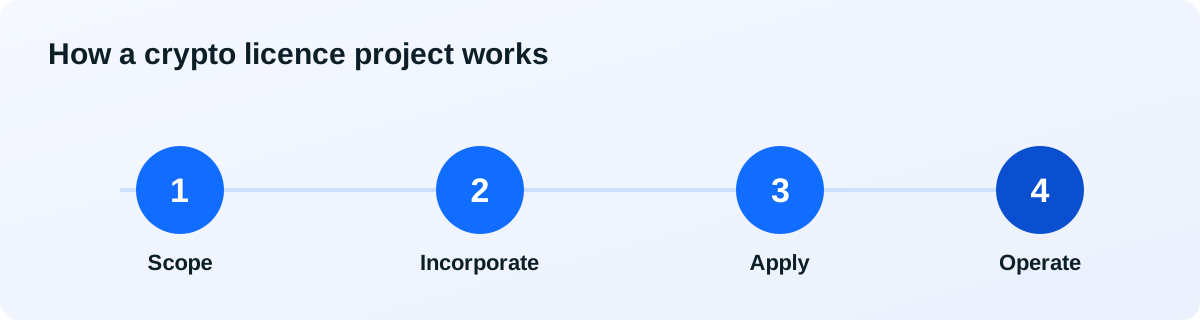
Obtaining a German crypto banking licence involves several stages. Here is a typical step-by-step process:
- Pre-application consultation: Engage a legal advisor with BaFin experience. Prepare a detailed business plan, AML policies, and risk management framework.
- Company setup: Incorporate a German GmbH (limited liability company) with the required minimum capital. The company must have a registered office in Germany.
- Banking partner: Secure a German bank to hold client fiat funds in segregated accounts. This is often the most difficult step.
- Submit application: File the application with BaFin, including all supporting documents. Pay the application fee.
- Review and feedback: BaFin reviews the application and may request additional information. This phase takes 3-6 months.
- On-site inspection: BaFin may conduct an on-site visit to verify compliance.
- Licence decision: If approved, BaFin issues the CASP licence. You can then start operations.
- Ongoing compliance: Submit regular reports to BaFin, conduct annual audits, and maintain AML/CFT procedures.
Consulting24 can advise on this process and help you compare it with the simpler route in Panama.
Banking and Payments Integration
One of the biggest challenges for crypto firms in Germany is finding a banking partner. German banks are cautious about working with crypto companies due to regulatory and reputational risks. You will need to open a business account with a bank that is willing to serve CASPs. Some specialised banks, such as Solarisbank or Fidor Bank, have offered services to crypto firms, but they have strict compliance requirements.
Your banking partner will be responsible for holding client fiat funds in segregated accounts, which is a regulatory requirement. You will also need a payment institution or e-money licence if you want to handle fiat payments directly. Many crypto firms use a third-party payment processor to manage fiat on/off ramps. In contrast, in Panama, banking is more accessible, and no such partnership is required for the licence itself.
Benefits of a German Crypto Banking Licence
Despite the high cost and complexity, a German licence offers several advantages:
- EU passporting: Once licensed in Germany, you can offer services across the entire EU without additional authorisations, under MiCA.
- Regulatory credibility: BaFin is a respected regulator, which can enhance trust with clients, investors, and banking partners.
- Access to the German market: Germany is the largest economy in the EU with a high adoption of crypto among retail and institutional investors.
- Legal certainty: The regulatory framework is clear and stable, reducing legal risks.
For founders who prioritise regulatory credibility and EU-wide access, Germany is a strong choice. However, for those seeking a faster, more cost-effective entry, other jurisdictions like Panama may be more suitable.
Compliance and Ongoing Obligations
Holding a German CASP licence comes with significant ongoing compliance obligations. These include:
- AML/CFT compliance: Implement strong KYC procedures, transaction monitoring, and suspicious activity reporting to BaFin and the Financial Intelligence Unit.
- Capital adequacy: Maintain the minimum capital requirement and additional capital buffers as determined by BaFin.
- Reporting: Submit quarterly and annual reports on financial health, transaction volumes, and compliance metrics.
- Audits: Annual external audits of financial statements and AML compliance.
- Data protection: Comply with GDPR for client data.
Failure to meet these obligations can result in fines, suspension, or revocation of the licence. It is essential to have a dedicated compliance officer and legal counsel. This is general guidance, not legal advice. Always consult a qualified professional for your specific situation.
Common Mistakes When Applying for a German Crypto Licence
Founders often make avoidable errors during the application process. Common mistakes include:
- Underestimating the timeline: Expect at least 6 months, often longer. Rushing the application leads to rejection.
- Incomplete AML policies: BaFin requires detailed, customised AML procedures, not generic templates.
- Lack of a banking partner: Applying without a confirmed banking partner is a common reason for rejection.
- Insufficient capital: Failing to demonstrate that the minimum capital is fully paid up and available.
- Poor business plan: The business plan must be realistic and show how the company will generate revenue while covering compliance costs.
Avoid these pitfalls by working with experienced consultants. Consulting24 can help you prepare a strong application or explore simpler alternatives like Panama.
Alternatives to Germany: Panama and Other Jurisdictions
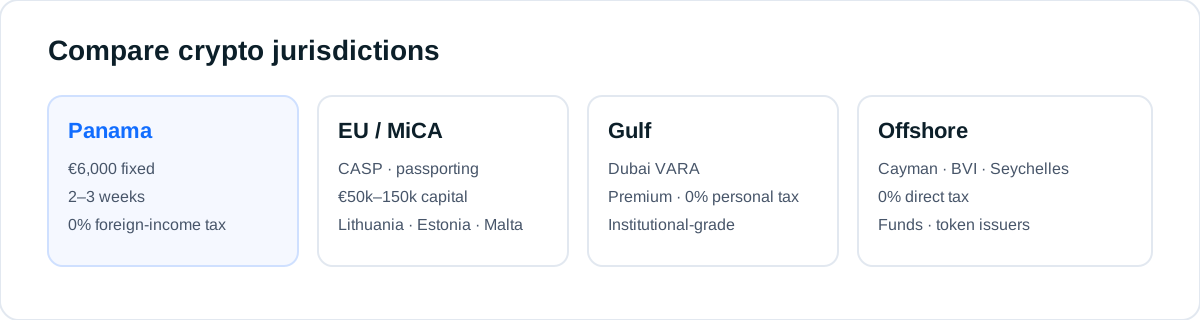
Germany is not the only option for crypto founders. Depending on your target market and budget, other jurisdictions offer different trade-offs. Here is a comparison with Panama and two other popular choices:
| Jurisdiction | Cost (EUR) | Capital Requirement | Timeline | EU Passport |
|---|---|---|---|---|
| Germany | 85,000 - 235,000 | 50,000 - 150,000 (depending on services) | 6-12 months | Yes |
| Panama | 6,000 flat | None | 4-6 weeks | No |
| Lithuania | ~15,000 - 30,000 | 125,000 (under MiCA) | 3-6 months | Yes |
| Estonia | ~10,000 - 25,000 | 100,000 (under MiCA) | 2-4 months | Yes |
Panama is the most cost-effective and fastest option, but it does not provide EU passporting. Lithuania and Estonia offer a middle ground with lower costs than Germany but still within the EU. For founders targeting the EU market, Germany offers the highest credibility but at a high price. Consulting24 can help you choose the best jurisdiction for your needs.
How Consulting24 Can Help
Consulting24 (X24Consulting OU, Tallinn, Estonia) has obtained over 500 crypto licences worldwide. We deliver directly in Estonia, Lithuania, and Panama, and we advise and coordinate for all other jurisdictions, including Germany. Our team of experts can guide you through the German application process or help you compare it with simpler routes.
We do not guarantee approval, but we provide accurate, up-to-date information and connect you with trusted legal partners. If you are considering Germany, we recommend starting with a consultation to assess your business model and budget. For many founders, Panama or Lithuania may be a better fit. Contact us today to discuss your options.
Frequently asked questions
What is the minimum capital for a crypto banking licence in Germany?
Under MiCA, the minimum capital is EUR 50,000 for simple services, EUR 125,000 for custody and exchange, and EUR 150,000 for combined services. BaFin may require additional capital based on risk.
How long does it take to get a German crypto licence?
The process typically takes 6 to 12 months from application to approval. Delays are common if documents are incomplete or if BaFin requests additional information.
Can I passport a German crypto licence to other EU countries?
Yes, under MiCA, a CASP licence issued by BaFin allows you to provide services across the EU without additional authorisation, subject to notification procedures.
Do I need a banking partner in Germany?
Yes, BaFin requires that client fiat funds be held in segregated accounts with a German bank. This is a key requirement and often the most difficult to fulfil.
What is the tax rate for crypto companies in Germany?
The effective corporate tax rate is around 30%, including trade tax. Crypto trading profits are taxed as ordinary income. VAT exemption applies to crypto-to-fiat exchanges.
Is a German crypto licence worth the cost?
It depends on your target market. If you need EU-wide credibility and access to German institutional investors, the cost may be justified. For early-stage startups, Panama or Lithuania may be more practical.
Can I apply for a German licence remotely?
No, you must have a registered office in Germany and a local management team. BaFin expects physical presence for compliance oversight.
What happens if I operate without a licence in Germany?
Operating without a BaFin licence is a criminal offence. You may face fines, imprisonment, and forced closure of your business. BaFin actively monitors the market.
Does Germany recognise crypto as a currency?
For regulatory purposes, crypto assets are treated as financial instruments under MiCA. For tax purposes, they are considered private assets or business assets, not legal tender.
How does Panama compare to Germany for crypto licensing?
Panama offers a flat fee of EUR 6,000 with no minimum capital and a 4-6 week timeline. However, it does not provide EU passporting. Germany is more expensive and slower but offers EU-wide access and higher credibility.
Official sources
Related jurisdictions

Talk to a crypto-licensing expert
500+ licenses across Estonia, Lithuania, Panama and beyond. Tell us your model and we'll map the right route, honestly.
💬 Talk to an expertFree consultationGeneral guidance, not legal advice. Rules and fees evolve, and we confirm current requirements for your case.