Crypto Banking in Canada: What Founders Should Expect in 2026

Crypto banking in Canada has evolved significantly by 2026, offering a regulated environment for crypto businesses. Founders seeking to operate in Canada must understand the licensing framework, capital requirements, and tax implications. This guide provides a clear, factual overview of what to expect, including costs, timelines, and compliance obligations.
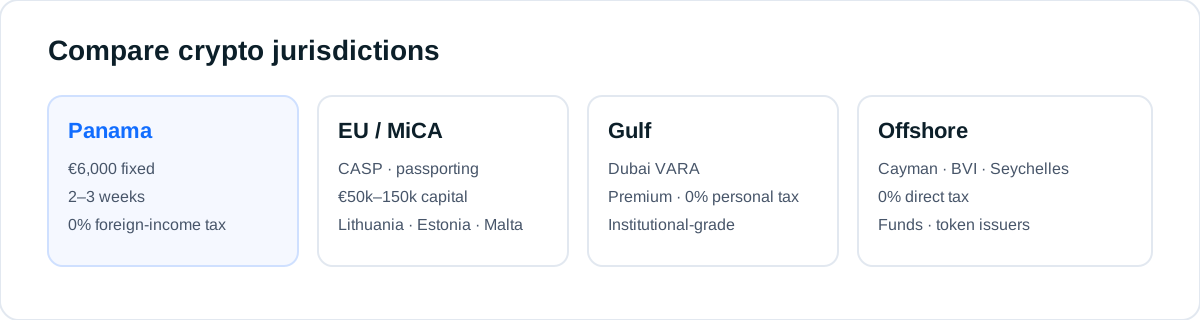
Canada's approach to crypto regulation is mature but distinct from the EU's MiCA regime. While Canada does not have a single federal crypto license, it requires registration as a Money Services Business (MSB) with the Financial Transactions and Reports Analysis Centre of Canada (FINTRAC) and, for certain activities, registration as a securities dealer with provincial securities regulators. For founders considering multiple jurisdictions, Panama offers a simpler, flat-fee structure at EUR 6,000, which we compare later.
This guide covers the key aspects of establishing a crypto banking operation in Canada, including who needs registration, the regulatory bodies involved, costs, timelines, capital requirements, tax treatment, allowed activities, the step-by-step process, banking and payment options, benefits, compliance obligations, common mistakes, and a comparison with other jurisdictions like Panama and Lithuania.
What is Crypto Banking in Canada?
Crypto banking in Canada refers to the provision of financial services such as custody, exchange, lending, and payment processing involving cryptocurrencies by regulated entities. Unlike traditional banking, crypto banking often involves digital assets and must comply with anti-money laundering (AML) and securities laws. The primary regulator is FINTRAC for AML compliance, while securities regulation falls under provincial bodies like the Canadian Securities Administrators (CSA).
Key characteristics of the Canadian crypto banking market in 2026 include:
- Mandatory MSB registration with FINTRAC for any entity dealing in virtual currency.
- Provincial securities registration for platforms offering crypto assets that are deemed securities.
- No federal crypto-specific license, but a patchwork of regulations that founders must work through.
- Strict KYC and AML requirements, including reporting of suspicious transactions.
- Active enforcement by regulators, with fines for non-compliance.
Canada's regulatory framework is designed to prevent money laundering and terrorist financing while supporting innovation. However, the lack of a single license and the involvement of multiple provincial regulators can create complexity. For a more streamlined approach, some founders opt for jurisdictions like Panama, which offers a single flat-fee license.
Who Needs a Crypto Banking License in Canada?
Any business that offers services involving virtual currencies such as exchanges, wallet providers, payment processors, or custodians must register as an MSB with FINTRAC. Additionally, if the platform facilitates trading of crypto assets that meet the legal definition of a security, it must register as a securities dealer with the relevant provincial regulator.
Founders should consider Canada if they target Canadian users or want to establish a presence in North America. However, the regulatory complexity can be high. Examples of businesses that need registration include:
- Cryptocurrency exchanges (centralized and decentralized if operating in Canada).
- Over-the-counter (OTC) trading desks.
- Cryptocurrency ATMs.
- Wallet providers that hold private keys.
- Payment processors that facilitate crypto transactions.
For those seeking a more straightforward path, jurisdictions like Panama offer a flat-fee license with no capital requirements, which we discuss in the alternatives section. Consulting24 helps founders choose the right route and set up where we operate directly, such as Estonia and Lithuania.
License Type & Regulator
Canada does not have a single 'crypto license' but rather a combination of registrations:
- FINTRAC MSB Registration: Required for any entity dealing in virtual currency. This is a federal requirement under the Proceeds of Crime (Money Laundering) and Terrorist Financing Act.
- Provincial Securities Registration: Required if the crypto assets offered are considered securities. The CSA provides guidance, but each province has its own securities commission (e.g., Ontario Securities Commission, British Columbia Securities Commission).
The primary regulator for AML is FINTRAC. For securities, the provincial regulators are key. There is no single national regulator for crypto banking. In 2026, the regulatory framework remains fragmented, but efforts are underway to harmonize through the CSA. Founders must comply with both federal and provincial requirements, which can be time-consuming.
For comparison, under the EU's MiCA regime (fully in force in 2026), there is a single passportable license with capital tiers of EUR 50,000, 125,000, or 150,000 depending on service class. Canada's approach is more decentralized.
Cost & Timeline
The cost of setting up a crypto banking operation in Canada varies by province and complexity. Below is a detailed estimate as of 2026:
| Item | Cost (CAD) | Notes |
|---|---|---|
| FINTRAC MSB registration | No fee, but compliance costs (AML program, reporting) can be CAD 10,000-30,000 | Includes developing policies, procedures, and risk assessment |
| Provincial securities registration | CAD 5,000-20,000 per province (filing fees, legal) | Varies by province; Ontario is typically more expensive |
| Legal & compliance setup | CAD 20,000-50,000 | Includes lawyer fees, compliance officer training, and audit |
| Ongoing annual compliance | CAD 10,000-30,000 | Annual audit, reporting, and regulatory filings |
| Total initial outlay (estimated) | CAD 35,000-100,000+ | Depending on scope and province |
Timeline: FINTRAC registration can take 3-6 months. Provincial securities registration can add another 3-6 months. Total timeline: 6-12 months. For a faster and cheaper alternative, Panama's cost is a flat EUR 6,000 with a timeline of 4-6 weeks. Consulting24 delivers Panama licenses directly.
Capital Requirement
Canada does not impose a specific minimum capital requirement for MSB registration. However, provincial securities regulators may require minimum capital depending on the activities (e.g., for dealer registration, typically CAD 25,000-100,000). Additionally, FINTRAC expects adequate financial resources to operate. In practice, founders should have at least CAD 50,000 in liquid capital to cover setup and compliance costs.
This contrasts with EU jurisdictions under MiCA, where capital tiers of EUR 50,000, 125,000, or 150,000 apply depending on service class. Canada's approach is less prescriptive but requires proof of financial stability. For example, if you plan to offer custodial services, you may need to demonstrate sufficient insurance or bonding.
For founders seeking no capital requirement, Panama is an attractive option, as it has no minimum capital for the license.
Tax Treatment
Canada treats cryptocurrency as a commodity for income tax purposes. The Canada Revenue Agency (CRA) considers crypto transactions as barter transactions, and any gain or loss is generally treated as capital gain or business income, depending on the activity. Mining is considered business income. GST/HST applies to crypto transactions in certain cases.
Key tax points:
- Capital gains tax: 50% of gain included in income (for individuals).
- Business income: fully taxable.
- Corporate tax rate: federal 15% + provincial (11-16%), effective ~26-31%.
- GST/HST: Generally applies to crypto transactions if the business is a GST/HST registrant.
Founders should consult a tax advisor. For those seeking tax efficiency, Panama offers territorial taxation (no tax on foreign-source income). Canada's tax regime can be burdensome for crypto businesses with international operations.
Allowed Activities
Under Canadian regulation, registered entities can engage in:
- Exchange of virtual currency for fiat or other virtual currency.
- Virtual currency transfer services.
- Custodial wallet services.
- Payment processing using virtual currency.
- Initial coin offerings (ICOs) if compliant with securities laws.
Activities that are not allowed without proper registration include: dealing in securities without a dealer license, operating an unregistered exchange, and failing to report suspicious transactions. Canada prohibits anonymous crypto accounts and requires full KYC for all transactions. Additionally, certain activities like crypto lending may be subject to securities regulation if the lending involves securities.
Founders should carefully review the CSA's guidance on crypto assets. For a broader range of allowed activities with less restriction, consider Lithuania under MiCA, which allows a full suite of CASP services.
Step-by-Step Process
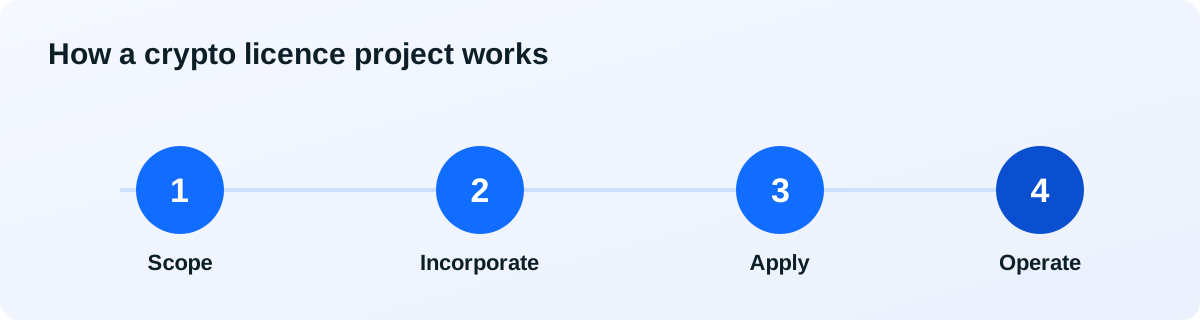
- Business Structure: Incorporate federally or provincially (e.g., Ontario, British Columbia). Choose a structure that suits your operations.
- AML Program: Develop a compliant AML/ATF program, including policies, procedures, and risk assessment. This must be tailored to your business.
- FINTRAC Registration: Submit an MSB registration application online. Include details of the business, ownership, and AML program. Expect a review period of 3-6 months.
- Provincial Securities Registration: If applicable, apply to the relevant securities commission for dealer or marketplace registration. This can take another 3-6 months.
- Banking Relationship: Open a corporate bank account with a Canadian bank that accepts crypto businesses (limited options). Prepare for thorough due diligence.
- Ongoing Compliance: File annual reports, suspicious transaction reports, and maintain records. Appoint a compliance officer and conduct regular training.
For a detailed breakdown, see our application process guide. Consulting24 advises on the process and can coordinate with local partners for jurisdictions we do not deliver directly.
Banking & Payments
Securing a bank account in Canada for crypto businesses is challenging but possible. Major banks like RBC, TD, and CIBC have restrictive policies, but some credit unions and smaller banks are more open. As of 2026, there are a few crypto-friendly banks, but most require a strong compliance framework and a track record.
Payment processors: Canadian crypto businesses can use services like Stripe, Square, or specialized crypto payment gateways. However, many traditional payment providers are cautious. Founders should prepare for a thorough due diligence process, including providing business plans, AML policies, and proof of registration.
For a more banking-friendly environment, Estonia offers a well-established e-residency program and easier access to banking for crypto firms. Consulting24 can help set up banking relationships in Estonia and Lithuania.
Benefits of Crypto Banking in Canada
- Regulatory Clarity: Canada has clear AML rules and securities guidance, reducing uncertainty.
- Stable Economy: Canada's political and economic stability attracts businesses.
- Access to North American Market: Canada serves as a gateway to the US market.
- Skilled Workforce: Strong tech talent pool.
- Government Support: Some provinces offer incentives for fintech innovation.
However, the regulatory burden is high. For a lighter alternative, consider Lithuania or Panama. Consulting24 helps founders evaluate the trade-offs.
Compliance & Trust
Compliance is critical in Canada. FINTRAC conducts regular audits, and non-compliance can result in fines or license revocation. Key requirements:
- Appoint a compliance officer.
- Conduct ongoing employee training.
- Perform annual independent audit of AML program.
- Report suspicious transactions within 30 days.
- Maintain records for at least 5 years.
This is general guidance, not legal advice. Consult a Canadian lawyer for your specific situation. Building trust with regulators and banks requires a proactive approach to compliance. For a jurisdiction with a simpler compliance regime, Panama has fewer ongoing requirements.
Common Mistakes
- Underestimating Provincial Requirements: Many founders focus only on FINTRAC and ignore provincial securities laws. This can lead to enforcement actions.
- Inadequate AML Program: A generic AML policy will not pass FINTRAC scrutiny. It must be tailored to your business model.
- Delaying Bank Account Setup: Banking is a bottleneck; start early and be prepared for a lengthy process.
- Ignoring Tax Obligations: CRA is active in crypto audits. Ensure proper tax reporting.
- Assuming a Single License: Canada's multi-regulator approach requires multiple registrations; plan accordingly.
Avoid these pitfalls by working with an experienced consultant. Our blog has more insights. Consulting24 provides guidance to help founders work through these challenges.
Alternatives: Canada vs Panama and Other Jurisdictions
For founders weighing their options, here is a comparison:
| Jurisdiction | Cost | Timeline | Capital Requirement | Tax | License Type |
|---|---|---|---|---|---|
| Canada | CAD 35,000-100,000+ | 6-12 months | No fixed minimum, but ~CAD 50,000 practical | ~26-31% corporate tax | MSB + provincial securities |
| Panama | EUR 6,000 flat | 4-6 weeks | None | Territorial (no tax on foreign income) | Fintech license |
| Lithuania (under MiCA) | EUR 5,000-15,000 | 3-6 months | EUR 50,000-150,000 (by service class) | 15% corporate tax | CASP license |
| Estonia | EUR 3,000-10,000 | 1-3 months | EUR 12,000 (share capital) | 20% corporate tax (distributed profits) | VASP license |
Canada offers a strong regulatory environment but at a higher cost and complexity. Panama provides a faster, cheaper alternative with no capital requirement and territorial tax. For EU access, Lithuania or Estonia are viable under MiCA. Compare Canada vs Lithuania for more details. Consulting24 delivers directly in Panama, Estonia, and Lithuania, and advises on other jurisdictions.
Frequently asked questions
Is a crypto banking license required in Canada?
Canada does not issue a specific crypto banking license. Instead, businesses must register as an MSB with FINTRAC and, if dealing in securities, register with provincial securities regulators. This dual registration is mandatory for crypto exchanges and wallet providers.
How long does it take to get regulatory approval in Canada?
FINTRAC registration typically takes 3-6 months. Provincial securities registration can add another 3-6 months, so total timeline is 6-12 months. This is longer than in Panama (4-6 weeks) or Estonia (1-3 months).
What are the capital requirements for crypto businesses in Canada?
There is no federal minimum capital requirement, but provincial securities regulators may require CAD 25,000-100,000. In practice, founders should have at least CAD 50,000 in liquid capital to cover setup and compliance costs.
What is the tax rate for crypto businesses in Canada?
Canada's corporate tax rate is approximately 26-31% (federal 15% plus provincial 11-16%). Cryptocurrency is treated as a commodity, and gains are taxed as capital gains or business income. This is higher than in Panama (territorial tax) or Lithuania (15%).
Can I operate a crypto exchange in Canada without a license?
No. Operating a crypto exchange without FINTRAC registration and, if applicable, provincial securities registration is illegal. Penalties include fines and potential criminal charges.
What activities are allowed under Canadian crypto regulation?
Allowed activities include exchange, transfer, custody, and payment processing of virtual currencies. ICOs are allowed if compliant with securities laws. Anonymous transactions are prohibited.
How do I get a bank account for my crypto business in Canada?
Securing a bank account is challenging. Approach credit unions or smaller banks that are more open to crypto. Prepare a strong AML program and be ready for extensive due diligence.
What are the common compliance mistakes in Canada?
Common mistakes include ignoring provincial requirements, using a generic AML program, delaying bank account setup, and neglecting tax obligations. These can lead to regulatory issues.
How does Canada compare to Panama for crypto licensing?
Canada has higher costs (CAD 35,000+), longer timelines (6-12 months), and higher taxes. Panama offers a flat EUR 6,000 fee, 4-6 week timeline, no capital requirement, and territorial tax. Panama is simpler but Canada offers access to a large market.
Is Canada part of the EU's MiCA regime?
No, Canada is not part of the EU. MiCA applies only to EU member states. Canada has its own regulatory framework, which is not harmonized with MiCA.
Can Consulting24 help with Canadian crypto licensing?
Consulting24 advises and coordinates for Canada but does not deliver directly. We deliver directly in Panama, Estonia, and Lithuania. We can help you choose the right jurisdiction and set up where we operate.
Official sources
Related jurisdictions

Talk to a crypto-licensing expert
500+ licenses across Estonia, Lithuania, Panama and beyond. Tell us your model and we'll map the right route, honestly.
💬 Talk to an expertFree consultationGeneral guidance, not legal advice. Rules and fees evolve, and we confirm current requirements for your case.