Crypto Banking in BVI: What Founders Should Expect

The British Virgin Islands (BVI) has long been a hub for offshore financial services, and in 2026 it is positioning itself as a credible jurisdiction for crypto banking. For founders seeking a stable, tax-neutral environment with a familiar common law system, BVI offers a regulated pathway for digital asset businesses. However, the market is evolving, and understanding the nuances of BVI's approach is critical before committing resources.
This guide provides a clear, factual overview of crypto banking in BVI, covering the regulatory framework, costs, timelines, and practical considerations. We compare BVI with other leading jurisdictions like Panama, Lithuania, and Estonia, drawing on Consulting24's direct experience delivering licences in the latter two and coordinating globally. Whether you are launching a crypto exchange, a payment processor, or a custody service, this page will help you assess whether BVI is the right fit for your venture.
Consulting24 advises founders on the best route for their specific needs. While we deliver directly in Estonia, Lithuania, and Panama, we coordinate with local partners for other jurisdictions including BVI. Our goal is to provide honest, up-to-date information so you can make an informed decision.
What Is Crypto Banking in BVI?
In the BVI context, crypto banking refers to the provision of financial services involving digital assets under the oversight of the BVI Financial Services Commission (FSC). This includes operating a virtual asset service provider (VASP) business, such as exchanging, transferring, or custodian services. Unlike some jurisdictions that have created a separate 'crypto licence', BVI integrates digital asset regulation into its existing financial services framework, primarily through the Securities and Investment Business Act (SIBA) and the Virtual Asset Service Provider Act (VASP Act) enacted in 2022.
The BVI has a well-established reputation for company incorporation, but its crypto banking regime is still maturing. The FSC applies a risk-based approach, requiring applicants to demonstrate strong AML/CFT controls, fit and proper management, and adequate capital. While BVI does not offer a dedicated 'banking licence' for crypto, licensed VASPs can offer services that functionally resemble banking, such as custodial wallets and payment processing.
Who Needs a Crypto Banking Licence in BVI?
Any business that provides virtual asset services to BVI residents or from within BVI must obtain a licence. This includes:
- Cryptocurrency exchanges (centralised and decentralised)
- Digital asset custodians
- Payment processors handling virtual assets
- Brokers and dealers in virtual assets
- Operators of crypto ATMs
- Issuers of stablecoins or tokenised assets
If your business only targets non-BVI clients and does not have a physical presence in BVI, you may not need a licence, but legal advice is essential. Many founders choose BVI as a corporate domicile while obtaining a licence elsewhere, such as Lithuania or Estonia, where the regulatory process is more straightforward.
License Type and Regulator
The primary regulator is the BVI Financial Services Commission (FSC). The main licence type for crypto banking is the VASP licence under the VASP Act 2022. There are two categories:
- Class 1: For businesses that only facilitate the exchange of virtual assets for fiat or other virtual assets (no custody).
- Class 2: For businesses that provide custodial services, including wallet services and safekeeping of virtual assets.
Class 2 licences require higher capital and more stringent operational requirements. The FSC also requires that the company be incorporated in BVI and have a registered office and a local director or manager in some cases. The regulator conducts a thorough review of the business plan, AML policies, and the background of key personnel.
Cost and Timeline
| Item | Estimated Cost (USD) | Notes |
|---|---|---|
| Application fee | $5,000 - $10,000 | Non-refundable |
| Licence fee (annual) | $10,000 - $20,000 | Varies by class |
| Legal and compliance setup | $15,000 - $30,000 | Depending on complexity |
| Registered office and agent | $2,000 - $5,000 per year | Mandatory |
| Total initial outlay | $30,000 - $60,000 | Excluding capital deposit |
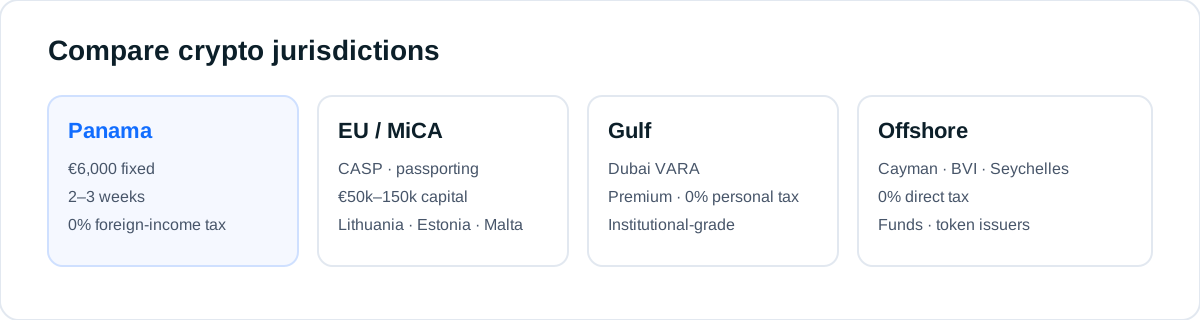
Timeline: 4-8 months from application to approval, assuming complete documentation. The FSC does not have a fixed timeline, and delays can occur if additional information is requested. For comparison, Panama offers a flat fee of EUR 6,000 with a faster process (2-4 months) for its crypto licence, though Panama's regulatory framework is less prescriptive.
Capital Requirement
BVI imposes a minimum capital requirement that varies by licence class. As of 2026, the FSC requires:
- Class 1: Minimum capital of $50,000 (or equivalent in other currencies).
- Class 2: Minimum capital of $100,000.
This capital must be maintained at all times and can be in fiat or highly liquid assets. The FSC may require a higher amount based on the business volume and risk profile. In contrast, Lithuania under MiCA requires EUR 50,000-150,000 depending on service type, while Estonia has no minimum capital but requires a 0.25% guarantee deposit. Panama has no formal capital requirement, making it attractive for startups.
Tax Treatment
BVI is a zero-tax jurisdiction for most business activities. There is no corporate income tax, capital gains tax, or withholding tax on dividends or interest. However, businesses must pay an annual licence fee and a registration fee. There is no VAT on crypto services, though the FSC may impose levies for regulatory oversight.
This tax neutrality is a major draw for crypto founders, but it comes with obligations: companies must file annual returns and maintain proper accounting records. The BVI is on the EU's grey list for tax cooperation, which may affect cross-border transactions with EU counterparties. For founders seeking a fully compliant EU base, Lithuania offers a 15% corporate tax rate with incentives for startups, while Estonia taxes only distributed profits at 20%.
Allowed Activities
Under the VASP Act, licensed entities can engage in the following activities:
- Exchange between virtual assets and fiat currencies
- Exchange between one or more forms of virtual assets
- Transfer of virtual assets (on behalf of clients)
- Custodial and wallet services
- Participation in and provision of financial services related to an issuer's offer or sale of a virtual asset
Activities that are not covered include issuing virtual assets (requires a separate prospectus under SIBA), operating as a crypto bank that accepts deposits and lends (banking licence required), and derivatives trading (regulated under SIBA). The FSC prohibits anonymous transactions and requires all clients to be KYC-verified.
Step-by-Step Application Process
- Pre-incorporation: Reserve a company name and incorporate a BVI business company (BC) with a registered agent.
- Document preparation: Draft a detailed business plan, AML/KYC policies, risk assessment, and financial projections.
- Appoint local representatives: Engage a BVI-licensed registered agent and, if required, a local director or manager.
- Submit application: File the VASP licence application with the FSC, including all supporting documents and the application fee.
- FSC review: The FSC reviews the application, conducts background checks on directors and shareholders, and may request additional information.
- Interview (if needed): Key personnel may be asked to attend an interview with the FSC.
- Approval and licensing: Upon approval, pay the licence fee and receive the licence certificate.
- Ongoing compliance: File annual returns, maintain capital, and submit periodic reports to the FSC.
Consulting24 can advise on this process and coordinate with local partners in BVI. For a more streamlined approach, consider Panama where we handle the entire process directly.
Banking and Payment Partners
Opening a corporate bank account in BVI can be challenging for crypto businesses, as many traditional banks are wary of digital assets. However, BVI has a few local banks that accept VASP-licensed companies, such as FirstBank BVI and VP Bank (BVI) Ltd. Additionally, some international banks with a presence in the Caribbean may offer services.
For payment processing, founders often rely on third-party payment gateways that support crypto-to-fiat conversion. BVI-licensed VASPs can also partner with EU-licensed payment institutions for better access to SEPA and SWIFT networks. If banking is a primary concern, Lithuania offers a more mature banking environment for crypto firms, with several fintech-friendly banks and EMI licences available.
Benefits of BVI for Crypto Banking
- Tax neutrality: Zero corporate tax, no capital gains, no VAT on crypto services.
- Common law system: Legal framework familiar to international investors, with strong asset protection.
- Established infrastructure: A well-developed corporate services sector, including registered agents and legal firms.
- Privacy: BVI does not have a public register of beneficial owners, though it must share information with foreign tax authorities under international agreements.
- No exchange controls: Free movement of capital in and out of BVI.
However, these benefits come with higher costs and longer timelines compared to Panama, which offers a flat fee of EUR 6,000 and faster processing.
Compliance and Trust Considerations
BVI's regulatory framework is designed to meet international standards, but it is not yet fully aligned with MiCA or FATF recommendations. The FSC expects licensees to implement strong AML/CFT programmes, including transaction monitoring, sanction screening, and suspicious activity reporting. Non-compliance can result in fines, suspension, or revocation of the licence.
Founders should also be aware that BVI is on the EU's list of non-cooperative jurisdictions for tax purposes (grey list), which may affect business relationships with EU counterparties. This does not preclude licensing but may require additional due diligence. As always, this is general guidance, not legal advice. Consult with a qualified attorney before proceeding.
Common Mistakes to Avoid
- Underestimating costs: The total initial outlay can exceed $50,000, not including ongoing compliance costs.
- Incomplete documentation: The FSC requires a detailed business plan and AML policies; generic templates are often rejected.
- Ignoring local presence: BVI requires a registered agent and may require a local director; failing to arrange this delays the process.
- Assuming banking is easy: Many banks still refuse crypto clients; secure banking arrangements before applying.
- Overlooking tax implications: While BVI is tax-neutral, founders may still be taxable in their home country.
To avoid these pitfalls, many founders choose to work with an experienced advisor like Consulting24, who can guide them through the process or recommend alternative jurisdictions such as Panama or Lithuania.
Alternatives and Comparisons
BVI is one of several jurisdictions for crypto banking. Here is how it compares to other popular options:
| Jurisdiction | Cost | Timeline | Capital | Tax |
|---|---|---|---|---|
| BVI | $30,000 - $60,000 | 4-8 months | $50,000 - $100,000 | 0% corporate tax |
| Panama | EUR 6,000 flat | 2-4 months | None | 0% on offshore income |
| Lithuania | EUR 10,000 - 20,000 | 3-6 months | EUR 50,000 - 150,000 | 15% corporate tax |
| Estonia | EUR 10,000 - 15,000 | 2-4 months | None (guarantee deposit) | 20% on distributed profits |
Panama offers the lowest cost and fastest timeline, with no capital requirement, making it ideal for startups. Lithuania and Estonia provide EU passporting under MiCA, offering broader market access. BVI is best for founders who prioritise tax neutrality and privacy and are willing to invest more time and money.
Why Work with Consulting24?
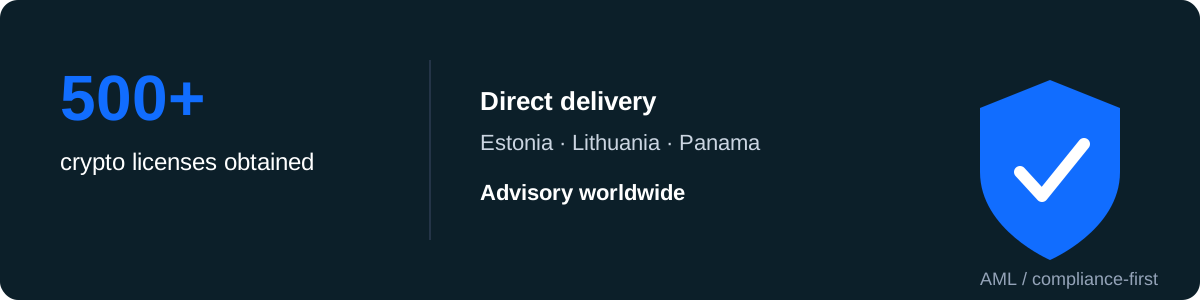
Consulting24 has obtained over 500 crypto licences worldwide, with direct delivery in Estonia, Lithuania, and Panama. For BVI, we advise and coordinate with local legal partners to ensure a smooth process. Our team provides end-to-end support, from jurisdiction selection to application preparation and banking introductions.
We do not guarantee approval, but we give you the best chance by ensuring your documentation is complete and compliant. If BVI does not suit your needs, we can help you choose from other jurisdictions we serve. Contact us today to discuss your project.
Frequently asked questions
What is the minimum capital for a BVI crypto licence?
Class 1 (exchange only) requires $50,000, and Class 2 (custody) requires $100,000. The FSC may require more based on business volume.
How long does it take to get a BVI crypto licence?
Typically 4-8 months, depending on the completeness of your application and the FSC's workload. Delays are common if additional information is needed.
Can I use a BVI company to serve EU clients?
Yes, but you must comply with EU AML regulations and MiCA if you target EU residents. BVI is on the EU grey list, which may complicate partnerships.
Is BVI tax-free for crypto businesses?
BVI has no corporate income tax, capital gains tax, or VAT on crypto services. However, you must pay annual licence fees and may be taxed in your home country.
Do I need a physical office in BVI?
You need a registered office and a registered agent in BVI. A physical office is not mandatory, but you may need a local director or manager.
What activities are not allowed under a BVI VASP licence?
You cannot issue virtual assets (requires a prospectus), accept deposits and lend (banking licence), or trade derivatives (SIBA regulated).
How does BVI compare to Panama for crypto licensing?
Panama costs EUR 6,000 flat, has no capital requirement, and takes 2-4 months. BVI is more expensive and slower but offers a more established legal framework.
Can I open a bank account for my BVI crypto company?
Yes, but it is challenging. Banks like FirstBank BVI and VP Bank accept licensed VASPs. You may also use international banks or EMIs.
Is BVI compliant with FATF standards?
BVI has implemented AML/CFT measures and is a member of the FATF-style regional body CFATF. However, it remains on the EU grey list.
What happens if I operate without a licence in BVI?
Unlicensed VASP activity is illegal and can result in fines, imprisonment, or both. The FSC actively monitors for non-compliance.
Official sources
Related jurisdictions

Talk to a crypto-licensing expert
500+ licenses across Estonia, Lithuania, Panama and beyond. Tell us your model and we'll map the right route, honestly.
💬 Talk to an expertFree consultationGeneral guidance, not legal advice. Rules and fees evolve, and we confirm current requirements for your case.