Crypto Banking and Payment Rails in Estonia: What to Expect in 2026

For crypto firms licensed in Estonia, securing reliable banking and payment rails is a critical operational challenge. Estonia's progressive regulatory framework, combined with its e-Residency program, has made it a hub for crypto innovation. However, the sector for crypto banking in 2026 is shaped by stricter compliance requirements under MiCA and local AML rules. This guide explains what licensed crypto businesses can expect when opening bank accounts, integrating payment processors, and managing fiat on/off ramps in Estonia.
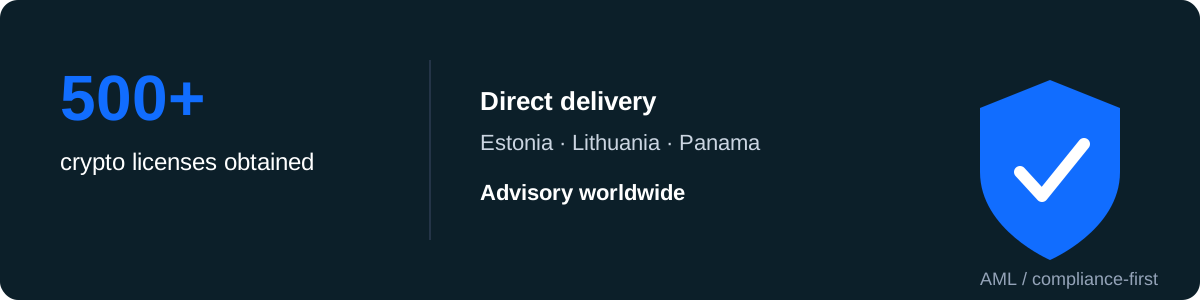
Whether you are a new applicant or an existing licensee, understanding the available banking options and their requirements is essential for smooth operations. Consulting24 has helped over 500 crypto firms work through these challenges, and we share practical insights below. For a comprehensive overview of licensing, visit our jurisdictions page.
Estonia remains a top choice for EU crypto licensing, but banking access is often the bottleneck. This guide covers everything from capital requirements to tax treatment, helping you plan your banking strategy effectively. We also compare Estonia with alternatives like Panama for firms seeking simpler banking setups.
What Are Crypto Banking and Payment Rails?
Crypto banking and payment rails refer to the infrastructure that allows crypto businesses to hold, send, and receive fiat currency (EUR, USD) and integrate with traditional financial systems. This includes business bank accounts, payment gateway providers, and virtual IBAN services. In Estonia, licensed crypto asset service providers (CASPs) need these rails to process client deposits, pay operational costs, and convert crypto to fiat.
Without proper banking, a crypto firm cannot operate legally or efficiently. Estonia's regulated environment means that banks and payment providers are more willing to work with licensed entities, but they still apply rigorous due diligence. The specific services required depend on your business model. For example, an exchange needs both incoming and outgoing fiat capabilities, while a wallet provider may only require a single account for operational expenses.
Payment rails also include infrastructure for instant payments, SEPA transfers, and SWIFT. In 2026, many providers offer API-based integration, allowing automated fiat-crypto conversions. Some firms use multiple providers to ensure redundancy. The choice of provider affects transaction fees, settlement times, and geographic reach. For instance, a firm serving EU clients may prioritise SEPA-compliant providers, while a global exchange may need SWIFT and multi-currency accounts.
Who Needs Crypto Banking in Estonia?
Any crypto business licensed in Estonia requires banking or payment rails. This includes:
- Cryptocurrency exchanges (buy/sell platforms)
- Wallet providers
- OTC desks
- Crypto payment processors
- Token issuers
Even firms that operate solely in crypto need some fiat access for tax payments, salaries, and fees. For startups, securing a bank account is often the first major hurdle after obtaining a license. Without it, you cannot on-board clients who want to deposit fiat or withdraw euros. The need is immediate and ongoing.
Additionally, firms that engage in DeFi or staking may still need fiat accounts for operational expenses. Even if your business model is purely crypto-to-crypto, you will eventually need to convert to fiat for payroll or vendor payments. Banks also require a fiat account to hold the minimum capital required by the license. Therefore, every licensed firm, regardless of its specific activities, must secure at least one banking relationship.
License Type and Regulator
Estonia's crypto license is issued by the Financial Intelligence Unit (FIU) under the Money Laundering and Terrorist Financing Prevention Act. As of 2026, this license is aligned with MiCA requirements for CASPs. The license allows activities such as exchange services, wallet provision, and transfer services. The regulator is the Estonian FIU, which also oversees AML compliance. For more details on the license itself, see our Estonia crypto license page.
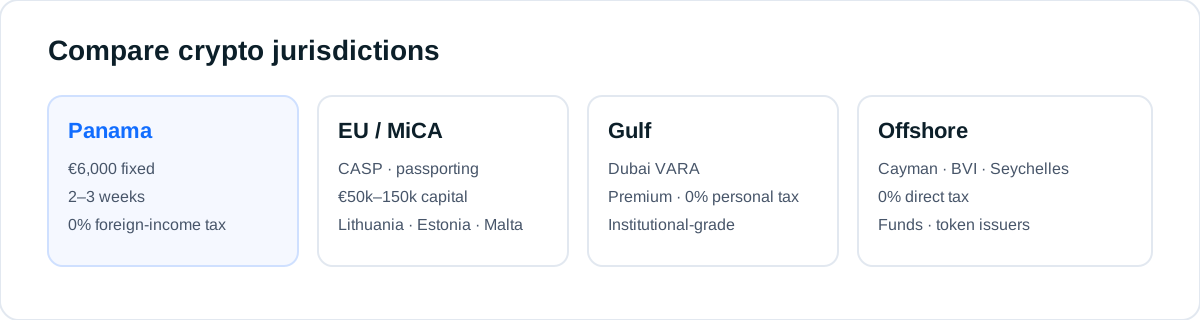
Under MiCA, capital requirements are tiered: EUR 50,000 for basic services, EUR 125,000 for exchanges, and EUR 150,000 for custodial wallets. These figures are mandatory and affect banking access, as banks often require proof of capital. The FIU also requires that the licensed entity have a physical presence in Estonia, including a registered office and a local AML officer. This presence can help build trust with banks, as they prefer to deal with locally established firms.
Cost and Timeline for Banking Integration
Opening a bank account for a crypto firm in Estonia typically takes 2-6 months, depending on the provider and the firm's compliance readiness. Costs vary by provider and account type. Below is a typical breakdown:
| Item | Cost (EUR) | Timeline |
|---|---|---|
| Account setup fee | 500 - 2,000 | 1-2 weeks |
| Monthly maintenance | 100 - 500 | Ongoing |
| Compliance review fee | 1,000 - 5,000 | 1-2 months |
| Virtual IBAN setup | 0 - 1,000 | 1-3 weeks |
| Payment gateway integration | 1,000 - 10,000 | 1-3 months |
| Annual compliance audit | 2,000 - 8,000 | Ongoing |
These figures are estimates; exact pricing is confirmed during consultation. Consulting24 can introduce you to vetted banking partners. Additional costs may include legal fees for contract review and ongoing compliance software subscriptions (e.g., for transaction monitoring). Some providers charge per-transaction fees (e.g., 0.5-2% of volume), which can add up for high-volume exchanges.
Timeline depends on the provider's due diligence process. Traditional banks like LHV may take 3-6 months, while neobanks like Revolut Business can open accounts in weeks but may restrict crypto-related transactions. It is wise to start the banking application as soon as you have your license, or even during the application process if the bank accepts a conditional approval.
Capital Requirement for Banking Access
Estonia's crypto license does not impose a statutory minimum capital for most activities, but banks often require a minimum deposit or capital base (e.g., EUR 50,000) to open an account. Under MiCA, capital requirements are tiered: EUR 50,000 for basic services, EUR 125,000 for exchanges, and EUR 150,000 for custodial wallets. Banks may also require proof of paid-up capital. For a full breakdown of capital rules, see our requirements page.
In practice, a new firm should have at least EUR 100,000 in capital to satisfy both regulatory and banking requirements. This capital must be held in a bank account, which creates a chicken-and-egg problem: you need a bank account to hold capital, but banks require capital to open an account. Consulting24 can help you work through this by introducing you to banks that accept staged deposits or by using a temporary account with a payment processor.
Some banks also require that the capital be held in a segregated account or that the firm maintains a minimum average balance. Failure to meet these requirements can lead to account closure. Therefore, it is essential to plan your capital structure carefully before approaching banks.
Tax Treatment of Crypto Banking
Estonia has a unique corporate tax system: profits are taxed only when distributed (0% on retained earnings). For crypto businesses, this means no corporate income tax on reinvested profits. However, VAT may apply to certain services, and personal income tax applies to salaries and dividends. Crypto-to-crypto trades are generally tax-free for corporations. Always consult a local tax advisor for your specific situation.
When using payment rails, consider that conversion fees and transaction costs may be deductible. Estonia also has a withholding tax on dividends (20% at source), but this can be reduced under tax treaties. For a detailed analysis, see our blog on crypto taxation.
Interest earned on fiat deposits is taxable as income. Similarly, any gains from forex trading (e.g., converting EUR to USD) may be subject to tax. It is important to maintain accurate records of all transactions, as the tax authority may request them during an audit. Using a dedicated accounting software for crypto can simplify this process.
Allowed Activities with Payment Rails
With a valid license and banking, you can conduct the following activities:
- Accept fiat deposits from clients
- Process withdrawals to client bank accounts
- Convert crypto to fiat and vice versa
- Issue virtual IBANs for clients
- Integrate with payment gateways (e.g., Stripe, Checkout.com)
Note that not all banks allow all activities; some restrict high-risk transactions. It is vital to disclose your business model upfront. For example, if you plan to offer margin trading or derivatives, additional licensing may be required. Always confirm with your bank which activities are permitted under your account terms.
Some banks may prohibit transactions with certain high-risk jurisdictions or require enhanced due diligence for large transfers. It is also common for banks to set transaction limits (e.g., EUR 100,000 per day) and require pre-approval for larger amounts. Understanding these restrictions in advance helps avoid operational disruptions.
Step-by-Step Process to Secure Banking
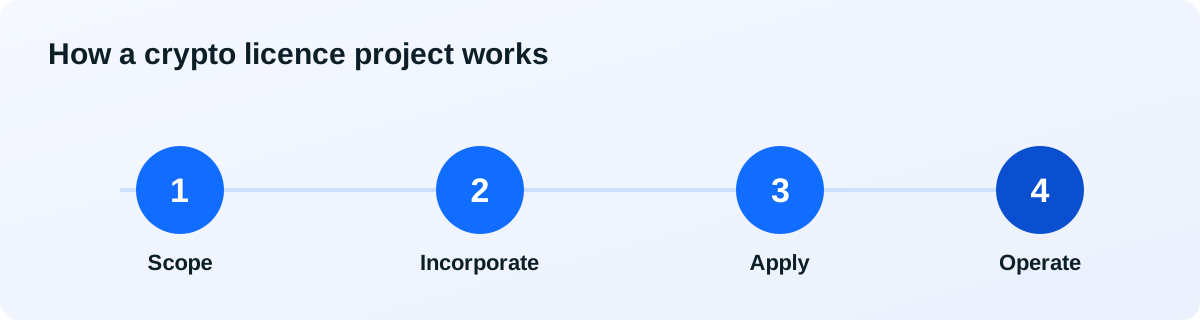
- Obtain your crypto license from the Estonian FIU. Consulting24 can assist with the application process.
- Prepare compliance documentation: AML policies, risk assessment, business plan, source of funds, and corporate structure.
- Approach banks or payment providers: Use our network of crypto-friendly banks in Estonia and Lithuania.
- Undergo due diligence: Provide all requested documents, including beneficial ownership details.
- Sign account agreement and set up technical integration (API, IBAN).
- Test transactions with small amounts before going live.
For a detailed application guide, visit our application process page. Expect each step to take 2-4 weeks, with the entire process lasting up to 6 months. Rushing often leads to rejection. It is advisable to have a dedicated compliance officer who can respond to bank queries promptly. Some banks also require an in-person meeting at their office, which can be conducted via video call if physical presence is not mandatory.
After account opening, maintain regular communication with your bank relationship manager. Notify them of any significant changes in your business model or transaction volumes. Proactive communication reduces the risk of account freezes or closures.
Banking and Payment Providers in Estonia
As of 2026, the following types of providers serve crypto firms in Estonia:
- Traditional banks: LHV, SEB, Swedbank (limited appetite, high compliance bar)
- Neobanks: Revolut Business, Wise (some restrictions on crypto)
- Payment processors: Stripe, Coinbase Commerce, BitPay
- Virtual IBAN providers: Clear Junction, Modulr, PayrNet
Many firms also use Lithuanian banks due to Estonia's stricter environment. Compare options on our vs Lithuania page. LHV is often the first choice for Estonian licensees, but they require a minimum deposit of EUR 50,000 and a detailed business plan. Neobanks like Revolut Business may restrict crypto inflows or outflows, so read their terms carefully.
Payment processors like Stripe allow crypto businesses to accept credit card payments, but they may impose rolling reserves or charge higher fees. Virtual IBAN providers offer multi-currency accounts that can be integrated via API, enabling automated fiat-crypto conversions. Some providers specialise in serving crypto firms and have faster onboarding processes. Consulting24 maintains a curated list of providers that have a proven track record with Estonian licensees.
Benefits of Estonia for Crypto Banking
Estonia offers several advantages:
- e-Residency: Allows remote company management and digital banking.
- Progressive regulation: Clear licensing framework under FIU.
- EU passporting: Licensed firms can serve clients across the EU.
- Low corporate tax: 0% on retained earnings.
However, banking access remains challenging, which is why many firms also consider Panama as an alternative jurisdiction with simpler banking. Panama offers a flat EUR 6,000 company setup, no capital gains tax, and more accessible banking for crypto firms. For a full comparison, see our jurisdictions page.
Estonia's digital infrastructure also includes X-Road, which allows secure data exchange between businesses and government agencies. This can streamline compliance reporting and KYC verification. Additionally, the e-Residency digital ID enables remote signing of contracts and banking documents, reducing the need for physical presence.
Compliance and Trust Requirements
Banks require strong AML/KYC procedures. Your firm must have:
- Written AML policy
- Risk assessment methodology
- Transaction monitoring system
- KYB (Know Your Business) checks
- Regular audits
Failure to maintain compliance can result in account closure. This is general guidance, not legal advice. Consulting24 can help you build a compliance framework that meets bank expectations. We recommend appointing a local AML officer and using automated screening tools like Chainalysis or Elliptic. Banks also expect a clean corporate structure with transparent beneficial ownership.
In addition, banks may require that your firm holds professional indemnity insurance or a surety bond. Some providers ask for a personal guarantee from the directors. It is important to have all corporate documents (e.g., certificate of incorporation, license, shareholder register) readily available in digital format. Regular compliance audits, at least annually, help identify gaps and demonstrate commitment to regulators and banks.
Common Mistakes When Seeking Crypto Banking
- Applying without a license: Most banks require proof of licensing.
- Incomplete documentation: Missing beneficial ownership or source of wealth details.
- Choosing the wrong provider: Some banks reject all crypto; use our curated list.
- Ignoring ongoing compliance: Banks monitor transactions; any red flag can freeze funds.
- Not having a backup: Always maintain at least two banking relationships.
Another common error is underestimating the timeline. Many founders expect to open an account in a few weeks, but the process often takes months. Plan ahead and start banking applications as soon as you have your license. Consulting24 can help you avoid these pitfalls.
Additionally, some firms fail to tailor their business plan to the bank's risk appetite. For example, if the bank is risk-averse, avoid mentioning high-risk activities like privacy coins or unregulated DeFi. Instead, focus on your compliance measures and the regulated nature of your business. Finally, do not neglect the importance of a professional website and corporate email address; banks often review these as part of due diligence.
Alternatives and Comparison: Panama and Lithuania
Panama: Panama offers a flat EUR 6,000 company setup with no crypto license requirement for certain activities. Banking is more accessible, and there is no capital gains tax on crypto. However, Panama is not an EU member, so passporting is limited. For many, Panama is a cost-effective alternative. See our Panama page for details.
Lithuania: Lithuania has a similar licensing regime under MiCA but with a lower capital requirement (EUR 40,000 for some services). Banking access is slightly easier than in Estonia, with more neobanks and payment processors willing to serve crypto firms. However, the tax treatment is less favourable: corporate income tax is 15% on profits, unlike Estonia's 0% on retained earnings. For a detailed comparison, see our vs Lithuania page.
Other EU jurisdictions: Malta, Cyprus, and the Czech Republic also offer crypto licenses under MiCA, each with its own banking sector. Malta has a more mature banking sector but higher costs. Cyprus offers a fast-track process for some activities. The Czech Republic has a liberal approach but requires a local bank account. Consulting24 can advise on the best fit for your business model.
Frequently asked questions
How long does it take to open a bank account for a crypto firm in Estonia?
Typically 2 to 6 months. Traditional banks like LHV may take 3-6 months, while neobanks can open accounts in weeks but may restrict crypto transactions. The timeline depends on the provider's due diligence and your compliance readiness.
What is the minimum capital required to open a bank account for a crypto business in Estonia?
Banks often require a minimum deposit of EUR 50,000 or proof of capital. Under MiCA, capital requirements are EUR 50,000 for basic services, EUR 125,000 for exchanges, and EUR 150,000 for custodial wallets. In practice, having at least EUR 100,000 is advisable.
Can I use Revolut Business for my crypto firm in Estonia?
Revolut Business allows crypto-related transactions but with restrictions. They may limit inflows from exchanges or require additional documentation. It is best to check their terms and have a backup provider. Some crypto firms use Revolut for operational expenses but not for client funds.
What documents do banks require from a crypto firm in Estonia?
Banks typically require the crypto license, AML policy, risk assessment, business plan, source of funds, beneficial ownership details, and corporate documents (e.g., certificate of incorporation). Some also ask for financial projections and personal guarantees from directors.
Is it possible to open a bank account before obtaining the Estonian crypto license?
Some banks may open a basic account during the licensing process, but most require proof of license. It is advisable to start discussions early and use a conditional approval if available. Consulting24 can help identify banks that accept pre-license applications.
What are the ongoing compliance requirements for crypto banking in Estonia?
You must maintain AML/KYC procedures, conduct regular transaction monitoring, perform annual audits, and report suspicious transactions to the FIU. Banks may also require periodic reviews of your compliance framework. Failure to comply can result in account closure.
Which banks in Estonia are most crypto-friendly?
LHV is the most crypto-friendly traditional bank, but it has a high compliance bar. Other options include neobanks like Revolut Business and payment processors like Stripe. Virtual IBAN providers like Clear Junction also serve crypto firms. Consulting24 can provide a curated list.
Can I use a Lithuanian bank for my Estonian crypto license?
Yes, many Estonian licensees use Lithuanian banks because they are more open to crypto. However, you must ensure the bank accepts clients with Estonian licenses. Some Lithuanian banks require a local presence or additional documentation. See our vs Lithuania page for details.
What is the tax treatment of crypto banking income in Estonia?
Corporate profits are taxed only when distributed (0% on retained earnings). Interest and forex gains are taxable. Crypto-to-crypto trades are generally tax-free for corporations. VAT may apply to certain services. Consult a local tax advisor for your specific situation.
What should I do if my bank account is frozen or closed?
Contact your bank immediately to understand the reason. Provide any requested documentation promptly. Maintain a backup account to avoid operational disruption. Consulting24 can help you work through the situation and find alternative banking solutions.
How does Panama compare to Estonia for crypto banking?
Panama offers a flat EUR 6,000 company setup, no crypto license for certain activities, and more accessible banking. However, it is not in the EU, so passporting is limited. Estonia offers EU passporting and 0% tax on retained earnings but stricter banking. See our Panama page for more.
Related jurisdictions

Talk to a crypto-licensing expert
500+ licenses across Estonia, Lithuania, Panama and beyond. Tell us your model and we'll map the right route, honestly.
💬 Talk to an expertFree consultationGeneral guidance, not legal advice. Rules and fees evolve, and we confirm current requirements for your case.