Common Mistakes When Applying for a Switzerland Crypto License

Applying for a Switzerland crypto license is a strategic move for blockchain companies seeking a reputable European base. However, the process is rigorous and many applicants stumble on avoidable errors. In this guide, we outline the most frequent mistakes we have observed while helping founders secure licenses across jurisdictions including Panama, Estonia, and Lithuania.
Switzerland’s Financial Market Supervisory Authority (FINMA) classifies crypto activities under its existing financial market laws, meaning applicants must work through anti-money laundering (AML) obligations, prospectus requirements, and capital adequacy rules. Common mistakes when applying for a Switzerland crypto license often stem from misunderstanding these regulatory nuances.
Whether you are a startup or an established exchange, avoiding these pitfalls can save months of delays and thousands in legal fees. Below we break down the critical errors and how to sidestep them.
What Is a Switzerland Crypto License?
Switzerland does not have a standalone “crypto license”. Instead, FINMA regulates crypto businesses under the Anti-Money Laundering Act (AMLA) and the Financial Services Act (FinSA). Depending on your business model, you may need a FinTech license, a securities dealer license, or simply to register as a financial intermediary with a self-regulatory organisation (SRO).
Common mistakes when applying for a Switzerland crypto license include assuming a single license covers all activities. In reality, the classification depends on whether you offer custody, trading, or issuance services. For example, a simple exchange might only need AML registration, while a platform offering staking or lending may require a banking license.
Consulting24 advises clients on the correct classification before they submit any paperwork, ensuring the application matches the intended business model. We have seen cases where a company spent six months preparing for a FinTech license, only to discover that their staking service required a full banking license. That kind of misstep can be avoided with upfront analysis.
Another frequent error is ignoring the need for a local presence. FINMA expects the company to have substance in Switzerland, including a registered office, a local director, and actual decision-making taking place in the country. Virtual offices are not accepted. Consulting24 helps clients set up a compliant Swiss entity before the license application begins.
Who Needs a Switzerland Crypto License?
Any entity that provides crypto-related financial services in or from Switzerland must comply with FINMA regulations. This includes:
- Crypto exchanges (centralised and peer-to-peer)
- Custodial wallet providers
- Issuers of utility tokens or security tokens
- Decentralised finance (DeFi) protocols with central governance
- Payment service providers using stablecoins
Common mistakes when applying for a Switzerland crypto license include founders wrongly believing that DeFi projects are exempt. FINMA looks at the economic function and control, not just the technology. If your project has a central team controlling funds or governance, it likely falls under regulation. For example, a DeFi lending platform with a multisig wallet controlled by the founding team would be considered a financial intermediary.
For non-Swiss founders, establishing a local entity is the first step. Consulting24 can help with company setup in Switzerland and guide you through the licensing process. We also advise on whether your business model might be better suited to a simpler jurisdiction like Panama, where the all-in cost is EUR 6,000 and no minimum capital is required.
License Type & Regulator
The primary regulator is the Swiss Financial Market Supervisory Authority (FINMA). The license types relevant to crypto are:
- FinTech License: For deposit-taking up to CHF 100 million, no interest allowed. Suitable for payment and custody services.
- Securities Dealer License: For trading securities (including tokenised assets) on own account or for clients.
- AML Registration: For simple exchange services without custody, registration with a FINMA-authorised SRO.
- Banking License: For full-service crypto banks offering lending, staking, and deposits.
Common mistakes when applying for a Switzerland crypto license include applying for the wrong license type. For instance, a startup offering custody might apply for AML registration only to be rejected because custody is considered a banking activity. Consulting24 conducts a thorough business analysis to match your services to the correct license category. We also review the FINMA guidelines on stablecoins and token classifications, as these can affect the license type needed.
Another mistake is not engaging with FINMA early. Pre-submission meetings are possible and can clarify the regulator’s expectations. Consulting24 can help arrange these meetings and prepare the necessary briefing documents.
Cost & Timeline
Costs vary significantly based on license type and complexity. Below is an indicative table:
| License Type | Estimated Cost (CHF) | Timeline |
|---|---|---|
| AML Registration (SRO) | 10,000 - 25,000 | 2-4 months |
| FinTech License | 50,000 - 150,000 | 6-12 months |
| Securities Dealer License | 100,000 - 300,000 | 9-18 months |
| Banking License | 500,000+ | 12-24 months |
Common mistakes when applying for a Switzerland crypto license include underestimating the timeline and budget. Many founders expect a quick process, but FINMA conducts thorough due diligence, including background checks on all beneficial owners. Consulting24 recommends budgeting at least 12 months for complex licenses and setting aside funds for legal fees, which can add 20-30% to the total cost.
For a fixed-fee alternative, consider Panama where the all-in cost is EUR 6,000 and the process takes 4-6 weeks. That jurisdiction is ideal for startups that want to test the market before committing to a more expensive Swiss license.
Capital Requirement
Switzerland imposes minimum capital requirements based on license type:
- AML Registration: No minimum capital, but must maintain adequate financial resources.
- FinTech License: Minimum CHF 300,000 (or equivalent in liquid assets).
- Securities Dealer License: Minimum CHF 1 million.
- Banking License: Minimum CHF 10 million.
Common mistakes when applying for a Switzerland crypto license include failing to demonstrate that capital is unencumbered and held in a Swiss bank account. FINMA may also require a business plan showing how the capital will be used. Consulting24 assists clients in structuring their capital proof to meet FINMA’s standards. For example, we help prepare bank confirmation letters and audited financial statements that show the capital is freely available.
Another mistake is using capital from crypto sources that cannot be easily verified. FINMA expects the source of funds to be transparent. If the capital comes from a previous crypto sale, you may need to provide trading history and tax records. Consulting24 can advise on acceptable capital sources.
In contrast, Panama has no minimum capital requirement for crypto companies, making it a more accessible entry point for startups.
Tax Treatment
Switzerland offers a favourable tax environment for crypto businesses. Corporate income tax rates range from 11.9% to 21% depending on canton. Crypto assets are treated as assets for wealth tax purposes, and trading gains may be tax-free for individuals if held as private assets.
Common mistakes when applying for a Switzerland crypto license include ignoring tax obligations at the cantonal level. Each canton has its own tax authority and rules. For example, Zug (Crypto Valley) has a lower tax rate but strict substance requirements. Consulting24 advises clients to choose a canton that aligns with their business model and tax strategy. We also recommend engaging a Swiss tax advisor early to avoid surprises.
Another mistake is not understanding VAT implications. Crypto transactions may be subject to VAT in certain cases, such as when issuing tokens for services. Consulting24 can connect you with tax specialists who understand the Swiss crypto sector.
For a simpler tax regime, Panama offers territorial taxation (no tax on foreign-source income) and no capital gains tax on crypto. That can be a better fit for companies with global customers.
Allowed Activities
A Switzerland crypto license permits a wide range of activities, but each license type has restrictions:
- AML Registration: Exchange of crypto to fiat and vice versa, limited custody (no third-party funds).
- FinTech License: Custody, payment services, token issuance (non-security), up to CHF 100 million in deposits.
- Securities Dealer License: Trading security tokens, underwriting, market making.
- Banking License: Full banking services including lending, staking, and deposit-taking.
Common mistakes when applying for a Switzerland crypto license include overestimating the scope of a license. For example, a FinTech licensee cannot offer lending or interest-bearing accounts. Consulting24 maps your planned activities to the correct license to avoid scope creep. We also review your tokenomics to determine whether your token qualifies as a security under Swiss law.
Another mistake is not updating the license when adding new services. If you later decide to offer staking, you may need to upgrade to a banking license. Consulting24 provides ongoing compliance monitoring to ensure your license scope remains appropriate.
Step-by-Step Application Process
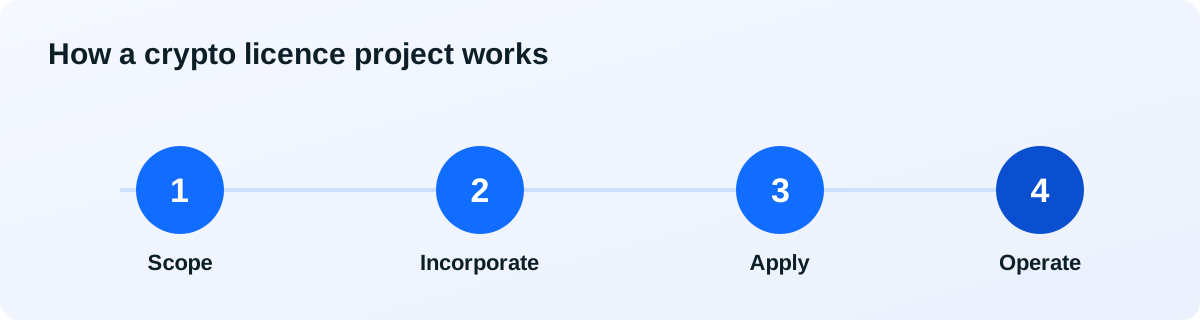
- Pre-application assessment: Business model review and license type determination.
- Company incorporation: Establish a Swiss entity (AG or GmbH) with proper substance.
- Document preparation: Business plan, AML policy, risk assessment, organisational chart, financial projections.
- Submission to FINMA or SRO: Depending on license type.
- Review and queries: FINMA may request additional information or clarifications.
- Approval and ongoing compliance: Regular reporting, audits, and AML updates.
Common mistakes when applying for a Switzerland crypto license include submitting incomplete documentation, especially the business plan. FINMA expects detailed descriptions of IT systems, security measures, and governance. Consulting24 provides template documents and reviews them before submission. We have seen applications rejected because the business plan lacked a clear description of the blockchain architecture or the wallet infrastructure.
Another mistake is not preparing for the interview. FINMA may request a meeting with the management team. Consulting24 conducts mock interviews to ensure you are ready to answer questions about your business model, risk management, and compliance procedures.
Banking & Payments
Opening a corporate bank account in Switzerland is challenging for crypto companies. Many traditional banks refuse crypto-related businesses. However, there are crypto-friendly banks like SEBA Bank, Sygnum, and some cantonal banks.
Common mistakes when applying for a Switzerland crypto license include not securing a bank account before applying. FINMA may require proof of a bank account in Switzerland. Consulting24 has relationships with crypto-friendly banks and can facilitate introductions. We also advise on alternative payment processors that can handle fiat on-ramps and off-ramps.
Another mistake is underestimating the time it takes to open an account. The process can take 2-4 months due to enhanced due diligence. Consulting24 recommends starting the bank account application in parallel with the license application.
For payment processing, Swiss-licensed companies can integrate with SEPA and SWIFT, but must comply with AML regulations. Some companies opt for a Panama entity for payment routing due to its flexible banking environment and faster account opening.
Benefits of a Switzerland Crypto License
- Reputation: FINMA regulation signals trust and compliance to partners and customers.
- Access to Swiss banking: Once licensed, banks are more willing to provide services.
- EU equivalence: Switzerland’s framework is recognised by the EU, facilitating cross-border operations.
- Tax advantages: Low corporate tax rates and favourable treatment of crypto assets.
- Innovation hub: Zug’s Crypto Valley offers a network of investors, lawyers, and developers.
Common mistakes when applying for a Switzerland crypto license include underestimating the ongoing compliance burden. Annual audits, AML training, and regulatory filings are mandatory. Consulting24 offers ongoing compliance support to ensure license holders stay in good standing. We also help clients use the reputation of a Swiss license to attract institutional investors and partners.
Another mistake is not planning for the future. If you intend to expand into the EU, a Swiss license may not automatically grant passporting rights. You may need to apply for a license in an EU member state under MiCA. Consulting24 can advise on multi-jurisdictional strategies, including using Panama as a base for non-EU operations.
Compliance & Trust
Switzerland’s regulatory framework is built on the principle of “same risks, same rules”. FINMA expects strong AML/KYC procedures, transaction monitoring, and regular reporting. Trust is earned through transparency and adherence to the law.
Common mistakes when applying for a Switzerland crypto license include having weak AML policies. FINMA will scrutinise your AML manual, customer due diligence process, and suspicious transaction reporting. Consulting24 provides a compliance toolkit tailored to Swiss requirements, including template policies and procedures.
Another mistake is not conducting regular internal audits. FINMA may require an annual audit by an independent firm. Consulting24 can recommend qualified auditors who specialise in crypto businesses.
Note: This is general guidance, not legal advice. Always consult a qualified Swiss attorney for your specific case.
Common Mistakes to Avoid
Based on our experience, here are the top mistakes founders make:
- Wrong license type: Applying for AML registration when you need a FinTech license.
- Inadequate capital proof: Not showing that capital is freely available in a Swiss account.
- Weak business plan: Lacking detail on IT security, governance, or financial projections.
- Ignoring substance requirements: No local office or director.
- Underestimating timeline: Expecting approval in 3 months when it takes 12.
- Not securing a bank account: FINMA may reject if you cannot open a Swiss bank account.
- Poor AML documentation: Using generic templates not tailored to Switzerland.
- Overlooking cantonal tax: Each canton has different rules and rates.
- Assuming DeFi is exempt: FINMA regulates based on economic function.
- Not engaging a consultant: Trying to do it alone often leads to delays.
Consulting24 helps you avoid all these mistakes. We have guided hundreds of companies through the licensing process in Switzerland and other jurisdictions. Contact us today to discuss your project.
Alternatives to Switzerland: Panama and Other Jurisdictions
Switzerland is not the only option for crypto licensing. Depending on your business model, budget, and target market, other jurisdictions may be more suitable.
Panama
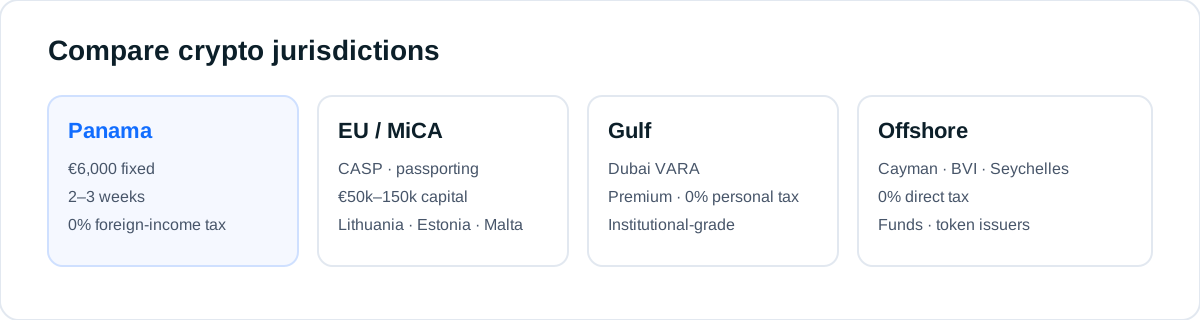
Panama offers a flat-fee crypto license at EUR 6,000 with no minimum capital requirement. The process takes 4-6 weeks, and there is no tax on foreign-source income. Panama is ideal for startups that want a quick, cost-effective entry into the Latin American market. Consulting24 delivers Panama licenses directly.
Estonia
Estonia was an early adopter of crypto regulation, but its regime has tightened. The cost is around EUR 3,000-5,000 for the license, but you need a local presence and AML compliance. However, Estonia is now part of the EU and must comply with MiCA, which may impose higher capital requirements. Consulting24 delivers Estonia licenses directly.
Lithuania
Lithuania offers a straightforward license for crypto exchanges and custodians. The cost is approximately EUR 2,500-4,000, with a minimum capital of EUR 125,000 under MiCA. The process takes 2-4 months. Lithuania is popular for its fast processing and EU passporting. Consulting24 delivers Lithuania licenses directly.
For a comparison of these options, see our Switzerland vs Lithuania guide. Consulting24 can help you choose the best jurisdiction for your needs.
Frequently asked questions
What is the most common mistake when applying for a Switzerland crypto license?
The most common mistake is applying for the wrong license type. Many founders assume a simple AML registration is enough, but if you offer custody or staking, you may need a FinTech or banking license. This error can cost months of rework. Consulting24 conducts a thorough business analysis to determine the correct license from the start.
How much does a Switzerland crypto license cost?
Costs vary by license type. AML registration via an SRO costs CHF 10,000-25,000. A FinTech license costs CHF 50,000-150,000. Securities dealer licenses range from CHF 100,000-300,000, and banking licenses start at CHF 500,000. These figures include regulatory fees but not legal or consulting fees. For a fixed-cost alternative, consider Panama at EUR 6,000.
How long does it take to get a Switzerland crypto license?
Timelines depend on the license type. AML registration takes 2-4 months, FinTech licenses 6-12 months, securities dealer licenses 9-18 months, and banking licenses 12-24 months. Many applicants underestimate this, leading to frustration. Consulting24 recommends planning for at least 12 months for complex licenses.
Do I need a local office in Switzerland to get a license?
Yes, FINMA requires substance in Switzerland, including a registered office, a local director, and actual decision-making taking place in the country. Virtual offices are not accepted. Consulting24 can help you set up a compliant Swiss entity with a physical office and local representation.
Can a DeFi project get a Switzerland crypto license?
It depends on the level of centralisation. If the project has a central team controlling funds or governance, FINMA will likely regulate it as a financial intermediary. Fully decentralised protocols with no central control may be exempt, but this is rare. Consulting24 can assess your DeFi project and advise on regulatory obligations.
What are the capital requirements for a Switzerland crypto license?
AML registration has no minimum capital, but you must maintain adequate financial resources. FinTech licenses require CHF 300,000, securities dealer licenses CHF 1 million, and banking licenses CHF 10 million. The capital must be unencumbered and held in a Swiss bank account. Consulting24 helps you prepare the necessary proof.
Is Switzerland crypto-friendly for tax purposes?
Yes, Switzerland offers low corporate tax rates (11.9-21% depending on canton) and favourable treatment of crypto assets. However, tax obligations vary by canton, and you must comply with wealth tax and VAT rules. Consulting24 can connect you with Swiss tax advisors who specialise in crypto.
Can I get a bank account for my crypto company in Switzerland?
It is challenging but possible. Crypto-friendly banks like SEBA Bank and Sygnum are options, as are some cantonal banks. You will need to undergo enhanced due diligence. Consulting24 has relationships with these banks and can facilitate introductions. Starting the process early is critical.
How does Switzerland compare to Panama for crypto licensing?
Switzerland offers a prestigious license with access to EU markets and low tax rates, but it is expensive and time-consuming. Panama offers a flat fee of EUR 6,000, no minimum capital, and a 4-6 week process, with no tax on foreign-source income. Panama is better for startups; Switzerland is better for established companies seeking reputation.
Does Consulting24 help with Switzerland crypto licenses?
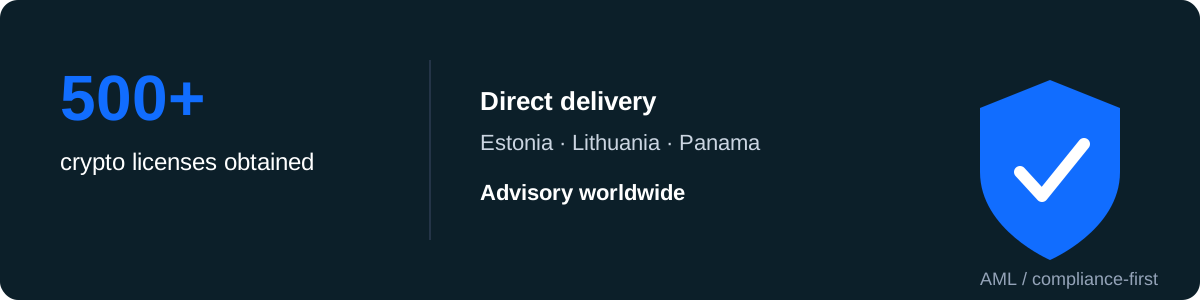
Consulting24 advises and coordinates for Switzerland crypto licenses, drawing on our network of local partners. We deliver directly in Estonia, Lithuania, and Panama. For Switzerland, we provide pre-application assessment, document review, and ongoing compliance support. Contact us to discuss your project.
What happens if I make a mistake in my application?
Mistakes can lead to rejection or lengthy delays. FINMA may request additional information, which can extend the timeline by months. In worst cases, a rejection can harm your reputation. Consulting24 helps you avoid errors by reviewing all documents before submission and preparing you for FINMA queries.
Is a Switzerland crypto license recognised in the EU?
Switzerland is not an EU member, so its license does not automatically grant passporting rights. However, the Swiss framework is considered equivalent by the EU for some purposes. If you want to operate in the EU, you may need a separate license under MiCA. Consulting24 can advise on a multi-jurisdictional strategy.
Official sources
Related jurisdictions

Talk to a crypto-licensing expert
500+ licenses across Estonia, Lithuania, Panama and beyond. Tell us your model and we'll map the right route, honestly.
💬 Talk to an expertFree consultationGeneral guidance, not legal advice. Rules and fees evolve, and we confirm current requirements for your case.