Common Mistakes When Applying for a Portugal Crypto License

Applying for a crypto license in Portugal is a strategic move for many blockchain businesses, but the process is fraught with pitfalls. In 2026, Portugal's regulatory framework under Banco de Portugal requires meticulous preparation. Many founders stumble on documentation, capital requirements, or compliance gaps. This guide highlights the most common mistakes and how to avoid them, drawing on Consulting24's experience across 500+ licenses. Whether you are considering Portugal or comparing it to other jurisdictions like Panama, understanding these errors can save you time and money.
Portugal offers a stable EU gateway with a clear licensing path, but the application demands precision. From misjudging the minimum capital to neglecting AML policies, mistakes can delay approval or lead to rejection. We cover the critical areas: regulator expectations, cost miscalculations, and operational oversights. For a full overview of licensing options, explore our jurisdictions page.
What Is the Portugal Crypto License?
The Portugal crypto license, issued by Banco de Portugal, authorizes entities to provide virtual asset services. Since MiCA came into full force in 2026, Portugal applies the EU-wide CASP regime. This means licensed firms must meet harmonized standards across capital, governance, and AML. The license covers activities like exchange, custody, and transfer of crypto assets. Portugal is attractive for its relatively fast processing (3-6 months) and clear regulatory stance. However, the application is rigorous, and common mistakes stem from underestimating the compliance burden. For instance, many applicants fail to provide a detailed business plan that outlines the specific services they will offer and the target market. Another frequent error is assuming that a license from another EU country will automatically be recognized in Portugal without additional registration. Consulting24 advises clients to approach the application with a thorough understanding of the local requirements and to prepare all documents in accordance with Banco de Portugal's guidelines. The regulator expects a clear demonstration of AML controls, governance structures, and financial stability. Without these, even a well-funded application can be rejected.
Who Needs a Portugal Crypto License?
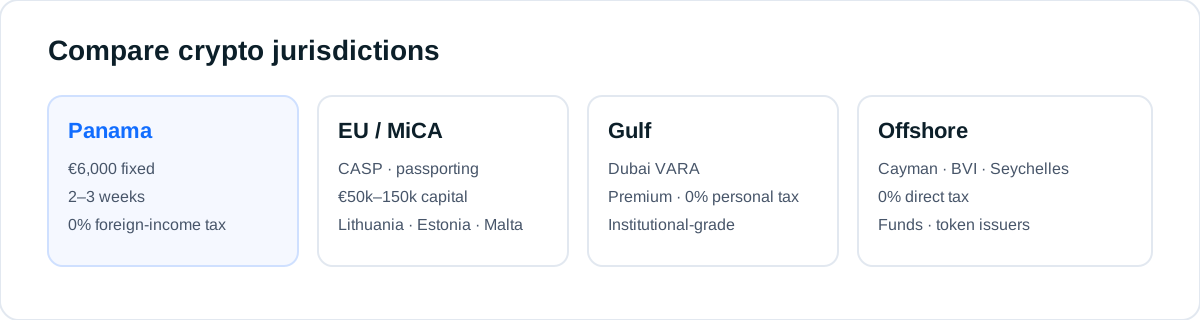
Any business offering crypto services to Portuguese residents needs this license. This includes exchanges, wallet providers, custodians, and payment processors. Even if your company is based elsewhere, if you target the Portuguese market, you must register. Many founders mistakenly assume a license from another EU country suffices under passporting, but Portugal requires direct registration. Consulting24 advises clients to clarify their target market early. For those seeking a simpler setup, Panama offers a flat EUR 6,000 license with no capital requirement, though it lacks EU passporting. Additionally, businesses that only provide crypto-to-crypto exchange services without fiat involvement may still need a license if they serve Portuguese residents. The regulator takes a broad view of what constitutes a crypto service, and failure to register can result in fines or legal action. A common mistake is assuming that a small operation or a startup does not need a license. In Portugal, even one-time transactions with residents can trigger licensing obligations. Consulting24 helps clients assess their exposure and determine the correct jurisdiction for their needs.
License Type and Regulator
The regulator is Banco de Portugal, operating under the European Central Bank's oversight. The license type is a Virtual Asset Service Provider (VASP) authorization, now aligned with MiCA's CASP classification. There is one main license for all crypto activities, but the scope of services affects capital tiers. Common mistake: applying for a broader scope than needed, increasing capital and compliance costs. Consulting24 helps match your business model to the appropriate tier. For example, if you only offer crypto transfer services, you should apply for the basic tier with EUR 50,000 capital, not the advanced tier with EUR 150,000. Another mistake is failing to understand that the regulator expects the license application to reflect the actual business activities. If you later expand your services, you must notify the regulator and potentially increase your capital. The application process involves submitting detailed information about the company's ownership, management, and operational structure. Banco de Portugal also requires a fit and proper test for all directors and beneficial owners. This includes background checks and proof of professional competence. Many applicants underestimate the time needed to gather these documents, especially if they involve international jurisdictions.
Cost and Timeline
Below is a typical cost breakdown for a Portugal crypto license application in 2026. Exact figures vary by complexity.
| Item | Cost (EUR) |
|---|---|
| Application fee | 2,000 - 5,000 |
| Legal and consultancy fees | 15,000 - 30,000 |
| AML compliance setup | 5,000 - 10,000 |
| Ongoing annual compliance | 10,000 - 20,000 |
| Total first-year estimate | 32,000 - 65,000 |
Timeline: 3-6 months for initial approval, assuming no errors. Common mistake: underestimating the time needed for document preparation. For a faster and cheaper alternative, Panama costs a flat EUR 6,000 and can be completed in 4-6 weeks. Another cost-related mistake is not budgeting for ongoing compliance. Many founders focus only on the initial application fees and ignore the annual costs of AML audits, reporting, and legal updates. Portugal requires licensed entities to maintain a compliance officer and to conduct regular transaction monitoring. The regulator may also require an external audit of AML procedures, which can cost EUR 5,000-10,000 per year. Additionally, if your application is rejected, you may need to pay additional fees to reapply. Consulting24 recommends setting aside a contingency fund of at least EUR 10,000 for unexpected expenses. The timeline can also be affected by the regulator's workload. During peak periods, processing times may extend beyond 6 months. To avoid delays, submit a complete application with all required documents upfront.
Capital Requirement
Under MiCA, capital requirements are tiered by service type: EUR 50,000 for simple services (e.g., transfer), EUR 125,000 for exchange and custody, and EUR 150,000 for advanced services. Many applicants mistakenly assume a single capital figure applies to all. Another error: failing to maintain the capital after licensing. Portugal requires proof of paid-up capital and ongoing solvency. Consulting24 advises clients to budget for at least EUR 125,000 if offering multiple services. The capital must be held in a bank account in Portugal or another EU member state and cannot be used for operational expenses. It serves as a buffer to cover potential losses or liabilities. Some applicants try to use crypto assets to meet the capital requirement, but the regulator requires fiat currency. Another common mistake is not providing clear evidence of the source of funds for the capital. The regulator will scrutinize the origin of the money to prevent money laundering. If the funds come from crypto trading, you may need to provide detailed transaction histories. Consulting24 helps clients prepare the necessary documentation to satisfy the regulator's requirements. Failure to meet the capital requirement is one of the top reasons for application rejection.
Tax Treatment
Portugal taxes crypto gains as capital income at a flat 28% for individuals, but corporate profits are taxed at the standard CIT rate of 21%. A common mistake is ignoring VAT implications for crypto-to-fiat transactions. Portugal also has a favorable regime for crypto mining, but trading activities are fully taxable. Consulting24 recommends engaging a local tax advisor early. For zero-tax jurisdictions, compare with Panama, which has no capital gains tax on crypto. Another tax-related mistake is not registering for VAT if your business provides services that are subject to VAT. For example, charging fees for crypto exchange services may be VAT-exempt in some cases, but the rules are complex. The Portuguese tax authority has issued guidance that crypto-to-fiat transactions are subject to VAT, while crypto-to-crypto transactions are not. However, this is still evolving. Corporate tax returns must include detailed records of all crypto transactions, and failure to do so can lead to penalties. Many founders also overlook the need to report crypto holdings in annual wealth declarations. Consulting24 works with local tax partners to ensure clients meet all obligations. The tax treatment of staking and lending rewards is also a gray area, and it is advisable to seek a tax ruling from the authorities.
Allowed Activities
A Portugal crypto license permits: exchange between crypto and fiat, exchange between crypto assets, custody and administration, transfer services, and participation in ICOs. Prohibited activities include unlicensed lending and derivatives trading without a separate MiFID license. Common mistake: assuming all crypto activities are covered under one license. For example, operating a crypto ATM requires specific authorization. Consulting24 helps scope your business correctly. Another mistake is offering services that are not explicitly listed in your license application. If you later decide to add a new service, you must apply for a variation of the license, which can take additional time and cost. The regulator also prohibits the use of anonymous transactions or privacy coins without proper AML controls. Some founders mistakenly believe that they can operate a peer-to-peer platform without a license, but if the platform facilitates transfers between users, it may be considered a transfer service. Consulting24 advises clients to clearly define their business model and seek pre-approval from the regulator if there is any doubt. The allowed activities list is based on MiCA's definitions, and any deviation could result in enforcement action.
Step-by-Step Application Process
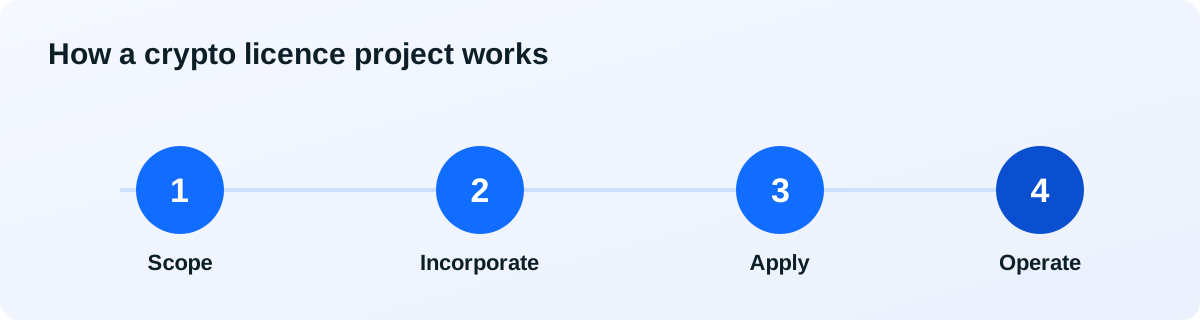
- Pre-application: prepare business plan, AML policies, and governance documents.
- Submit application to Banco de Portugal with all supporting documents.
- Regulatory review (2-4 months): regulator may request clarifications.
- On-site inspection or interview (if required).
- Approval and license issuance.
Common mistake: submitting incomplete or inconsistent documents. The regulator often rejects applications with missing information on beneficial ownership or source of funds. Consulting24 offers a document checklist and review service. Another mistake is not preparing for the on-site inspection. The regulator may visit your registered office to verify that you have the necessary infrastructure and personnel. This includes checking that you have a physical presence, such as an office or a virtual office with a local representative. The interview with management is also critical; the regulator will assess the competence and integrity of the directors. Some applicants fail to prepare for this interview and give vague answers. Consulting24 conducts mock interviews to help clients prepare. The application process also requires you to submit a detailed AML risk assessment and a description of your transaction monitoring system. If you use third-party software, you must provide evidence that it meets EU standards. The entire process can be streamlined with proper planning and professional support.
Banking and Payments
Opening a corporate bank account in Portugal for crypto businesses is challenging. Many banks refuse due to AML concerns. Common mistake: not securing a banking relationship before applying. Portugal has a few crypto-friendly banks, but they require a license first or a strong compliance record. Consulting24 advises clients to consider payment processors or e-money institutions as alternatives. For easier banking, Panama offers a more straightforward banking environment. Another mistake is relying on a single bank. If that bank later decides to close your account, you may be left without banking services. It is advisable to establish relationships with at least two banks or payment service providers. The regulator also expects you to have a bank account in Portugal to hold the required capital. Some applicants try to use an account in another EU country, but the regulator prefers a local account. Additionally, the bank will conduct its own due diligence, which can take several weeks. Consulting24 helps clients identify crypto-friendly banks and prepare the necessary documentation. For payment processing, you may need to integrate with a licensed payment institution that can handle fiat transactions. The cost of banking services for crypto firms is typically higher, with monthly fees ranging from EUR 50 to EUR 200.
Benefits of a Portugal Crypto License
Benefits include EU-wide market access under MiCA passporting, a stable regulatory environment, and a growing crypto ecosystem. Portugal also offers a non-habitual resident tax regime for individuals. However, the main benefit is credibility: a Portugal license signals compliance to partners and customers. Common mistake: overestimating the speed of passporting. While MiCA allows passporting, actual acceptance by other EU regulators can take additional time. Another benefit is the ability to participate in the European blockchain ecosystem, including access to EU funding and partnerships. Portugal has a relatively low corporate tax rate compared to other EU countries, and there are incentives for tech companies. The non-habitual resident regime allows individuals to pay a flat 20% income tax for 10 years, which can be attractive for founders relocating to Portugal. However, this regime does not apply to crypto gains, which are taxed separately. Consulting24 helps clients evaluate whether Portugal is the right fit based on their business goals and target market. For those who do not need EU passporting, Panama may be a more cost-effective option.
Compliance and Trust
Ongoing compliance includes AML/KYC procedures, transaction monitoring, and annual reporting. The regulator expects a dedicated compliance officer and regular audits. Common mistake: treating compliance as a one-time setup. Portugal conducts periodic inspections, and non-compliance can lead to fines or license revocation. Consulting24 provides ongoing compliance support. Note: this is general guidance, not legal advice. Always consult a qualified lawyer for your specific situation. Another mistake is failing to update AML policies in line with evolving EU regulations. For example, the EU's Travel Regulation for crypto transfers requires that you collect and share information about the originator and beneficiary of transactions. Non-compliance can result in penalties of up to 5% of annual turnover. The regulator also expects you to conduct regular training for staff on AML and data protection. Some companies neglect to appoint a data protection officer (DPO) as required under GDPR. Consulting24 helps clients set up a compliance framework that meets all regulatory expectations. The cost of ongoing compliance can be significant, but it is essential for maintaining the license. We recommend budgeting at least EUR 10,000 per year for compliance-related expenses.
Common Mistakes to Avoid
- Incomplete documentation: missing business plan or AML policy.
- Underestimating capital: applying with insufficient funds.
- Ignoring beneficial ownership rules: failing to disclose all ultimate owners.
- Poor AML/KYC procedures: not meeting EU standards.
- Choosing the wrong scope: applying for too many or too few services.
- Not securing a bank account in advance.
- Assuming passporting is automatic.
- Delaying tax planning.
- Failing to maintain the registered office and local presence.
- Not preparing for the on-site inspection or interview.
Each of these can derail your application. Consulting24's experts help you avoid these pitfalls. For example, one client applied for a license with a capital of EUR 50,000 but intended to offer exchange and custody services, which require EUR 125,000. The application was rejected, and they had to reapply, losing three months. Another client failed to disclose a beneficial owner who was a politically exposed person, leading to a fine. Consulting24 conducts a thorough pre-application review to identify such issues. We also help clients prepare a strong AML policy that meets the regulator's standards. The most common mistake is underestimating the time and cost involved. Many founders expect to receive a license in a few weeks, but the process typically takes several months. By working with Consulting24, you can avoid these delays and increase your chances of success.
Alternatives and Comparison
Portugal is not the only option. Compared to Panama, Portugal offers EU passporting but at a higher cost and longer timeline. Panama costs EUR 6,000 flat, no capital requirement, and processes in 4-6 weeks. However, Panama does not provide EU market access. Other alternatives include Lithuania (EUR 2,500 capital, faster processing) and Estonia (EUR 3,000 capital, but stricter AML). For a detailed comparison, see our vs Lithuania page and jurisdictions overview. Consulting24 advises clients based on their target market and budget. For example, if your primary market is Europe, a Portugal or Lithuania license may be worth the investment. If you are targeting global markets without EU focus, Panama is a cost-effective choice. Another alternative is the Czech Republic, which offers a crypto license with a capital requirement of EUR 50,000 and a timeline of 3-6 months. However, the Czech Republic is not yet fully aligned with MiCA, which may create uncertainty. Consulting24 helps clients compare the pros and cons of each jurisdiction. We also consider factors such as tax treatment, banking availability, and regulatory stability. For a full list of options, visit our jurisdictions page.
Why Choose Consulting24?
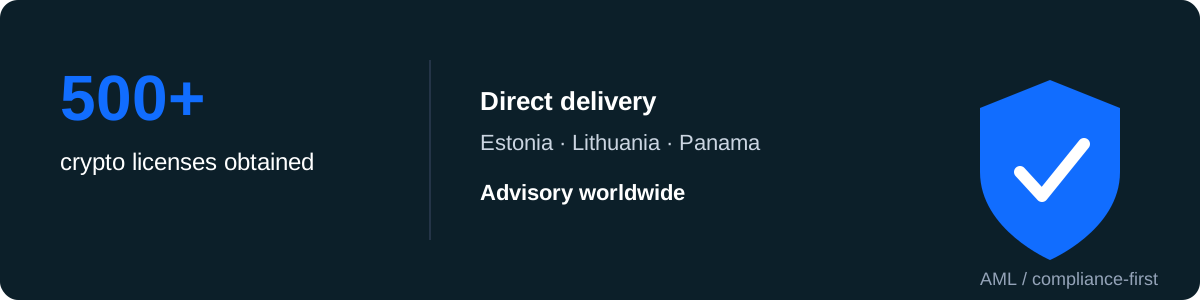
Consulting24 has obtained over 500 crypto licenses worldwide, including direct delivery in Estonia, Lithuania, and Panama. For Portugal, we advise and coordinate with local partners. Our team provides end-to-end support: from entity setup to application submission and ongoing compliance. We help you avoid common mistakes and streamline the process. Contact us on WhatsApp for a free consultation. Our expertise includes not only the application process but also post-license compliance, banking introductions, and tax planning. We understand the nuances of each jurisdiction and can guide you to the best option for your business. Whether you choose Portugal or another jurisdiction, we ensure that your application is complete and accurate. Our success rate is high because we take the time to understand your business and prepare a tailored application. We also offer a fixed-fee service for Panama licenses, making it easy to budget. For Portugal, we provide a transparent cost estimate and timeline. Contact us today to discuss your project.
Frequently asked questions
What is the minimum capital for a Portugal crypto license?
Under MiCA, capital requirements are EUR 50,000 for basic services, EUR 125,000 for exchange and custody, and EUR 150,000 for advanced services. You must maintain this capital throughout the license period. The capital must be in fiat currency and held in a Portuguese bank account.
How long does it take to get a Portugal crypto license?
The application process typically takes 3-6 months, but delays can occur if documents are incomplete. Consulting24 helps prepare a complete submission to minimize delays. The timeline includes regulatory review, possible inspections, and final approval.
Can I passport a Portugal crypto license to other EU countries?
Yes, under MiCA, a Portugal license allows passporting to other EU states. However, you must notify the regulator and comply with local requirements, which can take additional time. The passporting process is not automatic and requires coordination with each host regulator.
What are the main reasons for application rejection?
Common reasons include incomplete documentation, insufficient capital, poor AML policies, and failure to disclose beneficial owners. Consulting24 reviews your application to address these issues. Rejection can also occur if the regulator finds that the management lacks fit and proper status.
Is a Portugal crypto license cheaper than Panama?
No. Panama costs a flat EUR 6,000 with no capital requirement, while Portugal costs EUR 32,000-65,000 in first-year fees plus capital. Panama is cheaper but lacks EU passporting. For businesses targeting the EU market, Portugal may be worth the investment.
Do I need a physical office in Portugal?
Yes, you need a registered office in Portugal. This can be a virtual office, but you must have a local presence for regulatory communications. The regulator may conduct on-site inspections, so the office must be accessible during business hours.
What activities are prohibited under a Portugal crypto license?
Unlicensed lending, derivatives trading without a MiFID license, and activities not covered by your license scope are prohibited. Always check with a consultant. Operating a crypto ATM without specific authorization is also prohibited.
How often do I need to report to the regulator?
You must submit annual reports on AML compliance, financial statements, and transaction data. The regulator may also request ad-hoc reports. Failure to submit reports on time can result in fines. Consulting24 helps clients prepare and submit these reports.
Can I apply for a Portugal crypto license remotely?
Yes, the application can be submitted remotely, but you need a local representative and registered office. Consulting24 coordinates the process for international clients. All documents must be in Portuguese or accompanied by a certified translation.
What happens if my application is rejected?
You can appeal the decision or reapply after addressing the deficiencies. Consulting24 can help identify the reasons for rejection and prepare a stronger application. Reapplication may involve additional fees and time.
What are the ongoing compliance costs for a Portugal crypto license?
Ongoing costs include annual AML audits, compliance officer salary, reporting software, and legal fees. Typical annual costs range from EUR 10,000 to EUR 20,000. Consulting24 offers ongoing compliance support packages to help manage these costs.
Can I use a Portugal license to operate in other EU countries immediately?
No, you must go through the passporting process, which involves notifying the host regulator and possibly meeting additional local requirements. This can take several weeks to months. Consulting24 assists with passporting applications.
Related jurisdictions

Talk to a crypto-licensing expert
500+ licenses across Estonia, Lithuania, Panama and beyond. Tell us your model and we'll map the right route, honestly.
💬 Talk to an expertFree consultationGeneral guidance, not legal advice. Rules and fees evolve, and we confirm current requirements for your case.