AML/KYC Requirements for a Malta Crypto Company

If you are setting up a crypto company in Malta, understanding the AML/KYC requirements is essential for compliance and successful licensing. As of 2026, Malta applies the EU Markets in Crypto-Assets Regulation (MiCA), which mandates rigorous anti-money laundering (AML) and know-your-customer (KYC) procedures for all crypto-asset service providers (CASPs). This page provides a detailed, accurate guide to the AML/KYC framework for a Malta crypto company, including regulatory obligations, practical steps, and common pitfalls.
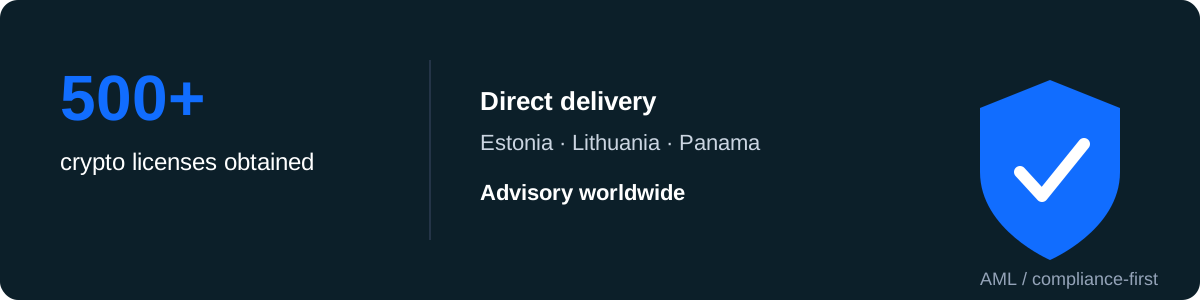
Consulting24 (X24Consulting OU) has obtained over 500 crypto licenses globally. We deliver directly in Estonia, Lithuania, and Panama, and advise and coordinate for other jurisdictions, including Malta. Whether you are a startup or an established exchange, our team can help you get through the AML/KYC sector and choose the right licensing route. For a flat fee of EUR 6,000, we also offer a complete Panama crypto company setup, which is often a simpler alternative to Malta's MiCA regime.
What Are AML/KYC Requirements for a Malta Crypto Company?
AML/KYC requirements are regulatory obligations that crypto companies must implement to prevent money laundering and terrorist financing. For a Malta crypto company, these requirements are defined under Malta's transposition of MiCA (Regulation (EU) 2023/1114) and the local Virtual Financial Assets Act (VFAA), as amended. The key components include:
- Customer due diligence (CDD): verifying the identity of customers and beneficial owners before any transaction. This includes collecting government-issued IDs, proof of address, and identifying ultimate beneficial owners (UBOs) with ownership stakes above 25%.
- Ongoing monitoring: tracking transactions for suspicious activity and reporting to the Financial Intelligence Analysis Unit (FIAU). Systems must flag unusual patterns, such as rapid trades or large transfers from high-risk jurisdictions.
- Record keeping: storing KYC documents and transaction records for at least five years after the business relationship ends. Records must be retrievable within 24 hours upon regulator request.
- Appointment of a compliance officer and a money laundering reporting officer (MLRO). The MLRO must be based in Malta and have sufficient seniority to report directly to the board.
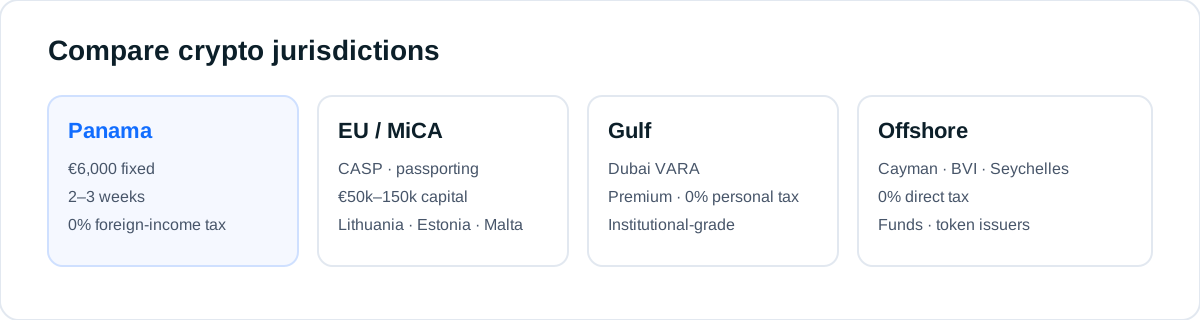
These rules apply to all CASPs, including exchanges, wallet providers, and custodians. Failure to comply can result in fines of up to EUR 5 million or 10% of annual turnover, license revocation, or criminal liability for directors. For a lighter regulatory environment, consider Panama, where AML obligations are minimal and setup costs a flat EUR 6,000.
Who Needs a Malta Crypto License with AML/KYC Compliance?
Any entity that provides crypto-asset services in or from Malta must hold a license under MiCA and comply with AML/KYC obligations. This includes:
- Crypto exchanges (trading platforms) that match buyers and sellers.
- Wallet providers (custodial and non-custodial) that hold private keys on behalf of clients.
- Custodians of crypto assets, including institutional-grade storage solutions.
- Brokers and dealers in crypto assets that execute trades for clients.
- Advisors and portfolio managers dealing with crypto, including robo-advisors.
If you are a founder looking to serve EU customers, a Malta license is one option, but you should also consider other jurisdictions like Estonia, Lithuania, or Panama, where the regulatory burden may be lighter. Consulting24 can help you compare the AML/KYC requirements across these jurisdictions. For example, Panama requires only basic identity verification for company formation, with no ongoing AML reporting to a financial intelligence unit.
License Type and Regulator
The Malta crypto license is issued by the Malta Financial Services Authority (MFSA) under MiCA. The license is classified as a CASP license, which covers all activities defined in MiCA. The MFSA works closely with the FIAU for AML supervision. The license types under MiCA are divided by service classes, each with specific capital requirements (see below). Malta also has a separate VFA license for entities that deal with virtual financial assets, but MiCA now supersedes most crypto services. For more details on the application process, see our application process guide. The MFSA is known for its thorough review process, which includes interviews with key personnel and on-site visits for complex operations.
Cost and Timeline
| Item | Cost (EUR) | Timeline |
|---|---|---|
| Application fee (MFSA) | ~4,000 | Paid upfront |
| Annual supervision fee | ~3,000-6,000 | Yearly |
| Compliance consultancy (AML/KYC setup) | 5,000-15,000 | 2-4 weeks |
| Legal fees for local representation | 3,000-8,000 | Ongoing |
| KYC software subscription (annual) | 2,000-10,000 | Yearly |
| Total licensing timeline | - | 6-12 months |
Exact costs depend on the complexity of your business model. Consulting24 can provide a detailed quote after an initial consultation. For a faster and cheaper alternative, consider our Panama crypto company setup at a flat EUR 6,000, with no AML/KYC burdens beyond basic due diligence. Panama companies can be operational in 2-4 weeks.
Capital Requirement
Under MiCA, the minimum capital requirement for a Malta crypto company depends on the services offered:
- EUR 50,000 for simple services (e.g., reception and transmission of orders).
- EUR 125,000 for custody and exchange services.
- EUR 150,000 for more complex services (e.g., operating a trading platform).
These figures are set by MiCA and apply to all EU member states. In addition, the MFSA may require higher capital based on risk assessment, for example if the company holds client assets or operates in multiple jurisdictions. Capital must be held in liquid assets, such as cash or government bonds. For comparison, Panama has no minimum capital requirement for a crypto company, making it a cost-effective option. Estonia requires EUR 100,000 for exchange licenses, while Lithuania requires EUR 125,000.
Tax Treatment
Malta offers a competitive tax regime for crypto companies. The corporate tax rate is 35%, but through a full imputation system, shareholders can claim refunds, effectively reducing the rate to 5-10% on distributed profits. Crypto transactions are treated as trading income or capital gains depending on the business model. VAT is not applicable on crypto-to-crypto exchanges, but fiat transactions may be subject to VAT at 18%. Additionally, Malta has no withholding tax on dividends paid to non-residents, and no capital gains tax on share disposals. Always consult a tax advisor for your specific situation. For Panama, the territorial tax system means only locally sourced income is taxed, and crypto gains from foreign sources are generally tax-free.
Allowed Activities Under a Malta Crypto License
A Malta CASP license allows the following activities under MiCA:
- Operation of a trading platform for crypto assets.
- Exchange of crypto assets for fiat currency or other crypto assets.
- Custody and administration of crypto assets on behalf of clients.
- Reception and transmission of orders for crypto assets.
- Placement of crypto assets (underwriting).
- Advice on crypto assets.
- Portfolio management of crypto assets.
Stablecoin issuance and asset-referenced tokens have additional requirements under MiCA, including a separate whitepaper and higher capital. If your business involves these, consult with our experts. The license does not cover derivatives or securities tokens, which fall under MiFID II. For a broader scope, consider Lithuania, where the license covers all crypto activities without the same restrictions.
Step-by-Step Process for AML/KYC Compliance
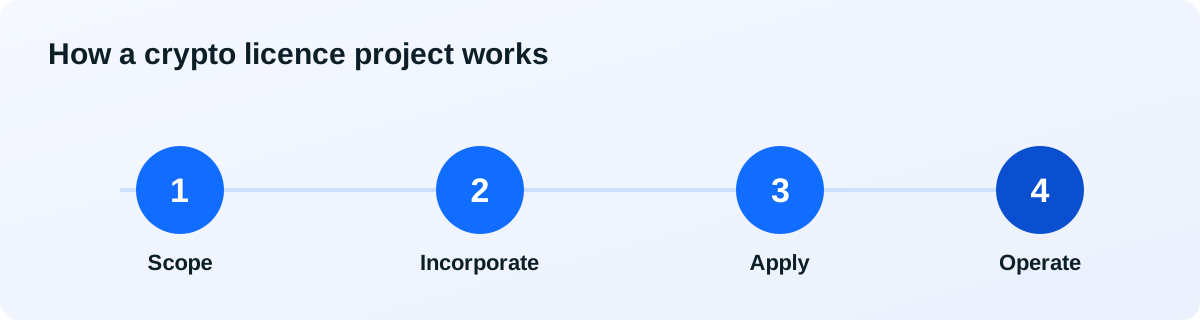
- Pre-application: Define your business model and identify the services you will offer. Engage a compliance consultant (like Consulting24) to draft your AML policy.
- AML policy draft: Create a written AML/KYC manual covering CDD, ongoing monitoring, record keeping, and reporting procedures. Appoint an MLRO and a board member responsible for compliance.
- Technology setup: Implement KYC software (e.g., identity verification, transaction monitoring). Ensure your system can screen customers against sanctions lists and PEP databases. Popular providers include Jumio, Onfido, and Chainalysis for transaction monitoring.
- Submit application: File the license application with the MFSA, including your AML policy, business plan, and financial projections. The MFSA will review and may request changes or additional information.
- Post-license: Once licensed, submit regular AML reports to the FIAU. Conduct annual independent audits of your AML program. The MLRO must file suspicious transaction reports (STRs) within 24 hours of detection.
For a detailed walkthrough, see our application process page. The entire process from start to license approval typically takes 6-12 months, depending on the completeness of your application.
Banking and Payments
Opening a bank account for a Malta crypto company can be challenging due to de-risking by traditional banks. Many Maltese banks accept crypto companies if they are licensed and have strong AML/KYC procedures. Banks like Bank of Valletta and APS Bank have been known to work with licensed CASPs, but they require a detailed business plan and proof of compliance. Alternative options include payment institutions, e-money institutions, or crypto-friendly banks in Lithuania or Estonia. For example, Revolut Business and Paysera offer accounts for crypto firms in the EU. Consulting24 can help you identify suitable banking partners. For a simpler banking setup, consider a Panama company, where banking is more accessible and less restrictive, with many international banks accepting Panama corporations.
Benefits of a Malta Crypto License
- EU passporting: a Malta license allows you to serve customers across the EU under MiCA, giving you access to a market of 450 million consumers.
- Reputable jurisdiction: Malta is a well-regulated, EU member state with a strong financial services track record, often called the 'Blockchain Island'.
- Competitive tax regime: effective corporate tax rate as low as 5% through refunds, and no withholding tax on dividends.
- Access to EU talent and infrastructure, including a skilled workforce in fintech and blockchain.
- Established ecosystem: Malta has a supportive government, with initiatives like the Malta Digital Innovation Authority (MDIA).
However, the AML/KYC burden is heavy. If you do not need EU passporting, other jurisdictions may be more cost-effective. For example, Panama offers no minimum capital, low taxes, and a flat setup fee of EUR 6,000.
Compliance and Trust
Compliance with AML/KYC requirements is not optional. The FIAU conducts regular inspections and can impose fines of up to EUR 5 million or 10% of annual turnover for breaches. Beyond legal obligations, strong AML/KYC procedures build trust with customers, banks, and partners. We recommend implementing automated KYC solutions and conducting regular staff training. For example, using biometric verification and liveness checks can reduce fraud. Additionally, consider obtaining ISO 27001 certification for information security, which is often required by institutional clients. General guidance, not legal advice. Always consult a qualified professional. Consulting24 can assist with compliance gap analysis and policy drafting.
Common Mistakes in AML/KYC Compliance
- Inadequate CDD: Failing to verify beneficial owners or using weak identity verification methods, such as accepting expired documents or not checking against PEP lists.
- Poor record keeping: Not storing documents for the required five years, or storing them in a format that is not easily retrievable.
- Ignoring ongoing monitoring: Only checking customers at onboarding and not monitoring transactions. This can lead to missing suspicious activity like structuring or rapid layering.
- Lack of MLRO: Not appointing a dedicated money laundering reporting officer with sufficient authority and resources.
- Underestimating costs: AML software and compliance staff can be expensive, often exceeding EUR 50,000 per year for a mid-sized operation.
- Not updating policies: Failing to update AML policies to reflect new regulations or typologies, such as those related to decentralized finance (DeFi).
Avoid these by working with experienced consultants like Consulting24. We have helped over 500 clients avoid these pitfalls.
Alternatives to Malta: Comparison with Panama and Other Jurisdictions
If Malta's AML/KYC requirements seem daunting, consider these alternatives:
| Jurisdiction | Min. Capital | AML/KYC Burden | Cost (EUR) | Timeline |
|---|---|---|---|---|
| Malta (MiCA) | 50,000-150,000 | High | ~10,000-25,000 | 6-12 months |
| Panama | None | Low | 6,000 flat | 2-4 weeks |
| Estonia | None (but 100,000 for exchange) | Medium | ~15,000 | 3-6 months |
| Lithuania | None (but 125,000 for exchange) | Medium | ~12,000 | 3-6 months |
For founders who want to avoid heavy AML/KYC, Panama is the simplest and cheapest option. Consulting24 delivers Panama company setup directly. For EU access, Lithuania or Estonia may be faster than Malta. See our comparison with Lithuania for more details. Each jurisdiction has trade-offs: Malta offers EU passporting but high compliance costs; Panama offers speed and low cost but no EU market access.
Why Choose Consulting24 for Your Malta Crypto License?
Consulting24 has extensive experience with crypto licensing across multiple jurisdictions. For Malta, we advise and coordinate with local legal partners to ensure your AML/KYC documentation meets MFSA standards. We do not file directly in Malta, but we guide you through the process, from policy drafting to regulator interviews. If Malta is not the right fit, we can help you set up in Estonia, Lithuania, or Panama, where we deliver directly. Contact us today for a free consultation. Our team can provide a cost-benefit analysis of Malta versus other jurisdictions based on your specific business model.
Frequently asked questions
What is the minimum capital for a Malta crypto company under MiCA?
The minimum capital depends on the services: EUR 50,000 for simple services (e.g., order transmission), EUR 125,000 for custody and exchange, and EUR 150,000 for trading platforms. These figures are set by MiCA and apply to all EU member states. The MFSA may require higher capital based on risk.
How long does it take to get a Malta crypto license?
The licensing process typically takes 6-12 months from application to approval. This includes the MFSA's review of your AML policy, business plan, and financial projections. Delays can occur if additional information is requested. For a faster alternative, Panama takes 2-4 weeks.
What are the ongoing AML/KYC obligations after licensing?
After licensing, you must submit regular AML reports to the FIAU, conduct ongoing transaction monitoring, file suspicious transaction reports within 24 hours, and undergo annual independent audits of your AML program. You must also update your risk assessment periodically.
Can I use a Malta license to serve customers in other EU countries?
Yes, under MiCA's passporting regime, a Malta CASP license allows you to provide services across the EU without needing additional licenses in each member state. You must notify the MFSA of your intent to passport and comply with local marketing rules.
What is the role of the MLRO in a Malta crypto company?
The MLRO (Money Laundering Reporting Officer) is responsible for receiving and analyzing internal suspicious activity reports, filing STRs with the FIAU, and ensuring the company complies with AML obligations. The MLRO must be based in Malta and have direct access to the board.
Are there any exemptions from AML/KYC for small transactions?
Under MiCA, simplified due diligence may apply for occasional transactions under EUR 1,000, but only if there is low risk of money laundering. However, the MFSA generally expects full CDD for all customers, especially for crypto services. Exemptions are rare and must be justified in your risk assessment.
What happens if I fail to comply with AML/KYC requirements?
Non-compliance can result in fines up to EUR 5 million or 10% of annual turnover, license suspension or revocation, and criminal liability for directors. The FIAU conducts regular inspections and can impose penalties for even minor breaches, such as late reporting.
Can I outsource AML/KYC compliance to a third party?
Yes, you can outsource certain functions like KYC verification or transaction monitoring to a regulated third party, but you remain ultimately responsible for compliance. The MFSA must approve any outsourcing arrangement, and you must have a written agreement in place.
How does Malta's tax regime compare to Panama for crypto companies?
Malta offers an effective corporate tax rate of 5-10% through refunds, while Panama operates a territorial tax system where foreign-source income is tax-free. Panama has no capital gains tax, making it more attractive for crypto trading profits. However, Malta provides EU market access.
What are the typical costs for KYC software for a Malta crypto company?
KYC software costs vary widely: basic identity verification can cost EUR 2,000-5,000 per year, while advanced solutions with transaction monitoring and sanctions screening can cost EUR 10,000-50,000 annually. Costs depend on transaction volume and number of users.
Official sources
Related jurisdictions

Talk to a crypto-licensing expert
500+ licenses across Estonia, Lithuania, Panama and beyond. Tell us your model and we'll map the right route, honestly.
💬 Talk to an expertFree consultationGeneral guidance, not legal advice. Rules and fees evolve, and we confirm current requirements for your case.