AML/KYC Requirements for an Estonia Crypto Company

If you are setting up an Estonia crypto company, understanding the AML/KYC requirements is critical. Estonia's Financial Intelligence Unit (FIU) enforces strict anti-money laundering and counter-terrorist financing rules for all virtual asset service providers. This guide covers exactly what you need to know to stay compliant in 2026.
Whether you are a startup or an established exchange, meeting these obligations is essential for obtaining and maintaining your license. Consulting24 has helped over 500 clients obtain crypto licenses, including in Estonia, and we share our expertise here. The AML/KYC framework is the backbone of your compliance program and directly impacts your approval odds.
What Are AML/KYC Requirements for an Estonia Crypto Company?
AML (Anti-Money Laundering) and KYC (Know Your Customer) requirements are the regulatory obligations that crypto companies must follow to prevent financial crime. In Estonia, these are mandated by the Money Laundering and Terrorist Financing Prevention Act (MLTFPA) and enforced by the FIU. Key obligations include customer due diligence, transaction monitoring, record keeping, and reporting suspicious activity.
For a crypto company, this means verifying the identity of every customer, understanding the source of funds, and maintaining a risk-based approach. Non-compliance can result in fines, license revocation, or criminal liability. The FIU expects a written AML policy that covers risk assessment, CDD procedures, ongoing monitoring, and internal controls. You must also appoint a Money Laundering Reporting Officer (MLRO) who is a resident of Estonia or another EEA country.
Practical example: if a customer deposits EUR 10,000 in crypto, you must verify their identity, check against sanctions lists, and assess the risk level. For high-risk customers, enhanced due diligence (EDD) is required, such as asking for proof of source of wealth.
Who Needs to Comply with Estonia's AML/KYC Rules?
Any company holding an Estonia crypto license must comply. This includes virtual currency exchange services, wallet providers, and other VASPs. The rules apply whether you are a startup or an established firm. Even if you outsource compliance, the legal responsibility remains with the license holder.
Consulting24 advises that even companies not yet licensed but planning to apply should start preparing their AML/KYC policies early. The FIU expects a comprehensive framework before approval. This includes drafting a risk assessment document, a customer acceptance policy, and procedures for transaction monitoring. The MLRO must be actively involved in the application process.
For example, a small exchange with 100 customers must still implement the same level of CDD as a large platform. The FIU does not exempt small firms from any obligation. Failure to comply can lead to fines of up to EUR 5 million or 10% of annual turnover under the MLTFPA.
License Type and Regulator
Estonia issues a single type of crypto license: the Virtual Currency Service Provider license. This covers exchange between virtual and fiat currencies, exchange between virtual currencies, and transfer of virtual currencies. The regulator is the Estonian Financial Intelligence Unit (FIU), which operates under the Ministry of Finance.
The FIU conducts ongoing supervision, including on-site inspections and reviews of AML procedures. As of 2026, Estonia remains a popular jurisdiction for crypto licensing due to its clear regulatory framework and EU membership. The license is indefinite but subject to annual compliance reporting. The FIU may request updates to your AML policy or conduct a surprise audit.
Compared to other EU jurisdictions, Estonia's FIU is known for being thorough but transparent. They provide guidance documents and are open to pre-application consultations. However, they have also revoked licenses for non-compliance, so maintaining standards is crucial.
Cost and Timeline for Estonia Crypto License
| Item | Cost (EUR) | Timeline |
|---|---|---|
| State fee for license application | 3,300 | Paid at submission |
| Company registration (e-Residency + OÜ setup) | 500 - 1,000 | 1-2 weeks |
| AML/KYC policy drafting (professional service) | 2,000 - 5,000 | 1-2 weeks |
| Consulting24 full package (incl. all of above) | From 12,000 | 3-6 months total |
| Total estimated cost | 15,000 - 20,000 | 3-6 months |
| License validity | - | Indefinite (annual compliance) |
Exact pricing is confirmed in a consultation. The timeline depends on the completeness of your documentation and the FIU's current workload. Rushing the application often leads to delays. Consulting24 recommends starting the process at least 6 months before your planned launch.
Capital Requirement
Estonia does not impose a minimum capital requirement for crypto license applicants. However, the FIU expects the company to have sufficient financial resources to operate and comply with AML obligations. In practice, most applicants allocate at least EUR 12,000 for initial setup and operational costs.
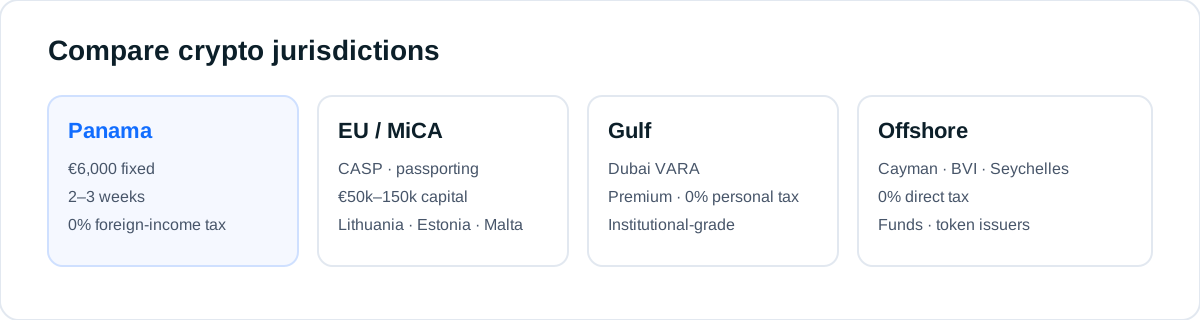
Compare this to other jurisdictions: Lithuania requires EUR 125,000 for exchange services, and the EU's MiCA framework introduces tiered capital of EUR 50,000 to 150,000 depending on service type. Estonia's lack of a formal capital floor makes it attractive for startups, but you must still demonstrate financial stability through a business plan and proof of funds.
For instance, if you plan to offer exchange services with high transaction volumes, the FIU may expect a higher capital buffer. Consulting24 advises having at least EUR 20,000 in liquid assets to cover initial expenses and compliance costs.
Tax Treatment for Estonia Crypto Companies
Estonia has a unique corporate income tax system: profits are not taxed until distributed. This applies to crypto companies as well. Corporate income tax is 20% on distributed profits (dividends). VAT is generally not applicable to crypto transactions, as the European Court of Justice has ruled them exempt.
However, if you provide services to EU customers, you may need to register for VAT in other member states. Consulting24 recommends consulting a tax advisor to structure your operations efficiently. For example, if your company holds crypto as an investment, any gains are not taxed until distributed as dividends. This can be a significant advantage for reinvesting profits.
Note that Estonia also has a withholding tax on certain payments to non-residents. A thorough tax plan is essential to avoid double taxation.
Allowed Activities Under the License
The Estonia crypto license permits the following activities:
- Exchange of virtual currency against fiat currency
- Exchange of virtual currency against virtual currency
- Transfer of virtual currency
- Virtual currency wallet services
Activities not covered include operating a crypto ATM (requires separate authorization) or providing custody services for third-party assets beyond wallets. The license does not cover security tokens or investment services under MiFID. You cannot offer staking or lending services without additional licensing.
If you plan to expand into DeFi or NFT marketplaces, check with the FIU whether these fall under the license. In general, any service that involves holding customer funds or executing transactions requires the license. Consulting24 can help you scope your activities correctly.
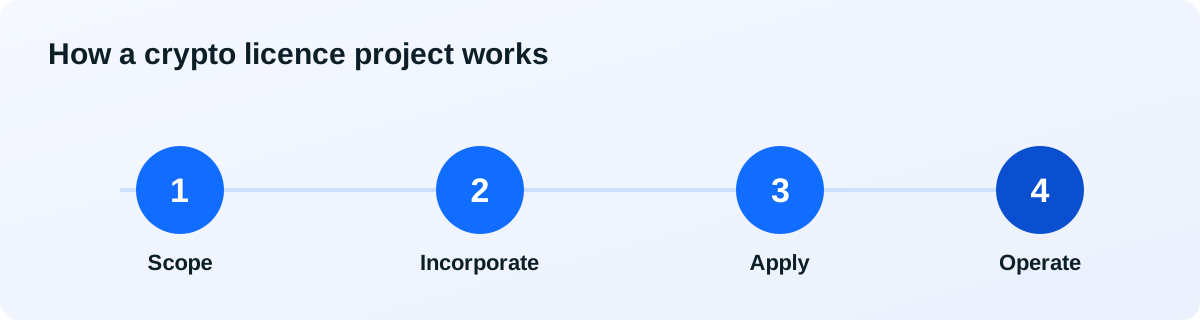
Step-by-Step Process to Obtain the License
- Company Setup: Register a company in Estonia (e.g., OÜ) with a registered address and management. Use e-Residency for digital setup.
- AML/KYC Policy: Draft comprehensive AML/KYC procedures, risk assessment, and internal controls. This must be tailored to your business model.
- Appoint MLRO: Designate a Money Laundering Reporting Officer (MLRO) who is resident in Estonia or an EEA country. The MLRO must have relevant experience.
- Prepare Documentation: Gather business plan, financial projections, proof of funds, and personal documents for beneficial owners. Include a detailed description of your transaction monitoring system.
- Submit Application: File with the FIU via the e-service, paying the state fee of EUR 3,300. Ensure all documents are in English or Estonian.
- FIU Review: The FIU assesses your application, which may include requests for additional information. They may also conduct an interview with the MLRO.
- License Grant: Once approved, you receive the license and are added to the public register. You can then start operations.
- Ongoing Compliance: Submit annual reports, maintain records for 5 years, and update AML policies as needed. The FIU may conduct on-site inspections.
Consulting24 manages the entire process, from company setup to final approval. We also provide ongoing compliance support to ensure you remain in good standing.
Banking and Payment Services
Opening a bank account for an Estonia crypto company can be challenging due to risk aversion. Many traditional banks refuse crypto-related businesses. Options include:
- Estonian banks (e.g., LHV, SEB) but they require strong compliance history and often a minimum deposit
- EMI (Electronic Money Institutions) like Monese, Payoneer, or TransferWise (now Wise)
- Cryptocurrency-friendly banks in other EU countries, such as those in Lithuania or Latvia
Consulting24 can introduce you to payment partners who work with licensed crypto firms. Having a clear AML/KYC policy helps in banking negotiations. Some EMIs require a minimum monthly volume or charge higher fees. For example, LHV may require a EUR 10,000 initial deposit and proof of active transactions.
Alternatively, you can use a crypto-friendly payment processor that handles fiat on-ramps and off-ramps. This is often easier than opening a traditional bank account. Consulting24 recommends starting the banking process early, as it can take 1-3 months.
Benefits of an Estonia Crypto License
- EU Passporting: As an EU member, your license is recognized across the EEA (subject to notification). This allows you to serve customers in 30+ countries.
- Low Setup Cost: No minimum capital requirement and competitive state fees. Total costs are typically EUR 15,000-20,000.
- E-Governance: Digital-first administration makes company management efficient. You can run everything online via e-Residency.
- Tax Efficiency: No tax on retained earnings; only on distributed profits. This is ideal for reinvesting growth.
- Reputation: Estonia is a respected fintech hub with a clear regulatory environment. The license is well-regarded by partners and customers.
For example, a startup can launch with minimal capital and then scale across Europe without additional licensing in each country. The tax deferral allows you to reinvest profits into development.
Compliance and Trust: Meeting AML/KYC Obligations
Compliance is not a one-time task. The FIU expects ongoing adherence to AML/KYC requirements. Key elements of a strong compliance program include:
- Customer due diligence (CDD) for all customers, enhanced for high-risk
- Transaction monitoring systems to detect suspicious activity, such as large or unusual transfers
- Record keeping for at least 5 years, including transaction details and identification documents
- Annual independent audit of AML procedures by a qualified auditor
- Training for employees on AML/KYC, conducted at least annually
This is general guidance, not legal advice. Consulting24 recommends working with a compliance specialist to tailor your program. For instance, if you operate a peer-to-peer exchange, your transaction monitoring must flag patterns like rapid in-and-out movements. The FIU expects your system to be operational from day one of licensing.
Failure to maintain compliance can lead to fines, license suspension, or revocation. In 2025, the FIU revoked several licenses for inadequate AML controls. Regular updates to your risk assessment are essential as your business evolves.
Common Mistakes When Applying for an Estonia Crypto License
- Incomplete AML Policy: Many applicants submit generic policies. The FIU expects a detailed, company-specific document that addresses your exact business model, customer base, and risk profile.
- Lack of Local Presence: The MLRO must be accessible. Remote-only setups are often rejected. You need a physical address in Estonia and a local contact person.
- Unclear Source of Funds: Beneficial owners must provide clear proof of legitimate funds. Bank statements, tax returns, or sale of assets are common proofs.
- Ignoring Transaction Monitoring: You need a system in place, not just a plan. The FIU may ask for a demo or screenshots of your monitoring software.
- Underestimating Timeline: Rushing leads to errors. Plan for 3-6 months. Some applications take longer if the FIU has a backlog.
Avoid these by engaging experts like Consulting24 from the start. We have seen these mistakes repeatedly and know how to address them. For example, we help draft a custom AML policy that includes a risk matrix and specific monitoring thresholds.
Alternatives and Comparison: Estonia vs. Other Jurisdictions
Estonia vs. Lithuania: Lithuania requires EUR 125,000 capital and has a more complex application process. Estonia is cheaper and faster, but Lithuania offers a larger market. See our Estonia vs Lithuania comparison.
Estonia vs. Panama: Panama offers a crypto license at a flat EUR 6,000 with no capital requirement and no tax on offshore income. However, Panama is not in the EU, so no passporting. For EU-focused businesses, Estonia is better; for global operations, Panama may be more cost-effective. Explore other jurisdictions.
Estonia vs. Malta: Malta has a more comprehensive regulatory framework under the Virtual Financial Assets Act, but requires higher capital (EUR 50,000-150,000) and a longer timeline (6-12 months). Estonia is simpler for smaller firms.
Each jurisdiction has trade-offs. Consulting24 can help you choose based on your target market, budget, and service type. We deliver directly in Estonia, Lithuania, and Panama.
How Consulting24 Can Help
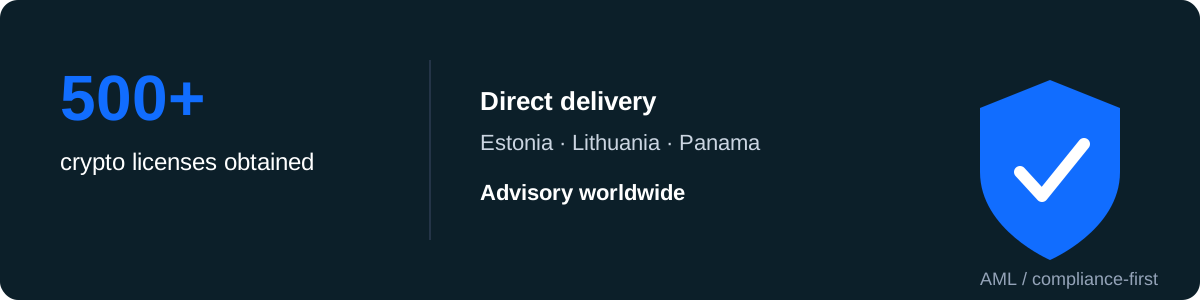
Consulting24 delivers directly in Estonia, Lithuania, and Panama. For Estonia, we handle the entire license application, including AML/KYC policy drafting, company setup, and FIU liaison. Our team has secured over 500 licenses. We advise and coordinate for other jurisdictions.
Contact us via WhatsApp to book a consultation and get a tailored quote. We will review your business model, recommend the best jurisdiction, and provide a fixed price for our services. Our support continues after licensing with compliance monitoring and annual reporting assistance.
Frequently asked questions
What is the AML/KYC requirement for an Estonia crypto company?
Estonia requires all crypto license holders to implement AML/KYC procedures per the MLTFPA. This includes customer due diligence, transaction monitoring, record keeping for 5 years, and reporting suspicious transactions to the FIU. The policy must be documented and tailored to your business.
Is there a minimum capital requirement for Estonia crypto license?
No, Estonia does not impose a formal minimum capital requirement. However, you must demonstrate sufficient financial resources to operate and comply with AML obligations. In practice, allocate at least EUR 12,000 for initial costs.
How long does it take to get an Estonia crypto license?
The application process typically takes 3 to 6 months, depending on the completeness of your documentation and the FIU's workload. Consulting24 can help expedite by ensuring all documents are correct from the start.
What are the costs for an Estonia crypto license?
The state fee is EUR 3,300. Consulting24's full package starts from EUR 12,000, making total estimated costs EUR 15,000-20,000. This includes company setup, AML policy drafting, and application management.
Can I operate in the entire EU with an Estonia crypto license?
Yes, as an EU member, Estonia's license allows passporting to other EEA countries, subject to notification. Under MiCA, this may become even more streamlined. You can serve customers across the EU without additional licenses.
What activities are covered under the Estonia crypto license?
The license covers exchange between virtual and fiat currencies, exchange between virtual currencies, transfer of virtual currencies, and wallet services. Activities like crypto ATMs, custody, or security tokens are not included.
Do I need a local director or MLRO?
You must appoint a Money Laundering Reporting Officer (MLRO) who is a resident of Estonia or another EEA country. The MLRO must have relevant experience and be accessible to the FIU. A local director is not mandatory but recommended.
What happens if I fail to comply with AML/KYC rules?
Non-compliance can result in fines up to EUR 5 million or 10% of annual turnover, license suspension, or revocation. The FIU actively supervises and conducts inspections. Maintaining a strong compliance program is essential.
Can I use a third-party compliance provider?
Yes, you can outsource compliance tasks, but the legal responsibility remains with the license holder. The FIU will hold your company accountable for any failures. Ensure your provider is reputable and experienced in crypto compliance.
Is Estonia a good jurisdiction for crypto startups?
Yes, due to low costs, no minimum capital, e-governance, and EU passporting. It is ideal for startups that want to serve the European market without heavy upfront investment. However, banking can be challenging, so plan ahead.
Official sources
Related jurisdictions

Talk to a crypto-licensing expert
500+ licenses across Estonia, Lithuania, Panama and beyond. Tell us your model and we'll map the right route, honestly.
💬 Talk to an expertFree consultationGeneral guidance, not legal advice. Rules and fees evolve, and we confirm current requirements for your case.